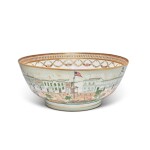

A Fine and Important Chinese Export 'Hong' Punch Bowl, Qing Dynasty, Jiaqing Period, circa 1810
清嘉慶 約1810年 粉彩描金廣州十三行景圖大盌
Auction Closed
April 20, 12:24 AM GMT
Estimate
50,000 - 70,000 USD
Lot Details
Description
A Fine and Important Chinese Export 'Hong' Punch Bowl
Qing Dynasty, Jiaqing Period, circa 1810
清嘉慶 約1810年 粉彩描金廣州十三行景圖大盌
13⅛ in. (33.2 cm.) diameter
Ralph M. Chait Galleries, New York
Wolf Family Collection No. 0595 (acquired from the above on October 1, 1982)
The present punch bowl is an extremely rare and possibly unique example of a Hong punch bowl, depicting on the exterior the American, Swedish, British, Dutch, Danish and Spanish flags. Hong, derived from the Cantonese pronunciation of 行 (hang), were Western 'factories' and de facto living quarters and offices of European and American traders in Canton (Guangzhou) in the 18th and 19th centuries. Undoubtedly costly to produce at the time, Hong bowls were either commissioned directly by high ranking Western merchants trading in Canton at the time to be brought back to the West as souvenirs documenting their time in Asia, or were presentation gifts given to foreign traders by Chinese merchants.
The earliest Hong punch bowls date from circa 1765, and there are only two examples of that early type published to date, each decorated on the exterior with puce enameled panels depicting the Hongs on one side, and the Copenhagen Stock Exchange (Børsen) on the other. One example is illustrated in Bredo L. Grandjean, Dansk Ostindisk Porcelæn, Copenhagen, 1965, fig. 113-114, cat. no. 107, now in the collection of M/S Maritime Museum of Denmark, Helsingør. The only other example published, formerly in the collection of François and Nicole Hervouët, was sold in our Monaco rooms, June 22, 1987, lot 1641. This example entered the Wolf Family Collection (no. 0951) and is offered in this sale, lot 51. The style of decoration on Hong bowls, as well as the scenes depicted, continued to evolve throughout the late Qianlong and early Jiaqing periods. A small group of examples, decorated with two major panels with the hongs in famille-rose enamels, were produced circa 1775. An example of this type, also formerly in the collection of François and Nicole Hervouët, entered the Wolf Family Collection (no. 1055) is offered in the Cross-currents in America sale, April 21, 2023, lot 622.
Around 1780-85, panoramic views of the hongs became the most iconic and recognizable decoration seen on Hong bowls. One example of this type, formerly in the collection of Mrs. Charles B. Manning and Hyde Park Antiques, New York, sold in these rooms, January 31, 2023, lot 41. The format of decoration on the present lot follows closely a delicately painted a panoramic view of the Hongs. The most notable difference on this bowl and the aforementioned examples is the presence of the American flag displayed prominently in the center of the scene.
Following the Revolutionary War, the United States began trading direct with China soon after its independence in 1784. On February 22, 1784, a month after the rectification of the Treaty of Paris, Captain John Green (1736-96) commanded the Empress of China on the first voyage of any American mercantile vessel from New York to Canton (Guangzhou). As described by historian Conrad Edick Wright in his essay 'Merchants and Mandarins: New York and the Early China Trade', in David Sanctuary Howard, New York and the China Trade, Frenchtown, 1984, p. 18:
"The Empress of China not only opened direct relations between the United States, the world's youngest nation, and China, perhaps the world's oldest... the voyage was doubly symbolic, expressing American aspirations for the acceptance by the world's great powers as an equal partner in both international trade and in diplomacy"
The beginnings of the American trade in China was also documented on Hong punch bowls. In fact, an example believed to have been brought back by Captain John Green on the Empress of China, sold in these rooms, January 24, 1990, lot 364, and entered the collection of H. Richard Dietrich Jr. and was exhibited in A Collector's Vision: Highlights from the Dietrich American Foundation, February 1-November 15, 2020, Philadelphia Museum of Art. It features the American flag between the English and Dutch flags, and the interior decorated with a ship portrait that is presumed to represent the Empress of China.
The present example, while depicting the same subject matter as other Hong bowls, appears to be unique. The lack of examples extant may suggest that this work is a private commission tailored to the taste of the patron. Compared to the bustling streets seen in Hong bowls made circa 1780 and 90, the present example depicts a more open quayside and is rendered in a painterly style. The flags of the foreign hongs are typically painted in a descriptive manner, with largely rectangular outlines intending for the viewer to identify the hongs almost instantaneously; however, the flags on the present bowl depict the lightly draped flags flowing in the wind, while remaining instantly recognizable. Lastly, the sky on the present example is given prominence, with the painter applying varying layers of white and sepia enamels to simulate swirling clouds which is not present in other examples. These characteristics closely correspond to China trade pictures painted in the early 19th century, and likely provided inspiration to the porcelain enameller. A closely related painting of the factories in Canton, is in the collection of the Philadelphia Museum of Art, Gift of Ann M. and William B. Carey, 2011, acc. no. 2011-91-10.
You May Also Like


