Francis Augustus Silva
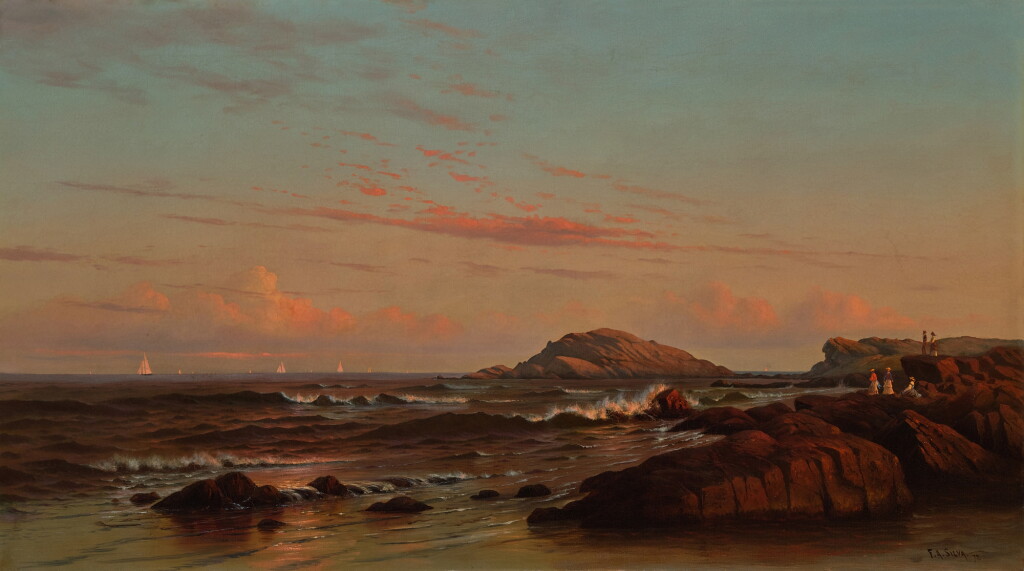
Brace's Rock, Cape Ann, Massachusetts
Auction Closed
April 20, 09:25 PM GMT
Estimate
120,000 - 180,000 USD
Lot Details
Description
Francis Augustus Silva
1835 - 1886
Brace's Rock, Cape Ann, Massachusetts
signed F.A. Silva. and dated 72 (lower right)
oil on canvas
20 x 36 in. (50.8 x 91.4 cm.)
Executed in 1872.
Sotheby Parke-Bernet New York, October 27, 1977, lot 8
Wolf Family Collection, No. 0255 (acquired from the above)
Washington, D.C., National Gallery of Art, 1985-2023 (on loan)
John I.H. Baur, "Francis A. Silva: Beyond Luminism," The Magazine Antiques 118, 1980, fig. 5, p. 1022
In this radiant landscape, Francis Augustus Silva invites the viewer to sit on the rocks and witness a resplendent sunset on the Atlantic. As waves crest against the shore, Silva extends the sky deep into the picture by alternating linear stratus clouds with cottony cumulus clouds. Lit by the setting sun outside the picture, their purple and pink tones continue until a row of triangular sails disappears along the distant horizon. Although Silva largely paints a picture of a place, its inhabitants—well-dressed onlookers and invisible sailors offshore—add elements of personal intrigue, threads of labor and repose caught within the greater American sublime.
Even among the other outstanding Hudson River School pictures in the Wolf Family Collection, the Silva stands alone for having been on regular display at the National Gallery of Art, Washington, D.C., for much of the last four decades. The landscape is distinctly representative of the American Luminist movement, of which the art historian Barbara Novak has written, “Luminist light tends to be cool, not hot, hard not soft, palpable rather than fluid, planar rather than atmospherically diffuse. Luminist light radiates, gleams, and suffuses on a different frequency than atmospheric light…Air cannot circulate between the particles of matter that comprise Luminist light” (Nature and Culture, London, 1980, pp. 18, 29).
You May Also Like