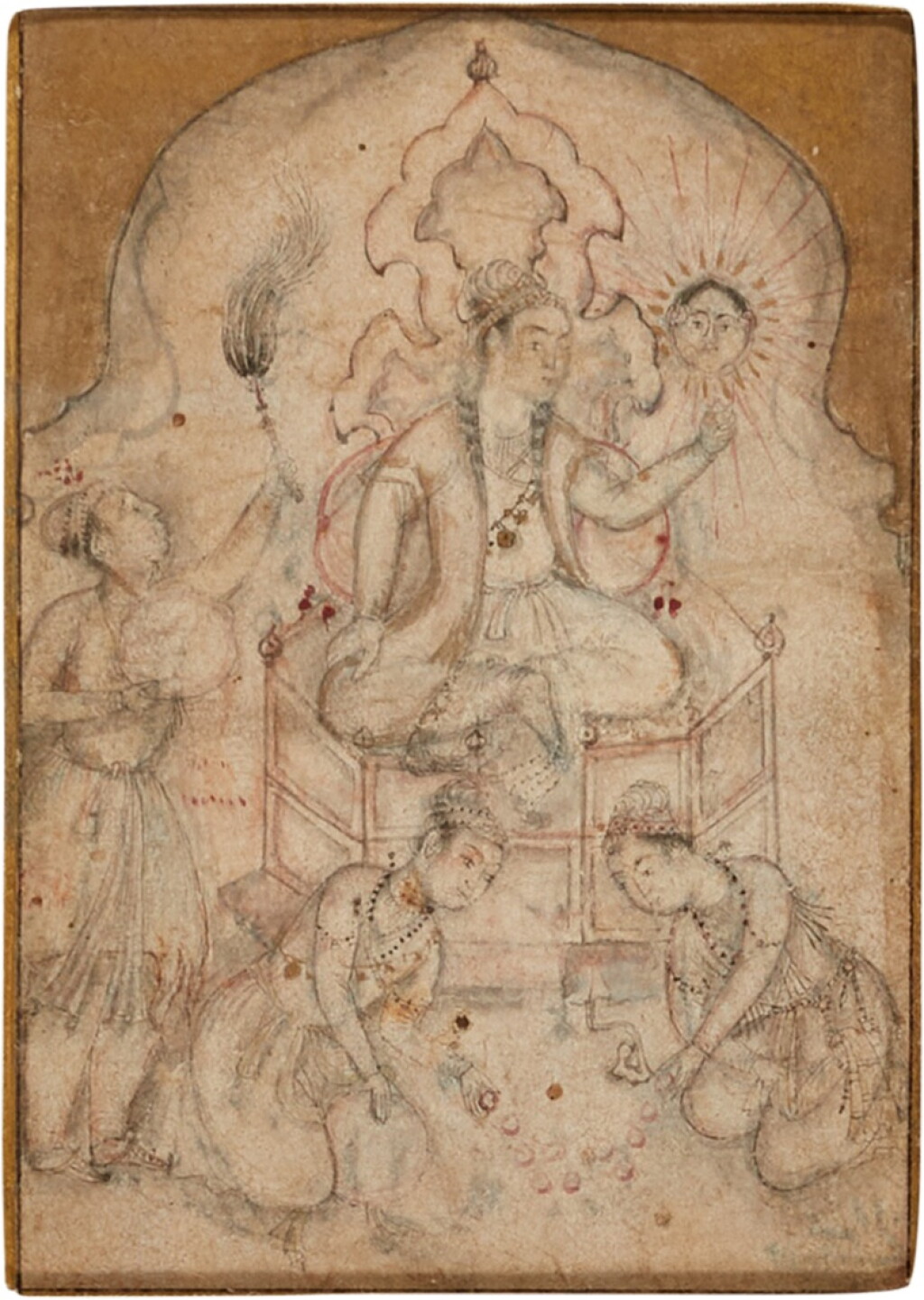
A ruler enthroned holding a mirror or sun-disc, probably Iskandar and the magic mirror, India, Deccan, Ahmednagar, late 16th century
Auction Closed
October 25, 12:38 PM GMT
Estimate
6,000 - 8,000 GBP
Lot Details
Description
ink with use of colours and gold on paper, mounted on an album page above a small drawing of two wrestlers, inner borders of blue and marbled paper, outer borders of silver-sprinkled and plain cream paper, nasta'liq inscription in upper border 'bikhuwn bud khurshid jahan tab', the reverse with backing paper of a fragmentary page from a 16/17th century Dutch printed book, possibly a book on martyrs or heretics
Drawing: 8.3 by 5.7cm. (3 ¼ by 6 ¼ in.)
Leaf: 28 by 15.8cm. (11 by 15.8 in.)
Acquired by Cary Welch before 1983
Sotheby's, London, The Stuart Cary Welch Collection, Part One, Arts of the Islamic World, 6 April 2011, lot 96
On loan at the Fogg Art Museum, Harvard University, 1983
M. Zebrowski, Deccani Painting, London, 1983, fig.15, p.27
This delicate and refined drawing of an enthroned ruler has been described as Iskandar holding a magic mirror. Cary Welch’s notes on the backboard of the frame suggest an episode in which Iskandar ponders the future with a magic mirror and fortune-telling dice. The theme of Iskandar and a magic mirror appears in several works of Persian literature, most famously the Khamsa of Nizami, the Divan of Hafiz and the A'ina-i Iskandari of Amir Khusrau Dihlavi (see Titley 1977, no.308 (10, 38), no.157 (1, 20, 47, 53, 82, 88), no.56 (16)), and also in the Khamsa of Ali Shir Nava'i. In the latter work the mirror is described in different episodes as radiating like the sun on one side and the moon on the other, and containing the wisdom of the world and revealing the future (Ismoilov 2018, pp.136, 139). The mirror in the present drawing is represented as a radiant sun, and the use of dice in the foreground provides a sense of augury. A painting of a similar scene is in the Raza Library, Rampur (see Schmitz and Desai 2006, pl.38).
However, the inscription above the drawing, hitherto not commented upon, describes the scene as “Mars in the abode of the world-illuminating Sun”, suggesting that the scene has an astrological theme. In Islamic astrological iconography Mars was usually depicted in warlike mode holding a sword and a severed head, very different from the present scene. If it is a depiction of Mars then it employs unusual iconography, but the possibility remains that it is related to Iskandar’s magic mirror and the inscription above is a misinterpretation by a later commentator.
Zebrowski attributed this drawing to the so-called Paris painter or a close follower, linking it to two well-known paintings of enthroned rulers on gold backgrounds and a group of closely-related drawings (Zebrowski 1983, figs.4-11, 16-17, pp.20-24, 27-29). For a recent discussion of this group of related paintings and drawings see Haidar and Sardar 2015, cats.14-19, pp.64-71. Two further related drawings are in the Edinburgh University Library, Or. Ms 373, ff.12v-13r.
You May Also Like