Agostino Tassi
The Embarkation of Saint Helen | L’embarquement de sainte Hélène
Lot Closed
November 14, 03:16 PM GMT
Estimate
12,000 - 18,000 EUR
Lot Details
Description
Agostino Tassi
Ponzano Romano 1578 - 1644 Rome
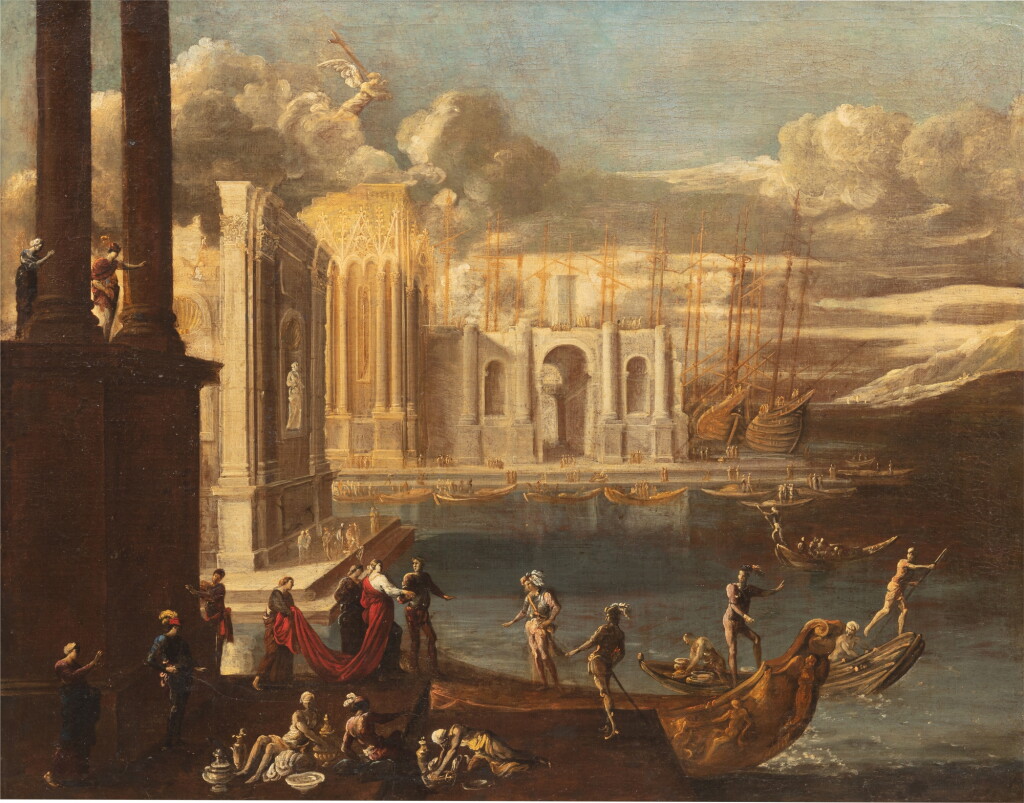
The Embarkation of Saint Helen
Oil on canvas
72,7 x 91,5 cm ; 28⅝ by 36 in.
____________________________________________
Agostino Tassi
Ponzano Romano 1578 - 1644 Rome
L’embarquement de sainte Hélène
Huile sur toile
72,7 x 91,5 cm ; 28⅝ by 36 in.
Possibly collection of the cardinal Antonio Barberini (1569-1646) (see P. Cavazzini in cat. exh. Rome, Agostino Tassi (1578-1644), Un paesaggista tra immaginario e realtà, 2008, p. 202).
____________________________________________
Peut-être collection du cardinal Antonio Barberini (1569-1646) (voir p. Cavazzini dans cat. exp. Rome, Agostino Tassi (1578-1644), Un paesaggista tra immaginario e realtà, 2008, p. 202).
Rome, Palazzo Venezia, Agostino Tassi (1578-1644), Un paesaggista tra immaginario e realtà, 2008, no. 19 (entry by P. Cavazzini) and p. 69.
____________________________________________
Rome, Palazzo Venezia, Agostino Tassi (1578-1644), Un paesaggista tra immaginario e realtà, 2008, n° 19 (notice de P. Cavazzini) et p. 69.
Epinal, cat. exh. Claude Lorrain et le monde des dieux, 2001, pp. 36 and 38, fig. 1.
____________________________________________
Epinal, cat. exp. Claude Lorrain et le monde des dieux, 2001, p. 36 et 38, fig. 1.
Agostino Tassi, whose real name was Agostino Buonamici, was one of the most important landscape and marine painters of his generation. Born in Perugia, he spent most of his career in Rome, producing easel paintings, like this work and lot 24 in this sale. However, as a specialist in architecture painting and quadratura, he was also involved in major decorative commissions such as the Palazzo del Quirinale, the Palazzo Rospigliosi and the Casino Ludovisi, where he collaborated with Guercino. He also taught Claude Lorrain and Viviano Codazzi.
The iconography of the Embarkation of Helena derives from late Christian accounts, especially the Golden Legend by Jacobus de Voragine: in a fourth century setting, Helena, mother of the Emperor Constantine, is shown leaving Rome for Judaea, with the aim of finding the True Cross on which Christ was crucified. In order to differentiate this scene from other embarkation scenes, which Tassi particularly favoured, the artist has deliberately positioned an angel emerging from the clouds and holding the Cross in the top part of the composition.
The painting may be compared to another of the artist’s works, produced in collaboration with his most famous pupil, Claude Lorrain, now in a Swiss private collection (see Agostino Tassi (1578-1644), Un paesaggista tra immaginario e realtà, exh. cat, fig. 78, p. 68). In this case, instead of the embarkation of Helena, a Roman and a saint, he depicted the abduction of the Greek Helen, who appears in the mid-ground of closely comparable, if not identical architectural elements.
As noted by PatriziaCavazzini, who dates this work to 1626-1627, the buildings in the background, especially the Gothic-inspired palazzo, painted in a very light, almost ghostly manner, are strongly reminiscent of the art of François de Nomé (another artist from Lorraine), who was in the Eternal City in the first decade of the seventeenth century.
____________________________________________
Agostino Tassi, de son vrai nom Agostino Buonamici, fut l’un des peintres de paysage et de marine les plus importants de sa génération. Natif de Pérouse, il fera l’essentiel de sa carrière à Rome, exécutant des tableaux de chevalet, comme cette œuvre et le lot 24 de ce même vente, mais participant également, en tant que spécialiste de la peinture d’architecture et de la quadratura, à des commandes décoratives d’envergure, comme au Palais du Quirinal, au Palais Rospigliosi, ou encore au Casino Ludovisi, où il collabore avec Guerchin. Il sera également le maître de Claude Lorrain et de Viviano Codazzi.
L’iconographie de l’embarquement d’Hélène dérive des récits chrétiens tardifs, principalement La Légende dorée de Jacques de Voragine. Elle met en scène Hélène, la mère de l’Empereur Constantin, qui, au IVe siècle, quitte Rome pour la Judée, dans le but de retrouver la Vraie Croix sur laquelle le Christ a été crucifié. Pour permettre de différencier cette scène des autres scènes d’embarquement, que Tassi affectionne particulièrement, le peintre a volontairement placé dans la partie supérieure de la composition un ange s’extirpant des nuées, portant la Croix.
Le tableau est à rapprocher d’une autre œuvre de l’artiste, exécutée en collaboration avec son élève le plus fameux, Claude Lorrain, et qui se trouve aujourd’hui dans une collection privée suisse (voir cat. exp. Agostino Tassi (1578-1644), Un paesaggista tra immaginario e realtà, fig. 78, p. 68). Représentant cette fois-ci non pas l’embarquement d’Hélène la romaine et la sainte, mais l’enlèvement d’Hélène la grecque, elle figure au second plan des éléments d’architecture très comparables, sinon identiques.
Comme le note Patrizia Cavazzini, qui date cette œuvre de 1626-1627, les bâtiments à l’arrière-plan, et notamment le palais d’inspiration gothique, exécuté de façon très légère, presque fantomatique, rappellent fortement l’art d’un François de Nomé (un autre Lorrain…), présent pour sa part dans la Cité Eternelle dans la première décennie du XVIIe siècle.
You May Also Like