
Charles-Joseph Flipart
The hour of the masked ball | L'heure du bal
Lot Closed
June 14, 01:43 PM GMT
Estimate
15,000 - 20,000 EUR
Lot Details
Description
Charles-Joseph Flipart
1721 - 1797
The hour of the masked ball
Oil on copper
Inscribed on the reverse ALESSANDRO LONGHI / VENEDIG / [...] 1780
45,5 x 34,3 cm; 17 7⁄8 by 13 1⁄2 in.
____________________________________________
Charles-Joseph Flipart
1721 - 1797
L'heure du bal
Huile sur cuivre
Inscrit au dos ALESSANDRO LONGHI / VENEDIG / [...] 1780
45,5 x 34,3 cm ; 17 7⁄8 by 13 1⁄2 in.
With Scarpa Art Company, 1953;
Anonymous sale, Christie's, London, 31 March 1989, lot 45 (as Circle of Pietro Longhi);
Anonymous sale, Christie's, London, 11 December 1992, lot 406 (as Circle of Pietro Longhi);
Anonymous sale, Sotheby's, London, 26 January 2012, lot 214;
Where acquired by the present owner.
____________________________________________
Scarpa Art Company, 1953 ;
Vente anonyme, Christie's, Londres, 31 mars 1989, lot 45 (comme Entourage de Pietro Longhi) ;
Vente anonyme, Christie's, Londres, 11 décembre 1992, lot 406 (comme Entourage de Pietro Longhi) ;
Vente anonyme, Sotheby's, Londres, 26 janvier 2012, lot 214 ;
Où acquis par l'actuel propriétaire.
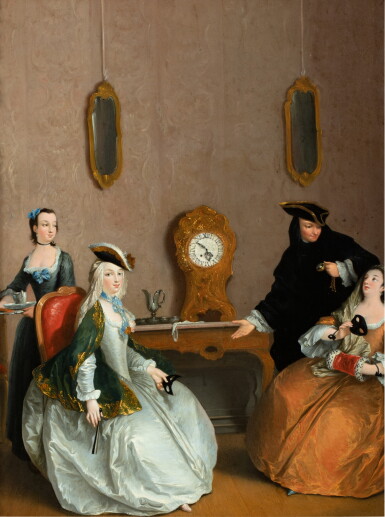
With its exquisitely delicate execution and refined treatment of the figures and their costumes, this painting by the French painter Charles Joseph Flipart was for a long time attributed to Pietro Longhi. The two artists shared a taste for elegant interior scenes composed in a simple and natural manner, and obviously an eminently Venetian character.
Having learnt the art of engraving from his father, Flipart went on to be trained as a painter by the Venetian Jacopo Amigoni, who encouraged him to move to Venice in the 1740s. Here, working in Joseph Wagner’s print workshop, he was influenced by Longhi and engraved many of his works. He tapped into this source of inspiration for his own pictorial production, as is clearly the case here, although his manner of painting continued to display a smoother, more delicate mode of execution, with fresher colours, that clearly betrayed his French origin.
This delightful work shows two young women and a man ready to go to a ball, while a servant removes the remains of the refreshments they have just taken, in a charming and precise reflection of Venetian life of the eighteenth century. The man, comparing his pocket watch with the clock, seems to be encouraging the young women to make haste. In the centre, the clock once more has its original face: the central part was replaced at an unknown date with a real watch face, which was removed in 1992 and the clock face returned to its original state.
____________________________________________
Exécuté avec une exquise délicatesse, et une finesse dans le traitement des figures et de leurs costumes, ce tableau du français Charles Joseph Flipart a été longtemps donné à Pietro Longhi, avec les œuvres duquel il partage le goût pour des scènes d’intérieurs raffinées composées de façon simple et naturelle, et bien évidemment un caractère éminemment vénitien.
Formé à l’art de la gravure par son père, Flipart poursuit sa formation de peintre auprès du vénitien Jacopo Amigoni, qui l’encourage à s’installer à Venise dans les années 1740, où, travaillant dans l’atelier d’impression de Joseph Wagner, il subit l’influence de Longhi, dont il grave abondamment les œuvres. Il puisera par la suite à cette source pour ses propres productions picturales, comme c’est évidemment le cas ici, à ceci près qu’il conservera, dans sa manière de peindre, un mode d’exécution plus lisse, plus délicat, et des coloris plus frais qui trahissent nettement son origine française.
Cette séduisante œuvre, qui met en scène deux jeunes femmes et un homme, tous apprêtés pour se rendre au bal, tandis qu’une servante les débarrasse de la collation qu’ils viennent de prendre, reflète avec charme et exactitude la vie vénitienne du XVIIIe siècle. L’homme, comparant l’heure de sa montre oignon avec celle de l’horloge, semble enjoindre les demoiselles à se presser. Au centre, l’horloge a retrouvé son cadran original. En effet, la partie centrale avait été remplacée à une date inconnue par une montre véritable, qui fut enlevée en 1992, tandis que le cadran était restauré à son état initial…