Alexander Rothaug
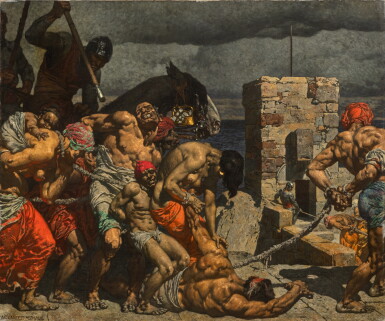
The Prisoners | Les prisonniers
Auction Closed
June 13, 02:06 PM GMT
Estimate
50,000 - 70,000 EUR
Lot Details
Description
Alexander Rothaug
Vienna 1870 - 1946
The Prisoners
Oil on canvas
Signed lower left ALEXANDER · ROTHAUG; further signed and titled on the reverse DIE GEFANGENEN. / ÖLGEMÄLDE VON / .ALEXANDER. ROTHAUG.
100,2 x 120,5 cm; 39½ by 47½ in.
____________________________________________
Alexander Rothaug
Vienne 1870 - 1946
Les prisonniers
Huile sur toile
Signé en bas à gauche ALEXANDER · ROTHAUG ; au dos, titré et signé DIE GEFANGENEN. / ÖLGEMÄLDE VON / .ALEXANDER. ROTHAUG.
100,2 x 120,5 cm ; 39½ by 47½ in.
Private collection, Austria;
Anonymous sale, imKinsky, Vienna, 8 July 2021, lot 2027.
____________________________________________
Collection particulière, Autriche ;
Vente anonyme, imKinsky, Vienne, 8 juillet 2021, lot 2027.
In 1885, Rothaug was admitted to the Academy of Fine Arts in Vienna, where he attended courses given by the Orientialist painter Leopold Carl Müller. He then left for Munich, where he produced many illustrations – still sought out by bibliophiles today – and discovered the work of Franz von Stuck. He returned to Vienna in 1896 and in 1910 joined the Association of Visual Artists Vienna. As well as his monumental works, such as the Nibelungen cycle for the Grand Hôtel de l'Europe at Bad Gastein and the decoration of the Kurhaus in Meran, in collaboration with Rudolf Jettmar, and his spectacular works, like this striking painting, he also produced theatre back-cloths, notably for the Schauspielhaus in Frankfurt am Main and for the Staatstheater Nürnberg in Nuremberg. The multidisciplinary Alexander Rothaug – painter, theatre designer and illustrator – is a singular and unclassifiable artist, who created his own style. Well-known outside Austria, he skilfully and vigorously combined academic Classicism with elements of Jugendstil, with an abiding interest in the representation of ancient mythology and legendary stories of Germanic and Nordic heroes.
The prisoners, painted by Rothaug in about 1934, was reproduced in the magazine Der getreue Eckart in the same year and exhibited in 1938 alongside four other paintings by him at the large exhibition of German art in the Haus der Deutschen Kunst in Munich, where it was bought by the Berlin Office of Culture. We know of several preparatory sketches for this work as well as a squared-up sketch of the whole composition in a sketch book from the collection of Ernst Fuchs (Bassenge sale, Berlin, 8 June 2023, lot 3015). Rothaug’s distinctive art, of which this work is a perfect illustration, was of interest to critics for a while because of its ‘Germanic’ aspects. These same critics finally regarded his work as outdated and too close to the symbolism of Franz von Stuck and Arnold Böcklin. Nevertheless, Rothaug was invited to the Haus der Deutschen Kunst in Munich, and in 1941 the Künstlerhaus in Vienna organized an exhibition of his works, numbering thirty-eight in the catalogue, to mark his seventieth birthday.
The treatment of the bodies in this painting is typical of Rothaug’s style, while his two years’ training in sculpture surely influenced his approach to their plasticity. He had moreover developed a theory of proportions and considered the representation of the human figure to be the embodiment of everything beautiful and practical. His interest in anatomy even led to him becoming a judge in a bodybuilding and beauty contest in 1935. Light plays an equally important part in this composition: Rothaug thought that the distribution of light and shadow was essential.
This composition, supported by his lush, vigorous technique and his sculptural subjects, is strikingly powerful. The viewer cannot remain indifferent: the painting fascinates and overwhelms with the themes it expresses.
____________________________________________
Rothaug entre à l'Académie des beaux-arts de Vienne en 1885 où il reçoit les cours du peintre orientaliste Leopold Carl Müller. Il part ensuite à Munich où il réalise de nombreuses illustrations recherchées par les bibliophiles jusqu’à aujourd’hui et où il découvre l’œuvre de Franz von Stuck. Il rentre à Vienne en 1896 ou il adhère en 1910 à l'Association des artistes viennois. Outre ses œuvres monumentales comme le cycle des Nibelungen pour le Grand Hôtel de l'Europe à Bad Gastein ou le décor du Kurhaus de Merano en collaboration avec Rudolf Jettmar, et ses œuvres spectaculaires, comme ce saisissant tableau, on connaît de lui des rideaux de théâtre notamment pour le Schauspielhaus de Francfort-sur-le-Main ou le Stadt-theater Nürnberg de Nuremberg. Alexander Rothaug, pluridisciplinaire, peintre, scénographe et illustrateur, est un artiste singulier et inclassable, qui s’est créé son style. Connu bien au-delà des frontières de l'Autriche, il mêle avec talent et force le classicisme académique à des éléments du Jugendstil avec un intérêt constant pour la représentation de la mythologie ancienne et des récits légendaires des héros germaniques et nordiques.
Les prisonniers, peint par Rothaug vers 1934, a été reproduit dans le magazine Der getreue Eckart cette année-là et a été exposé en 1938 avec quatre autres de ses peintures lors de la grande exposition d'art allemand à la Haus der Deutschen Kunst de Munich où il a été acheté par l'Office culturel de Berlin. Nous connaissons pour ce tableau plusieurs esquisses préparatoires ainsi qu’une esquisse de la composition d’ensemble mise aux carreaux dans un carnet de croquis provenant de la collection d’Ernst Fuchs (vente Bassenge, Berlin, 8 juin 2023, lot 3015). L‘art singulier de Rothaug dont cette œuvre est une parfaite illustration intéresse pendant un temps certains critiques pour ses aspects « germaniques ». Ces mêmes critiques ont finalement considéré son œuvre suranné et trop proche du symbolisme de Franz von Stuck et d'Arnold Böcklin. Toujours est-il que Rothaug est invité à la Haus der Deutschen Kunst de Munich et, en 1941, le Künstlerhaus de Vienne organise une exposition des œuvres de Rothaug avec trente-huit numéros de catalogue, à l'occasion de son soixante-dixième anniversaire.
Le traitement des corps dans ce tableau est caractéristique du style de Rothaug, la formation à la sculpture qu’il a suivie pendant deux ans a sûrement exercé une influence sur son approche de leur plasticité. Plus encore, il développe une théorie des proportions et considère la représentation de la figure humaine comme l'incarnation de tout ce qui est beau et pratique. Son intérêt pour l’anatomie l’a même conduit à être juge d'un concours de culturisme et de beauté en 1935. La lumière joue un rôle tout aussi important dans cette composition, Rothaug estimait que la répartition de la lumière et de l'ombre était essentielle.
Cette composition, portée par une technique généreuse et puissante, aux sujets sculpturaux est saisissante par sa force. Elle ne peut laisser indifférent, elle fascine et bouleverse par les thèmes qu’elle convoque.
You May Also Like