
Govert Jansz., called Mijnheer | Govert Jansz., dit Mijnheer
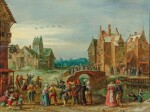
A carnival procession in a village street on Shrove Tuesday | Scène de carnaval en hiver
Auction Closed
June 13, 02:06 PM GMT
Estimate
30,000 - 50,000 EUR
Lot Details
Description
Govert Jansz., called Mijnheer
Amsterdam 1578 - 1619
A carnival procession in a village street on Shrove Tuesday
Oil on panel
27,1 x 36,5 cm; 10⅝ by 14⅜ in.
____________________________________________
Govert Jansz., dit Mijnheer
Amsterdam 1578 - 1619
Scène de carnaval en hiver
Huile sur panneau
27,1 x 36,5 cm ; 10⅝ by 14⅜ in.
With S. Nystad, The Hague, 1975;
Anonymous sale, Christie's, Amsterdam, 6 November 2000, lot 74 (as Attributed to Govaert Jansz., called Mijnheer).
____________________________________________
S. Nystad, La Haye, 1975 ;
Vente anonyme, Christie's, Amsterdam, 6 novembre 2000, lot 74 (comme Attribué à Govaert Jansz., dit Mijnheer).
Vastenavond - Carnaval: feesten van de omgekeerde wereld, Bois-le-Duc, Noordbrabants Kunstmuseum and Bergen-op-Zoom, Markiezenhof, September-February 1993, no.61, repr.
____________________________________________
Vastenavond - Carnaval: feesten van de omgekeerde wereld, Bois-le-Duc, Noordbrabants Kunstmuseum et Bergen-op-Zoom, Markiezenhof, septembre-février 1993, n° 61, repr.
An excited crowd of people is milling around a bridge in the centre of a village; some are masked, all wear different clothes with accessories symbolizing their folly. For example, in the centre of the composition, the figure wearing a red hat with a yellow feather is holding a grill and has a cockerel hanging from his belt; next to him, another character has attached a ladle to his hat.
Two elements make it possible to identify the scene more precisely: the man who seems to be leading the procession, wearing a plumed hat, is brandishing a slotted spoon, while in the background a masked man carries a pair of bellows. These two implements are traditionally associated with the iconography of Lent, explaining the group’s astonishing garb.
Govert Jansz takes pains to convey the detail of the costumes and masks worn by all the protagonists, drawing his models from the series Masquerades engraved by Jacques de Gheyn and published in 1595-96 (fig. 1). In the seventeenth century, carnival marked an important spiritual moment: the beginning of fasting, which would be observed throughout Lent. It was an occasion for a festive procession, illustrating different popular traditions, recurring subjects in the painting of the Northern Schools.
Born in 1577 in Amsterdam, Govert Jansz remained in the city of his birth, where he was apprenticed to Gerrit Pieter Sweelinck.
Fig. 1 Jacques de Gheyn, A veiled woman with two masked musicians playing a gridiron and a bellows from the series The masquerades © The Trustees of the British Museum.
____________________________________________
Une foule de personnages agités s’anime autour d’un pont, au cœur d’un village : certains sont masqués, tous portent des habits différents et des accessoires symbolisant leur folie. Ainsi, au centre de la composition, le personnage portant un chapeau rouge à plume jaune, tient entre ses mains un rôtisseur tandis qu’un coq est suspendu à sa ceinture ; à ses côtés, un autre a fixé une louche à son chapeau.
Deux éléments permettent d’identifier plus précisément la scène : l’homme qui semble mener la procession, coiffé d’un chapeau à plume, brandit en effet un écumoire, tandis que dans l’arrière-plan, un homme masqué porte un soufflet. Ces deux ustensiles traditionnellement liés à l’iconographie du Carême, expliquent l’étonnant accoutrement de ce groupe.
Govert Jansz s’applique à détailler les costumes et les masques de chacun des protagonistes, puisant ses modèles dans la série des Mascarades gravée par Jacques de Gheyn, publiée en 1595-96 (fig. 1). La fête du carnaval marque en effet un moment spirituel important au XVIIe siècle : le début du jeûne, qui sera respecté pendant toute la durée du Carême. Elle est l’occasion d’un défilé festif, décrivant les différentes traditions populaires, sujets récurrents dans la peinture des Ecoles du Nord.
Né en 1577 à Amsterdam, Govert Jansz reste dans sa ville natale, où il fait son apprentissage auprès de Gerrit Pieter Sweelinck.
Fig. 1 Jacques de Gheyn, Femme et musiciens jouant avec un gril et un soufflet, de la série des Mascarades © The Trustees of the British Museum.
You May Also Like