
Property from the collection of the late Visconde de Lançada
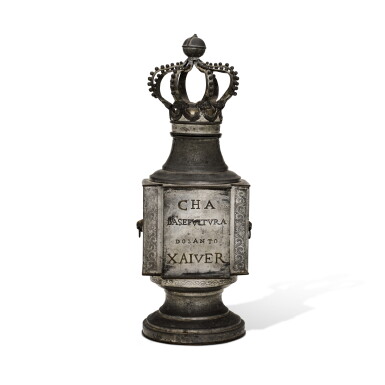
A Chinese engraved pewter box to contain the soil of St Francis Xavier's tomb, mid 18th century
Lot Closed
January 18, 03:08 PM GMT
Estimate
4,000 - 6,000 GBP
Lot Details
Description
Property from the collection of the late Visconde de Lançada
A Chinese engraved pewter box to contain the soil of St Francis Xavier's tomb,
mid 18th century
inscribed with CHA / DASEPVLTVRA / DOSANTO / XAVIER, the reverse depicting the death of Saint Francis
41cm. high
(1)
Dom Alexandre de Sousa e Holstein Beck, Visconde de Lançada (1934-2014);
Thence by descent to the present owner.
This rare, possibly unique, box is a cross-cultural material example of Christianity in Orient, a likely commission from a Portuguese patron in Goa to a skilled Chinese metalwork workshop, which reveals the intense veneration in the Catholic world for Saint Francis Xavier, the Jesuit missionary known as the “Apostle of the Orient”, and its uncorrupted body that lies in Goa since 1553.
One of the sides of the boxes has the Portuguese inscription “Cha da Sepultura do Santo Xaiver”, meaning ground, or soil, from the tomb of Saint Francis Xavier, whilst the other depicts the death of the veneered saint, which follows, in a simplified version, the traditional iconography of his life cycle disseminated by paintings and prints in the 17th century. The episode of his death is normally represented with the saint lying on Shangchuan Island beach, south of Macau, with the remnants of a humble hut with his missionary’s cross, with a ship on the horizon, representing the missed opportunity of evangelizing China, where he was heading.
When he died in Shangchuan, Saint Francis was buried in a wooden coffin, following Chinese practices and two months later was moved to the Portuguese trading post of Malacca. Later in the year, his seemingly uncorrupt body travelled to Goa, where quickly became a pilgrimage destination for Christians and the report of numerous miracles started.
Topped by a crown, which follows the design of the royal Portuguese crown, the rest of the box is finely engraved with Chinese motifs, with the other two sides with ring handles dangling from lion masks.
An unusual material to be found in Chinese art for the export market, one should note that pewter was used for small containers in the early 18th century, as it is an interesting example sold by Sotheby’s with the Imperial arms of Peter the Great of Russia (1672–1725), sold London, 2007 - https://www.sothebys.com/en/auctions/ecatalogue/2007/russian-sale-works-of-art-faberge-l07113/lot.594.html)