
Property from a Deceased's Estate
Hans Rottenhammer the Elder
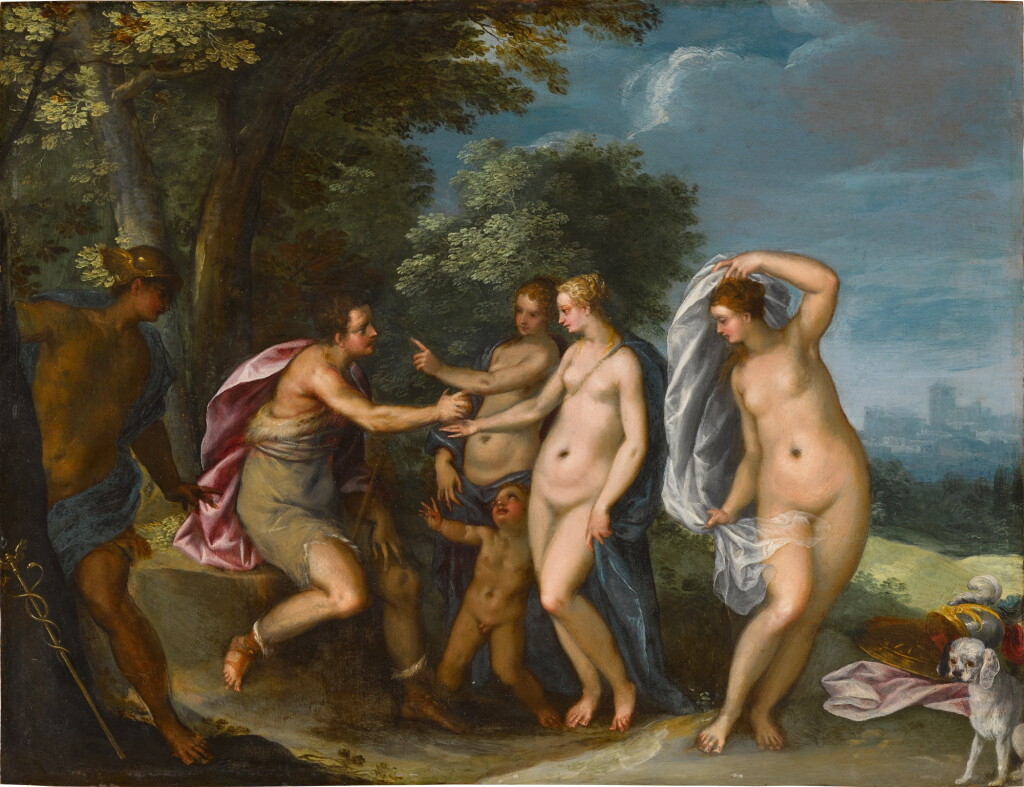
The Judgement of Paris
Lot Closed
December 7, 10:25 AM GMT
Estimate
20,000 - 30,000 GBP
Lot Details
Description
Property from a Deceased's Estate
Hans Rottenhammer the Elder
Munich 1564–1625 Augsburg
The Judgement of Paris
oil on copper
unframed: 31.5 x 49.9 cm.; 12½ x 16⅛ in.
framed: 41.5 x 50.9 cm.; 16⅜ x 19⅞ in.
Mrs Drey, 1960;
Anonymous sale, Munich, Neumeister Auktionshaus, 11 December 1991, lot 352;
With Katrin Bellinger, Munich 1992;
From whom acquired by the late owner.
H. Schlichtenmaier, Studien zum Werk Hans Rottenhammer d.A., Dissertation, Tübingen 1988, p. 231, no. GI 34;
H. Borggrefe, in H. Borggrefe et al., Hans Rottenhammer, exh. cat., Lemgo and Prague 2008, p. 131, reproduced fig. 180.
The Judgement of Paris was a theme frequently dealt with by Rottenhammer during his Venetian period of 1591 to 1604, with the artist varying the composition in terms of both the format and the arrangement of figures. In a vertical version dated 1597, now in the Petit Palais, Paris, the protagonists crowd in close together, a tired looking Paris placing the golden apple in a strident Aphrodite's hand.1 In a horizontal composition in the Alte Pinakothek, Munich, dated to 1605, the direction of the scene is reversed and Minerva turns her back to us.2 The present version, dated by Schlichtenmaier to circa 1600, is perhaps the most successful, with its intelligent arrangement of figures in a frieze-like grouping set against an expansive landscape, and its attention to detail, particularly noticeable in the delicate vegetation. The debt to Venetian painting, and above all to Tintoretto and Palma Giovane, reveals itself in the elongated figures and in the vibrant colouring.
Heiner Borggrefe believes that Rubens may have been inspired by this version of the Judgement, linking it to his oil on copper sketch of the same subject, executed in circa 1601, in the Academy of Fine Arts, Vienna.3 Indeed, in both compositions a slender Aphrodite demurely rests a bent right leg against the left, and the figures are set out in the same order and with the same spacing. One perhaps also senses a broader appeal for Rubens in the proportions and sway of Rottenhammer's goddesses.
Rottenhammer also experimented with the theme of the Judgement of Paris in a series of drawings, whose compositions differ from the painted versions. Examples of these can be found in the Museum of Fine Arts, Budapest,4 the Yale University Art Gallery, New Haven5 and the Crocker Museum, Sacramento.6 The figure of Aphrodite in the present work is closely comparable to that in a drawing of circa 1600 in the National Gallery, Copenhagen.7 The wealth of different variations, both painted and drawn, reveal Rottenhammer's enduring fascination with this subject.
1 Inv. no. 964, oil on copper, 23 x 18 cm. Borggrefe in Lemgo and Prague 2008, p. 129–30, cat. no. 34, reproduced.
2 Inv. no. 750, oil on copper. Borggrefe in Lemgo and Prague 2008, p. 75, reproduced fig. 119.
3 Borggrefe in Lemgo and Prague 2008, p. 131, reproduced fig. 181. Michael Jaffé had previously noted the similarities between the Rubens oil sketch and the Rottenhammer version in Paris (see M. Jaffé, Rubens and Italy, Oxford 1977, p. 63).
4 Inv. no. 1933, black chalk, brown ink and brown wash on paper, 32.7 x 26.5 cm.
5 Inv. no. 1961.65.27, pen and brown ink and brown wash over black chalk on paper, 20.1 x 19.8 cm.
6 Inv. no. 1871.55, red chalk, brush and brown washes on paper, 28.5 x 24.1 cm.
7 Inv. no. KKSgb7772, pen and brown ink, pencil and brown wash on paper, 19 by 16.5 cm.