Property from the Collection of the late Christiane and Antonin Besse
Follower of Giuseppe Arcimboldo
The Four Elements
Auction Closed
July 6, 10:53 AM GMT
Estimate
60,000 - 80,000 GBP
Lot Details
Description
Property from the Collection of the late Christiane and Antonin Besse
Follower of Giuseppe Arcimboldo
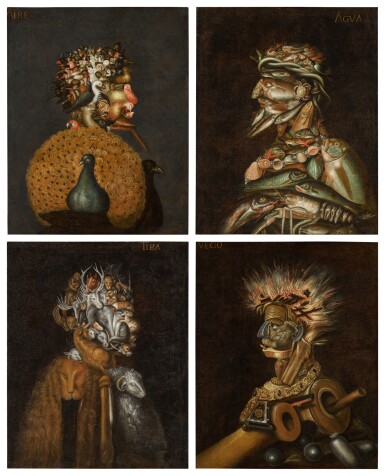
The Four Elements: Earth, Air, Water, Fire
oil on canvas
each unframed: 100.2 x 80.2 cm.; 39½ x 31⅝ in.
each framed: 117.9 x 99 cm.; 46⅜ x 39 in.
(4)
Private collection, Spain;
With Galerie Jacques Kugel, Paris, circa 1958–1963;
From whom acquired.
Venice, Palazzo Grassi, Ecce Arcimboldo, 10 February – 10 June 1987, nos 235–38.
G. Annequin, 'Un appartement-musée: sur des pistes inédites', in L'Œil, September 1990, pp. 40–43, reproduced.
Versions of Arcimboldo's memorable figures representing the Elements appear very rarely at auction, and this series would appear to be the only complete set of four ever to come to the market. Giuseppe Arcimboldo (1526–93), Milanese by birth, produced some of the most memorable paintings of the 16th century, the resonance of which has been felt through generations of artists ever since, the surreal nature of his anthropomorphic figures finding echoes in the works of the likes of Salvador Dalí and Max Ernst. Arcimboldo was celebrated at the courts of Prague and Vienna, where he produced his first set of highly unusual personifications of the Elements for the Emperor Maximilian II in 1566, of which only the panels depicting Fire and Water, in the Kunsthistorisches Museum, Vienna, and Earth, in an Austrian private collection, now remain.1 A contemporary copy of Air is in a private collection in Switzerland.2
Like the famous series of Seasons, these compositions may be read as flattering political allegories representing Maximilian's harmonious reign over his people, and by extension even the Elements – the eagle that appears in Air and in the double headed symbol on the torso of Fire refer to the Habsburg dynasty, as do the Order of the Golden Fleece, which the latter wears, and the lionskin on the shoulder of Earth, evoking the hero Hercules; the canons in Fire are also thought to relate to the victories the Habsburgs had achieved over the Ottomans in 1566. Later versions, like this set, were most likely produced for the open market, which undoubtedly saw a demand for these iconic, decorative and amusing images.
While the figure of Fire is constructed from inanimate objects, the other Elements are formed of birds (Air), mammals (Earth), and fish (Water – the only female figure in the set of Elements or Seasons), many of which derive from studies that Arcimboldo had made, particularly during his time in Prague when working for Maximilian II, and his son Rudolph II. The court in Prague held a menagerie of exotic creatures including elephants and lions, which provided inspiration for a number of court artists, and many of Arcimboldo's drawings of the animals there survive.
1 Fire: https://www.khm.at/en/objectdb/detail/73/; Water: https://www.khm.at/en/objectdb/detail/74/; and Earth: see T. DaCosta Kaufmann, in V. Delieuvin and S. Ferino-Pagden (eds), Arcimboldo (1526–1593), exh. cat., Paris 2008, p. 151, no. IV.20, reproduced in colour p. 152.
2 DaCosta Kaufmann, in Delieuvin and Ferino-Pagden 2008, p. 147, no. IV.16, reproduced in colour p. 147.
You May Also Like


