Property from the Grasset Collection
Isaak Soreau and Workshop
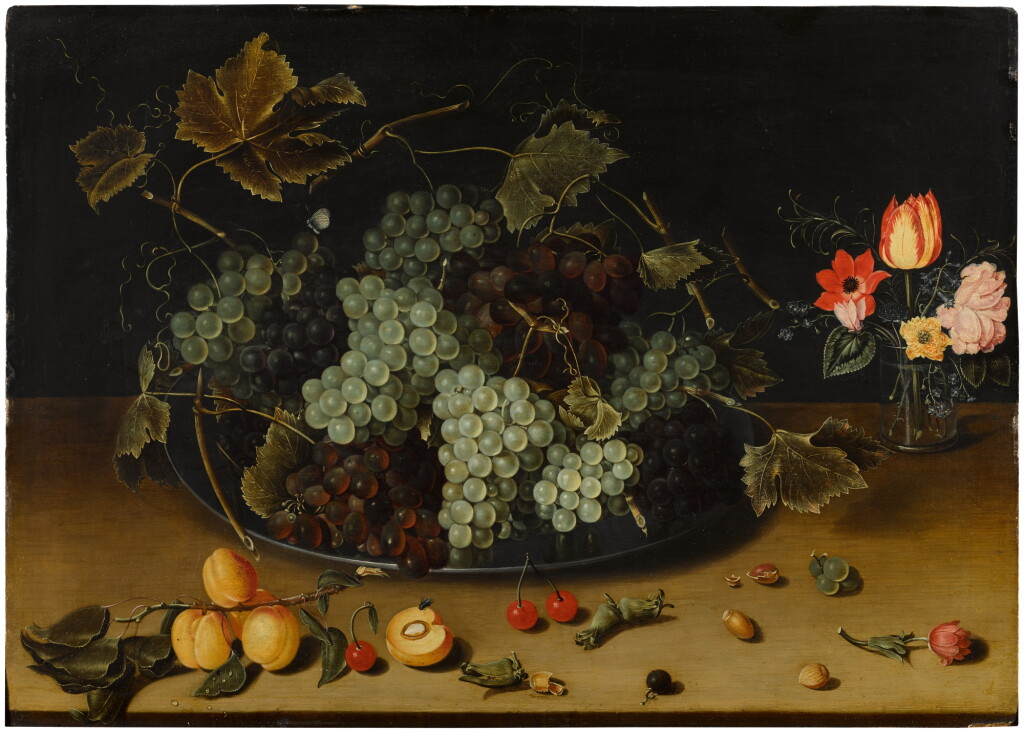
Still life with grapes on a pewter dish, a vase of flowers and other fruits
Auction Closed
July 6, 10:53 AM GMT
Estimate
40,000 - 60,000 GBP
Lot Details
Description
Property from the Grasset Collection
Isaak Soreau and Workshop
Frankfurt-am-Main 1604–1645 or after
Still life with grapes on a pewter dish, a vase of flowers and other fruits
oil on oak panel
unframed: 51.6 x 73.1 cm.; 20¼ x 28¾ in.
framed: 69.2 x 90.3 cm.; 27¼ x 35½ in.
With Richard Green, 1974;
From whom acquired for the Grasset Collection.
Madrid, Palacio de Velázquez (Parque del Retiro), Pedro Pablo Rubens (1577–1640), December 1977 – March 1978, no. 142;
San Diego, The San Diego Museum of Art, Brueghel to Canaletto, European Masterpieces from the Grasset Collection, 2 April – 2 August 2016, no. 21;
Saint Petersburg, Florida, Museum of Fine Arts, A Feast for the Eyes, European Masterpieces from the Grasset Collection, 23 March – 2 September 2019, no. 34.
M. Díaz Padrón et al., Pedro Pablo Rubens (1577–1640), exh. cat., Madrid 1977, p. 148, no. 142, reproduced p. 258;
F.G. Meijer, Brueghel to Canaletto, European Masterpieces from the Grasset Collection, exh. cat., San Diego 2016, p. 26, no. 21, reproduced in colour ;
S. Thomas, A Feast for the Eyes, European Masterpieces from the Grasset Collection, exh. cat., Saint Petersburg, Florida 2019, pp. 78 and 100, no. 34, reproduced in colour.
Although Soreau was born in Hanau, near Frankfurt, many of his paintings show the influence of Antwerp artists, such as Jacob van Hulsdonck, and it seems very likely that Soreau worked in the city and may even have trained with Hulsdonck. His father was a painter and his two brothers also specialised in executing still lifes. Isaak Soreau focused primarily on displays of fruit and flowers on tables, as in the present work, which is entirely characteristic of his œuvre, with the large pewter plate dominating the composition, and a small vase of flowers beside it. Many of these blooms appear in other works by Soreau, suggesting that he must have kept a series of studies of individual flowers which he used together in different combinations. The distribution of fruits and nuts on the tabletop in the foreground is a device that derives from Hulsdonck's example.
Another, slightly larger, version of this composition was with Didier Aaron, Paris, in 1983.1 In comparison, the execution of the present work, which is rather harder, probably reflects at least some participation from an artist in Soreau's workshop. A similar level of quality and style of execution is found in another version of the design, of almost identical dimensions, in an American private collection.2
1 G. Bott, Die Stillebenmaler Soreau, Binoit, Codino und Marrell in Hanau und Frankfurt 1600–1650, Hanau 2001, p. 175, no. WV.IS.10, reproduced.
2 Bott 2001, p. 175, WV.IS.11, reproduced.
You May Also Like