Property from a European Private Collection
Jacob Jordaens and Workshop
Mercury and Battus
Auction Closed
July 6, 10:53 AM GMT
Estimate
150,000 - 200,000 GBP
Lot Details
Description
Property from a European Private Collection
Jacob Jordaens and Workshop
Antwerp 1593–1678
Mercury and Battus
oil on canvas
unframed: 119.7 x 150.8 cm.; 47⅛ x 59⅜ in.
framed: 144.9 x 176 cm.; 57 x 69¼ in.
Paul Friedrich Meyerheim (d. 1915), Berlin, by 1905;
His Estate sale, Berlin, Rudolph Lepke, 14–15 March 1916, lot 87 (as measuring 145 x 183 cm.), where unsold;
Reoffered, Berlin, Rudolph Lepke, 13–15 February 1917, lot 48 (as measuring 145 x 183 cm.), for 7,200 Marks;
Probably where acquired by the grandfather of the present owners, and certainly in the family collection by 1949;
Thence by descent.
Antwerp, Koninklijk Museum voor Schone Kunsten, Tentoonstelling Jacob Jordaens, 1905, no. 36 (lent by Paul Meyerheim).
Album der Tentoonstelling Jacob Jordaens, Antwerp 1905, n.p., no. 36, reproduced;
M. Rooses, Jacob Jordaens, his life and work, German and French eds, Berlin, Amsterdam and Antwerp 1906, pp. 147 and 275; English ed., London and New York 1908, pp. 144 and 257 (as Jordaens);
Kunstmarkt, vol. 14, no. 23, 2 March 1917, p. 126;
L. van Puyvelde, Jordaens, Paris and Brussels 1953 , p. 182, n. 177 (as 'a replica');
N. de Poorter, G. Jansen and J. Giltaij (eds), Rubens en zijn tijd: eigen collectie, exh. cat., Rotterdam 1990, p. 53, under no. 9, under note 3 (as a 'copy').
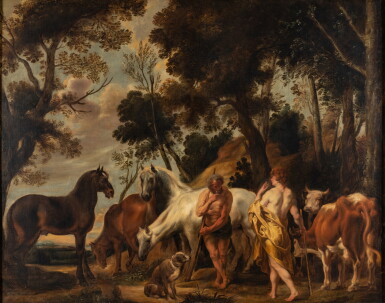
Not exhibited publicly in almost 120 years, this large and impressive painting may be dated to the 1630s, when Jacob Jordaens was fully established as one of the foremost painters in Antwerp, with his own studio of assistants, and increasingly interested in myths and fables. The subject of the work is Mercury and Battus, a story from Ovid's Metamorphoses (though the painting has previously been erroneously described as Mercury and Argus, another episode that Jordaens depicted a number of times). This scene depicts Battus, an old shepherd, having witnessed Mercury hide Apollo's stolen cattle, promising to keep the god's secret in exchange for a heifer. Subsequently, sceptical of Battus' assurance, Mercury returns in disguise and bribes the old man to reveal the whereabouts of the herd, in return for a cow and a bull. Battus' willingness to give up the secret provokes Mercury into turning him to stone as punishment for his indiscretion.
Another version of the scene, which is smaller, on panel, and probably contemporaneous or executed just slightly earlier, is in the Museum Boijmans van Beuningen, Rotterdam.1 Other individual elements recur in Jordaens' œuvre: the cow seen from behind on the right of this composition, appears in Jordaens' earlier Five studies of cows, dating to the early 1620s, in the Musée des Beaux-Arts, Lille;2 and the figure of Mercury appears in the slightly later collaborative depiction of Mercury and Argus by Jordaens and Jan Wildens, probably dating to the early 1640s, in the Norton Simon Museum, Pasadena.3 Max Rooses (see Literature) noted the depiction of Mercury in the present painting, in particular: 'The slender figure of the god is unusually elegant'.
It is interesting and important to note that it is these elements on the right-hand side, including the figure of Battus, as well as the freely painted landscape, that derive from Jordaens' own hand. The animals to the left, including the horses and the dog, which repeats in reverse the dog in Jordaens' first depiction of Mercury and Argus from the early 1620s,4 would appear to be the work of an assistant in the workshop. This practice is likewise found to an extent in the Rotterdam version of this subject, and in The Triumph of Bacchus, in the Musées royaux des Beaux-Arts de Belgique,5 in which Jordaens has clearly worked from right to left, leaving the left-hand side of the composition more unresolved (though there does not appear to have been any studio involvement in that painting).
This painting was once surrounded by additions, as the listed dimensions and illustration in the Meyerheim sale of 1916 make clear (see Provenance). These had been removed by the time that Ludwig Burchard saw the painting in person in 1949, in the collection of the family of the present owners, as he notes in a letter dated 22 March of that year.
We are grateful to Dr Joost van der Auwera for his thoughts on this painting, following first-hand inspection.
1 https://www.boijmans.nl/en/collection/artworks/4582/mercury-and-battus
2 https://commons.wikimedia.org/wiki/File:Jacob_jordaens,_studio_per_cinuew_vacche,_1620_ca.jpg
3 https://www.nortonsimon.org/art/detail/F.1976.01.P
4 https://commons.wikimedia.org/wiki/File:Jordaens-mercure.jpg
5 https://fine-arts-museum.be/fr/la-collection/jacques-jordaens-le-triomphe-de-bacchus
You May Also Like