Property of a German Baronial Family
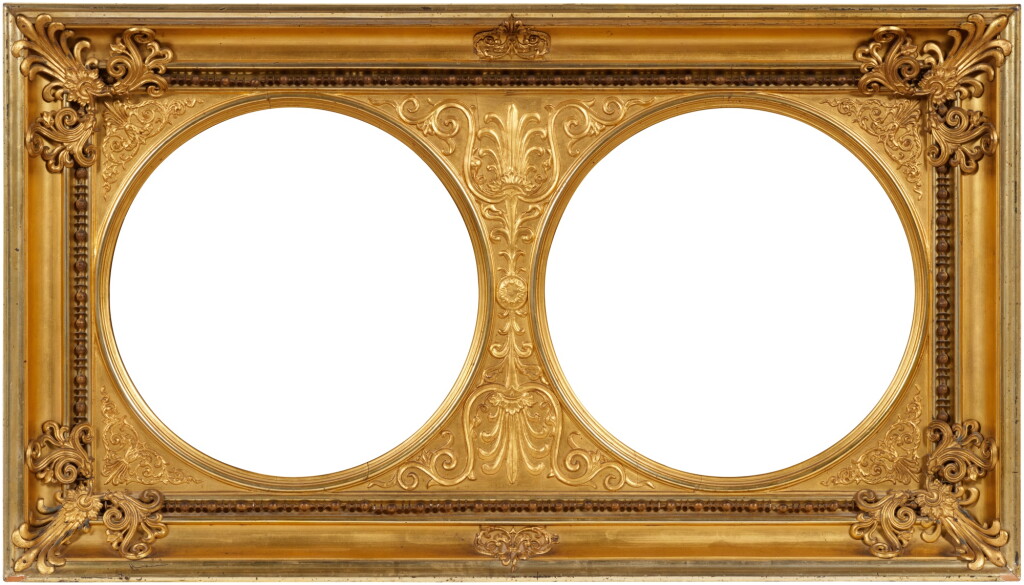
A pair of German Neoclassical double-portrait frames, by Karl Friedrich Schinkel, Berlin, circa 1825 | Paar neoklassizistische Doppelporträt-Rahmen von Karl Friedrich Schinkel, Deutschland, Berlin, circa 1825
Lot Closed
October 18, 02:48 PM GMT
Estimate
10,000 - 15,000 EUR
Lot Details
Description
A pair of German Neoclassical double-portrait frames, designed and executed by Karl Friedrich Schinkel, Berlin, circa 1825
both wooden frames with yellow varnished poliment silvering and applied with elaborate cast metal palmette and volute mounts and pearl-bead mouldings, the reverse with the original paper label of the frame maker H.W. Röhlich K. Hoflieferant Fabrik Alte Leipzigerstr.2
frames: each 54 x 95 cm
___________________________________________________
Paar neoklassizistische Doppelporträt-Rahmen, entworfen und ausgeführt von Karl Friedrich Schinkel, Deutschland, Berlin, circa 1825
Designed and executed by Schinkel and gifted to Georg Abraham Gabain (1763-1826) and his wife Caroline Henriette Auguste Gabain, née Gropius (1769-1831);
thence bequeathed to their youngest third daughter Marie Louise Jeanne Gabain (1813-1891) who married Herman Quincke (1808-1891); and thence by descent to the present owners.
Kurpfälzisches Museum, Heidelberg;
Karl Friedrich Schinkel - Architektur, Malerei, Kunstgewerbe, Verwaltung der Staatlichen Schlösser und Gärten and Nationalgalerie Berlin, Berlin 1981
Johannes Sievers, Karl Friedrich Schinkel Lebenswerk: Die Möbel, Berlin 1950, p. 83 and 107, ill. 214;
Gerhard Kolberg, Die Funktion der Bilderrahmung und ihr Verhältnis zur Bildgestaltung der Malerei und Grafik der Deutschen Romantik, Berlin 1977, p. 279, ill. 221
Exhibition catalogue: Helmut Börsch-Supan, Lucius Griesebach, Karl Friedrich Schinkel - Architektur, Malerei, Kunstgewerbe, Verwaltung der Staatlichen Schlösser und Gärten and Nationalgalerie Berlin, Berlin 1981, cat. no. 284, p. 319 (illustrated)
One of these frames formerly displayed the portrait roundels of Georg Gabain and his wife Caroline painted by Prof. Carl Joseph Begas (1794–1854), the other the portrait roundels of Herman Quincke and his wife Marie painted by Prof. Wilhelm (Willi) Döring (1850-1915).
Georg Gabain (1763-1826), married to Caroline Gropius (1759-1831), was the founder of a silk weaving mill in Berlin, the first mechanical weaving mill in Prussia. The weaving mill was particularly known for its silk wallpaper and furniture upholstery, which were produced for royal castles and other prestigious commissions.
Georg Gabain was extremely wealthy, very sociable and maintained various houses and several summer residences in Berlin. In one of his houses, he had two apartments especially prepared for the family of his wife Caroline. Caroline's two brothers, Friedrich and Carl Christian Gropius, would become partners in Gabain's silk weaving mill. Both sides of the family from early on enjoyed a close relationship with Karl Friedrich Schinkel: Schinkel occupied a small artist's studio in the aforementioned Gabain house and from time to time even shared the facilities and comforts of the two Gropius rooms.
This close connection between Schinkel and the Gabain and Gropius families resulted in numerous commissions for construction projects, decorative arts etc. In 1820 Schinkel designed a new building for Gabain in Charlottenburg, ‘das Landhaus Gabain’, a project which was unfortunately never realised. This friendly relationship also saw Schinkel design and execute these two frames as a special and personal gift for the Gabain family.
You May Also Like