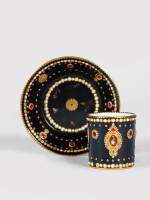
Former Property of a German Countess
A Meissen ‘Blaue Rispe’ pattern part-coffee service, circa 1904-1910 | Kaffeeserviceteile ‚Blaue Rispe‘, entworfen von Richard Riemerschmid für Meissen, circa 1904-1910
Lot Closed
October 18, 03:13 PM GMT
Estimate
3,000 - 5,000 EUR
Lot Details
Description
A Meissen ‘Blaue Rispe’ pattern part-coffee service, designed by Richard Riemerschmid, circa 1904-1910
painted in blue with stylised lime-leaf decoration on a white ground, comprising:
a coffeepot and cover;
a sugar bowl and cover;
a milk jug;
8 cups and saucers;
and 11 cake or dessert plates,
crossed sword marks in underglaze-blue, various items with impressed numbers 82 and 1603. 32 pieces.
_____________________________________________
Kaffeeserviceteile ‚Blaue Rispe‘, entworfen von Richard Riemerschmid für Meissen, circa 1904-1910
Acquired from Von Zezschwitz Art and Design Auctions, Munich, October 23, 2009, lot 153;
Former collection of a German Countess and thence by descent to the present owners.
Prof. Hans W. Singer, 'Some New Meissen Porcelain', The Studio, vol. 40, 1907, p. 57 (for a period discussion of both the van de Velde and Riemerschmid patterns designed for Meissen)
Winfried Nerdinger, Richard Riemerschmid. Vom Jugendstil zum Werkbund, Munich 1982, p. 283
Katherine Bloom Hiesinger, Art nouveau in Munich : Masters of Jugendstil, Philadelphia 1988, pp. 132 and 133 (for a period design, and an illustration of other pieces from the pattern)
Judy Rudoe, Decorative Arts 1850-1950, London 1991, p. 256
Winifred Nerdinger, 100 Jahre Deutscher Werkbund 1907-2007, New York 2007, p. 44
This pattern was conceived as a modernist response to Meissen's poor showing of dated forms and patterns at the the Paris Exposition Universelle in 1900. Riemerschmid was asked to create an updated service that would reference Meissen classics with a modern aesthetic. The resulting service has a lower sleek profile with restrained decoration limited predominantly to the edges, which reflect Riemerschmid's design concepts executed in other materials.
You May Also Like