
Abdur Rahman Chughtai
The Desert in Bloom; A Serenade
Auction Closed
March 20, 05:04 PM GMT
Estimate
6,000 - 8,000 USD
Lot Details
Description
Abdur Rahman Chughtai
1894 - 1975
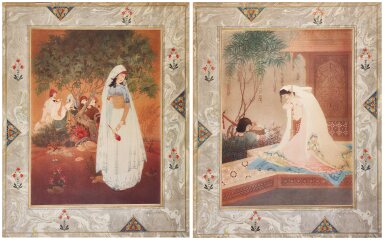
The Desert in Bloom; A Serenade
Chromolithographs
The Desert in Bloom: Signed indistinctly on the mount 'AChughtai' lower right
A Serenade: Signature printed in Urdu lower left and further signed indistinctly on the mount 'AChughtai' lower right
22 ⅜ x 16 ½ in. (56.7 x 42 cm.); 22 ¼ x 16 ½ in. (56.5 x 42 cm.)
The Desert in Bloom:
A. Naqvi, Image and Identity: Fifty Years of Painting and Sculpture in Pakistan, Oxford University Press, Karachi, 1998, fig. 22 (original gouache)
A Serenade:
A. Naqvi, Image and Identity: Fifty Years of Painting and Sculpture in Pakistan, Oxford University Press, Karachi, 1998, fig. 21 (original gouache)
M. Sirhandi, Contemporary Painting in Pakistan, Ferozsons (Pvt.) Ltd., Lahore, 1992, fig. 3 (medium/edition not specified)
Born into a family of court painters and descending from a lineage of artisans, Abdur Rahman Chughtai is one of Pakistan’s foremost 20th century masters. In 1911, Chughtai studied at the Mayo School of Art in Lahore where he was influenced by a mix of Mughal miniature, Bengal School and Santiniketan School styles. Chughtai formulated his own approach to the diverse, indigenous visual languages of the region, and blended classical Islamic and Indian traditions, from beloved Punjabi folk tales to Hindu and Buddhist mythological themes, as well as mystical Persian love poetry. Chughtai also looked to artistic traditions beyond South Asia to inform his style. He found inspiration in Japanese prints and Art Nouveau graphics, and these were key elements in Chughtai’s revival of the Mughal aesthetic.
The present lot consists of two chromolithographs from Muraqqa-i-Chughtai, first published by the Jahangir Book Club, Lahore in the late 1920s with a foreword by Dr. Sir Muhammad Iqbal, a cultural and political leader of the early 20th century. The book contains paintings by Chughtai paired with the Diwan-i-Ghalib, a compilation of poetry by Persian and Urdu poet, Mirza Asadullah Khan Ghalib. Famous for his ghazals, poetic texts based on love, loss and separation, Ghalib remains one of the greatest interpreters of connection and the human condition.
In both compositions, Chughtai captures sentiments and themes common to ghazals. In The Desert in Bloom, a woman stands alone in a sandy terrain holding a drinking vessel, perhaps intoxicated and in search of her lover. Meanwhile, in A Serenade, a woman listens to a song sung by a lover in rapture. Her body tilts toward the musician and her hair falls forward, parallel to the falling flowers.
Such works are rare not only in medium but also in concept. They are interpretations of Ghalib’s poetry, a true example of the many influences – textural, visual and mythological – that informed Chughtai’s oeuvre.
You May Also Like


