Property from a Private Collection, USA
Emil Nolde
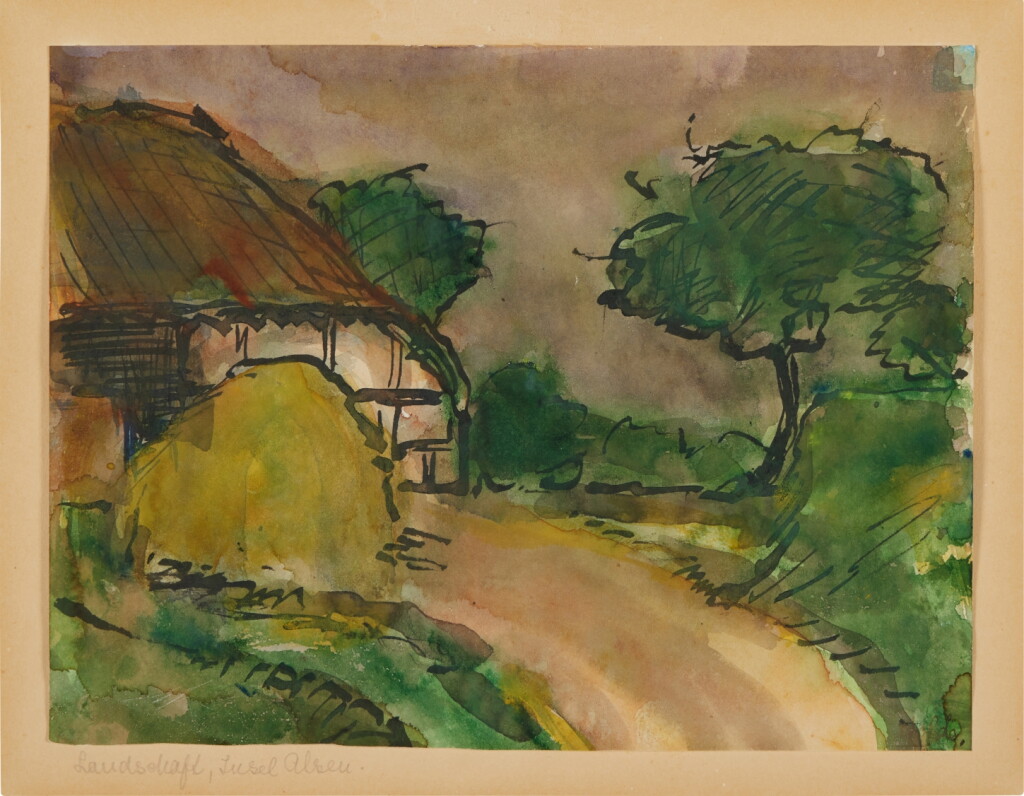
Landschaft, Insel Alsen
Lot Closed
March 30, 02:00 PM GMT
Estimate
18,000 - 25,000 EUR
Lot Details
Description
Property from a Private Collection, USA
Emil Nolde
1867 - 1956
Landschaft, Insel Alsen
signed Nolde (lower right) and titled (lower left on the mount)
watercolor and brush and ink on paper
19 by 25 cm.
7½ by 9⅞ in.
Executed in 1909/1910.
The authenticity of this work has been confirmed by Prof. Manfred Reuther, Klockries.
Anna Mosle, USA (acquired in Germany in the late 1940s)
Margo Loeffler, USA (acquired by descent from the above circa 1972)
Thence by descent to the present owner
“On one of our walks through Alsen we found a very, very small empty house on the side of a forest, not far from the sea. It was a fisherman's house, because there were brown-tarred fish traps hanging on the wall outside. We soon found a bearded fisherman and 50 Deutschmarks was the annual rent we had to pay. It was good that it was so little, because the last of our money was spent on building a small shack by the sea, which was to become my studio. My little studio, how happy I was!" (Emil Nolde, circa 1904, quoted in: Emil Nolde, Jahre der Kämpfe, 1902 - 1914, Cologne, 1991 p. 28, translated from German.)
The present watercolour by Emil Nolde dated from 1909/10 depicts a landscape of beech grove and a farmhouse on the island of Alsen, Nolde's residence at the time. Alsen is located in the Baltic Sea, which is now Denmark and belonged to Germany until 1920. From around 1904, he rented a small fisherman's house together with his wife, Ada. He spent the summer months there until circa 1915/16, while he worked in his studio in Berlin during the winter. On the east coast of the island, Nolde built himself a small and simple wooden shed directly on the beach, which he used as his studio. In the harsh nature he could observe the sea closely at any time of the day in all its atmospheres. During his creative period on the beach at Alsen, Nolde's Herbstmeer series, which have since become one of the artist's most sought after subjects, were executed.
Not only the sea inspired Nolde in Alsen, but also the barren landscape. The farmhouse was likely on the way from his house to the beach. He often walked along the paths and thus artistically recorded his area around him on the island which he executed shortly after.
This vibrant depiction of the Nordic landscape appears sketchy at first due to the artist's vivid brushworks, but the colourfulness transforms into an astonishing depth. North German landscapes are a key motif in Emil Nolde's extensive oeuvre of drawings, watercolours and oil paintings.
In 1910, Nolde began to use absorbent thin paper. Harnessing the fluidity of his chosen medium, the artist allowed differing colour planes to merge. Embracing the element of chance and the interplay between nature and colour, Nolde conveys the overwhelming dynamism of nature and portrays the true manifestation of expressionist ideals.
Born in 1867, Emil Nolde is a German artist who was always fascinated with landscapes, flowers and changing weather. He joined the German Expressionist group “Die Brücke” in 1906.
Nolde’s work is held in a number of the world's leading public collections, including the Museum of Modern Art, New York; the Art Institute of Chicago; the Brücke Museum, Berlin; and the Nasjonalmuseet for Kunst, Oslo. Following Nolde's death, his home in Seebüll was transformed into a museum of the artist's work.
You May Also Like