Mohamed Melehi
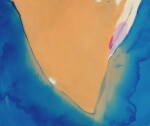
Yellow Flame Between Black and Brown
Lot Closed
March 21, 03:13 PM GMT
Estimate
50,000 - 70,000 GBP
Lot Details
Description
Mohamed Melehi
Moroccan
1936-2020
Yellow Flame Between Black and Brown
oil on canvas
120 by 109.5cm., 47¼ by 43⅛in.
framed: 126.7 by 117cm., 49⅞ by 46in.
Executed c. 2007
Property from a private collection, London, acquired directly from the artist
Bonhams, London, Modern and Contemporary Middle Eastern Art , 24 November 2020, Lot 31
Acquired from the above sale by the present owner
'Conscious of the fact that I needed to represent Africa —too huge of a task, really—I wanted to create a form that, while traditional (the wave appears in all African art), while new (it is structurally modern), symbolizes a determined situation: despite its bloodthirsty, metallic, and programmed oppression, the dynamic spirit of this continent (its ‘SOUL’) rises up forcefully towards the sky.'
The Artist, 1968
The present work is an exceptional example of Mohamed Melehi's unique works on canvas and demonstrates the artist's painterly hand. Towards the latter half of his life, Melehi moved away from panel and embraced a new medium, creating numerous tour-de-force works.
The undulating waves that have come to be Mohamed Melehi's trademark motif, and would feature in many variations throughout his practice, made their first appearance in New York in a work from 1963 simply titled New York. The New York paintings were more mature compared to those Melehi painted previously in Europe – he had moved to Europe from Morocco in 1955 to study fine art – his lines and forms became brighter, clearer and smoother, a reference to the work of Franck Stella or Jasper Johns, who both heavily influenced young Melehi. Melehi’s innovation in New York established his name in the US and culminated in the inclusion of his works in two influential group shows in 1963, the Hard Edge and Geometric Painting and Sculpture exhibition at MoMA and Formalists at the Washington Gallery of Modern Art.
For Melehi, the rhythmic wave carries a multitude of meaning and is at once personal and universal. Having grown up in the seaside town of Asilah, the waves reminded Melehi of his childhood but are also a clear reference to Islamic and Berber art. The wave, both abstract and representational, is symbolic of our existence and the cosmic forces at play in our lives.
You May Also Like