Uche Okeke
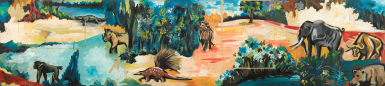
Animals in Procession (Mural for the Children's Library in Enugu)
Lot Closed
March 21, 03:45 PM GMT
Estimate
100,000 - 150,000 GBP
Lot Details
Description
Uche Okeke
Nigerian
1933-2016
Animals in Procession (Mural for the Children's Library in Enugu)
oil on wooden panel
122 by 244cm., 48 by 96in.(each panel); 122 by 488cm., 48 by 192⅛in. (together)
Acquired from the Enugu State Library Board by the family of the artist
Uche Okeke, LeClair Grier Lambert, Art in Development: A Nigerian Perspective, (1982, p. 73)
Uche Okeke, Treasures of Asele Institute, (1988, p. 10)
C. Krydz Ikwuemesi, The Triumph of a Vision: An Anthology on Uche Okeke and Modern Art in Nigeria, (2003, p. 26)
A founding member of the Zaria Art Society, a group at the forefront of postcolonial modernism in Nigeria, Uche Okeke’s contribution to African art both as a practice and discipline has placed him amongst the most revered African modernists. Okeke's work is characterized by a unique fusion of traditional Igbo art forms and modern techniques, resulting in bold and dynamic compositions that showcase his mastery of color, texture, and form. His works often feature intricate patterns and symbols that draw upon his cultural heritage and explore themes of identity, spirituality, and nationalism. The present lot, a monumental painting depicting a rural tropical landscape, employs painterly techniques commonly associated with European expressionism and post-Impressionism, and exemplifies the conceptual foundations which distinguished Okeke as a leading artist in his lifetime.
Okeke pioneered National Synthesis, a movement which sought to blend art historical techniques developed in the European academy with pre-colonial ethnic visual culture in pursuit of a distinctly Nigerian artistic tradition. Okeke calls upon his distinctive style, which draws from the Uli tradition of symbolic two-dimensional line drawing indigenous to his Igbo heritage. His approach to the depiction of form, the bold, confident outlines with which the animals and landscape are rendered, invoke this pre-colonial aesthetic tradition. With this work, Okeke pushes Uli practice forward by seamlessly integrating this motif into a vibrant, semi-naturalistic landscape composition.
After his return from Germany in 1963, Okeke settled in Enugu, then capital of Nigeria’s Eastern Region. With the help of other former Zaria Art Society artists, Okeke established a cultural center, which he directed from 1964 to 1967. Modelled on prominent scholar Ulli Beier’s Mbari Artists and Writers Club in Ibadan, Okeke’s Mbari Enugu brought together artists, writers, dramatists and intellectuals to exchange ideas, collaborate, exhibit and discuss new work.
The present lot was produced by the artist in 1964 for the children’s section of the East Central State Library in Enugu, Nigeria, where Okeke's then fiancée Kaego, later his wife, worked. The library itself was created as part of the postcolonial Nigerian government’s effort to establish Universal Primary Education across the country in the 1960s and 1970s. Okeke contributed significantly to the development of an indigenous education system in postcolonial Nigeria, becoming head of the Fine Arts department at the University of Nigeria, Nsukka, from 1971 to 1985. These panels, produced in the midst of this postcolonial optimism, encapsulates the approach toward cultural development which comes to characterise Okeke’s work. Okeke's legacy continues to inspire generations of African artists, and his contributions to the world of contemporary art are celebrated today as a testament to his enduring talent and vision.
You May Also Like