
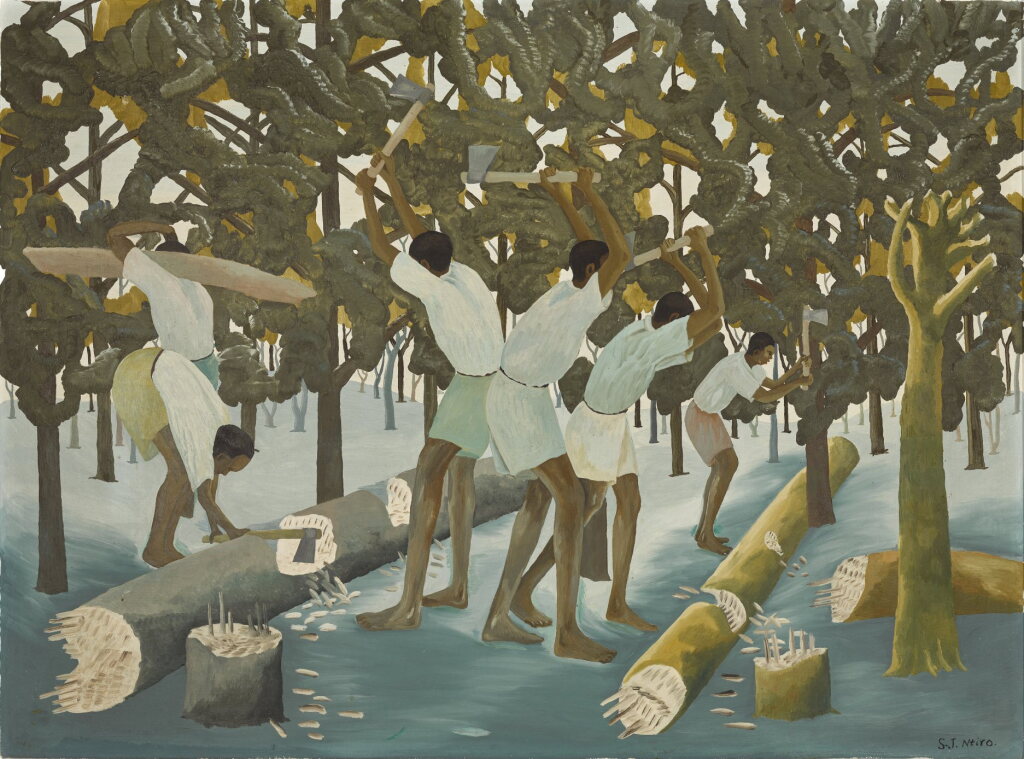
Sam Joseph Ntiro
Woodcutters
Lot Closed
October 19, 04:00 PM GMT
Estimate
7,000 - 9,000 GBP
Lot Details
Description
Sam Joseph Ntiro
Tanzanian
1923-1993
Woodcutters
signed (lower right) and inscribed Woodcutters by S.J Ntiro and April 1955 (on gallery label affixed to reverse)
oil on board
90 by 120cm., 35⅜ by 47¼in.
The Piccadilly Gallery, London
Acquired from the above by the present owner in 1968
“A good deal of my painting is about life, tradition, the customs and the day to day activities of the lives of my people, the Chagga, on the slopes of Mount Kilimanjaro.”
As an artist, educator and civil servant, Ntiro is a foundational figure in the art history of East Africa. He was the first East African artist to hold solo exhibitions abroad, and the first African painter to hold a solo exhibition in a New York gallery, at the Merton Simpson Gallery in 1961, the same year he became the first modern African artist to have a work purchased by MoMA in New York, and possibly by any public institution in the United States.
Born in the chiefdom of Machame and educated in a Lutheran mission school, Ntiro studied art at Makerere College, University of East Africa, in Kampala, Uganda, where he taught painting from 1948. From 1952-1955 Ntiro furthered his education at the Slade School of Art. During this time, Ntiro published his book Desturi za Wachagga (Traditions of the Chagga) in 1953, and sold over thirty works in his debut exhibition Paintings of Africa at the Piccadilly Gallery in 1955.
After graduating from the Slade, Ntiro returned to Uganda and his role at Makerere, until Tanzania gained independence in 1961. Prime Minister Nyerere appointed Ntiro High Commissioner to the United Kingdom 1961-1964, where he continued to paint, holding another solo exhibition at the Piccadilly Gallery in 1964, when the present lot was shown. Upon his return to Tanzania, Ntiro went back to teach at Makerere before becoming Commissioner for Culture in the Tanzania Civil Service in 1967, when he left Makerere for good.
Bibliography:
Mario Pissarra, 'Re/writing Sam J Ntiro: Challenges of framing in the excavation of a ‘lost’ pioneer', Third Text Africa, Vol. 4, 2015, pp. 25-60
You May Also Like


