PROPERTY FROM THE BEAVERBROOK ART GALLERY, SOLD TO BENEFIT FUTURE ACQUISITIONS
Sir William Orpen, R.W.S., N.E.A.C., R.A., R.H.A.
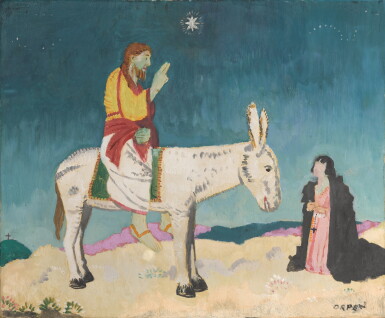
Palm Sunday A.D. 33
Auction Closed
November 22, 01:24 PM GMT
Estimate
10,000 - 15,000 GBP
Lot Details
Description
Sir William Orpen R.S.W., N.E.A.C., R.A, R.H.A
1878 - 1931
Palm Sunday A.D. 33
signed ORPEN (lower right)
oil on canvas
unframed: 42 by 50.5cm.; 16½ by 20in.
framed: 58.5 by 68cm.; 23 by 26¾in.
Executed in 1930.
The Artist
Miss Cara Copland
Gifted by the above to Beaverbrook Art Gallery
Paul George Konody and Sidney Dark, Sir William Orpen: Artist and Man, Seeley Service and Co., Ltd., London, 1932, p. 276 (titled Palm Sunday)
Orpen’s recourse to Biblical subject matter at the end of his life after years of dissipation seems intelligible. Marked indelibly by his struggle to make sense of experiences on the Western Front, he pedalled furiously on the ‘golden treadmill’ of portrait commissions in the 1920s to obliterate the sights he had seen in the trenches. His choice of subject matter was occasioned more by available visual sources than by any preordained programme and a moving twelfth century carving at Bode Museum, Berlin supplied the inspiration for Christ in two extant versions of Palm Sunday.
Fig 1 Anon, Christus ale Eseltreiber, mitgeführt bei Prozessionen am Palmsonntag, 12th century, (the donkey is a pre-1930 addition), Bode Museum, Berlin.
What was Orpen trying to do in these paintings? His Jesus on a donkey set against a brilliant blue sky at first looks like an illustration from a children’s picture book or Sunday school flannel-graph. But here, there are no crowds crying ‘Hosanna!’, no waving palm fronds – only a single penitent seeking absolution and transcribed from earlier drawings used in the so-called ‘Irish Trilogy’ fifteen years before.
It appears that this version of Palm Sunday was painted for Miss Cara Copland, who befriended the artist in his final months.
Kenneth McConkey
You May Also Like