
Property from the Collection of A.M. ('Ton') van den Broek (1932-1995)
Claes Jansz. Visscher
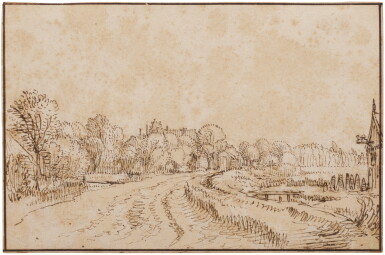
View near Amsterdam: on the Sloterweg, by the Red Lion tavern
Auction Closed
January 25, 04:44 PM GMT
Estimate
10,000 - 15,000 USD
Lot Details
Description
Property from the Collection of A.M. ('Ton') van den Broek (1932-1995)
Claes Jansz. Visscher
Amsterdam 1587 - 1652
View near Amsterdam: on the Sloterweg, by the Red Lion tavern
Pen and brown ink, within brown ink framing lines
108 by 163 mm; 4¼ by 6½ in.
where purchased by A.M. ('Ton') van den Broek (1932-1995), Haarlem (bears his mark, verso, not in Lugt)
In 1915, the Dutch art historian, documenter and collector Frits Lugt published his famous Walks with Rembrandt, in and around Amsterdam, in which he reconstructed, through incredibly careful and insightful research and observation, the actual routes that Rembrandt had followed on the walks around Amsterdam that provided him with the subjects for many of his most beautiful landscapes, both drawn and etched. Then, in 1998, Lugt’s work was miraculously brought to life, in the exhibition held at the Amsterdam Archives and the Fondation Custodia (see Literature), and we were able to walk along with Rembrandt, in our hand a gazetteer identifying so many of the seemingly insignificant farms, inns and country houses that we passed along the way. Both these publications were milestones in Dutch art history, and in our understanding of the deep connection between the landscape artists of the 17th century and the details of their surroundings.
But some 40 years before Rembrandt, another Dutch artist had been doing much the same thing. In the very first decade of the 17th century, the printmaker, publisher and draughtsman Claes Jansz. Visscher also walked through, and drew, the environs of Amsterdam, and Haarlem. Some of the drawings that he made were subsequently used for prints, others were not, but all were as immediate, and as serenely low-key, as the corresponding landscapes of Rembrandt. In her unpublished 1958 University of Freiburg dissertation on Claes Jansz. Visscher, which remains to this day the only catalogue of the artist's drawings, Maria Simon listed 78 sheets that she considered autograph, since when a few more have come to light, but the artist's drawings remain extremely rare, and only some six drawings by Visscher have been offered at auction since the present work was acquired by Mr. Van den Broek, more than four decades ago.1
The originality and significance of this group of drawings by Visscher, which includes the present sheet, is considerable. Before this time, it was extremely unusual for an artist to devote themselves to the depiction of seemingly inconsequential views and locations, and even more unusual to take the trouble to turn these anonymous landscapes into prints. The main precedent for this was the series of drawings and prints by the unidentified artist known as The Master of the Small Landscapes, who worked in the third quarter of the 16th century, in the orbit of Pieter Bruegel the Elder, but from then until the works of Visscher, Goltzius and the other pioneers of the early 17th century, such subjects were hardly represented. This was, however, the moment when the rebellious, Protestant northern provinces of the Netherlands were finally nearing the moment of achieving their independence from their Catholic Spanish rulers, and in literature and art alike, the glorification of the native Dutch landscape, down to its most unimportant details and corners, took on immense symbolic significance. In his role as publisher, Visscher not only reissued the earlier prints of the Master of the Small Landscapes, but also produced comparable series, based on his own drawings, devoted to depictions of locations around Haarlem and Amsterdam. A number of the drawings for these prints survive, some inscribed with the names of the locations depicted and the date 1607, but other, similar landscapes by Visscher, like this example, were neither engraved nor inscribed, making the identification of their subjects more challenging.
When sold in 1979, this unassuming drawing was thought to be a view of the road to Diemen, to the west of Amsterdam, but the authors of the 1998-9 exhibition catalogue established that it is in fact a view on the Sloterweg, to the south-east of the city centre. Unlike Diemerweg, the road leading up to the village of Sloten is bordered by substantial trees – as seen in the various Rembrandt drawings of this location, including those in the Getty Museum, in Hamburg and elsewhere.2 To the far right of Visscher’s drawing there is also a clearly identifiable landmark, namely the popular Rode Leeuw (Red Lion) tavern, which stood half way along the Sloterweg, at the boundary of the tax jurisdiction of the city of Amsterdam, established in 1539. Only beyond this point could wine and beer be freely sold, without restrictions or taxes. A tavern with the sign of the Red Lion is specifically mentioned in this location in a document of 1636, but clearly existed from a rather earlier date. The tavern stood well into the 19th century, and in around 1880 had the nickname of ‘Drunkards’ Retreat.’
In this unassuming sheet, Visscher captured so much of the essence of the Dutch landscape, and of the Dutch identity in the years around the start of the Twelve Years Truce (1609), which marked the effective beginning of Dutch independence from Spanish rule. Like his later compatriot, Rembrandt, Visscher demonstrates an extraordinary ability to convey a sense of atmosphere, and even weather, with total economy of technique, effortlessly transporting the viewer back more than four centuries, to join the artist on his stroll to the country pub.
1. The most notable being the drawing sold from the Van Regteren Altena Collection, Amsterdam, Christie's, 10 December 2014, lot 138, and the two from the Klaver Collection, sold, Amsterdam, Sotheby's, 10 May 1994, lots 15 and 47
2. Los Angeles, Getty Museum, inv. 85.GA.95, Benesch 1253; Hamburg, Kunsthalle, inv. 7644, Benesch 1285
You May Also Like


