Johan Tobias Sergel
Recto: Sergel’s Italian teacher in Rome Verso: Study of an interior of a room and separate studies of a table and chair
Auction Closed
January 25, 04:44 PM GMT
Estimate
10,000 - 15,000 USD
Lot Details
Description
Johan Tobias Sergel
Stockholm 1740 - 1814
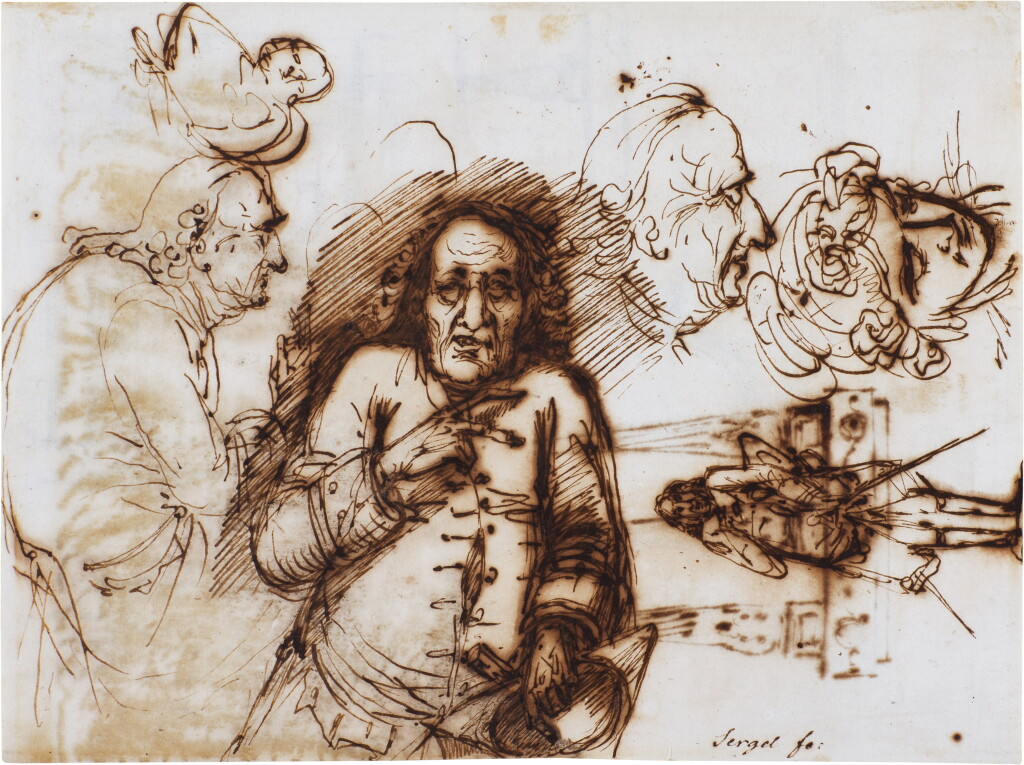
Recto: Sergel’s Italian teacher in Rome
Verso: Study of an interior of a room and separate studies of a table and chair
Pen and brown ink (recto) and black chalk (verso);
Signed, lower right, in brown ink: Sergel fe
180 by 244 mm; 7 by 9⅝ in.
sale, Stockholm, Bukowskis, autumn 1994;
sale, Stockholm, Stockholms Auktionsverk, 8 June 2022, lot 339
A major figure in the international Neoclassical movement, the Swedish sculptor Johan Tobias Sergel trained first in Paris, before travelling to Rome in 1767. He spent some twelve years in the Eternal City and elsewhere in Italy, and together with his younger contemporaries Antonio Canova, Bertel Thorwaldsen and John Flaxman, was influential in the development of Neoclassicism. While in Italy, he enjoyed the patronage of many leading figures, including Sir William Hamilton, in Naples, who described Sergel to the Comte d’Angiviller as ‘not only the foremost sculptor now working in the whole world but…also the greatest since the days of Michelangelo.’
A talented draughtsman as well as a sculptor, his drawings include not only classicising figure studies, but also humorous and caricatural images, recording with wit and verve all the people with which he surrounded himself, and their foibles. In 1779, he was summoned back to Sweden by the King, and worked in Stockholm for the rest of his life.
This particularly good example of one of Sergel’s caricatures is believed to be a biting representation of the person who taught him Italian, following his arrival in Rome. In the recent Stockholm sale catalogue, it was suggested that this teacher was the Swiss-born French artist, Jean-Antoine Julien, called Julien de Parme (1736-1799), but it is not clear what the basis is for this identification.
You May Also Like