
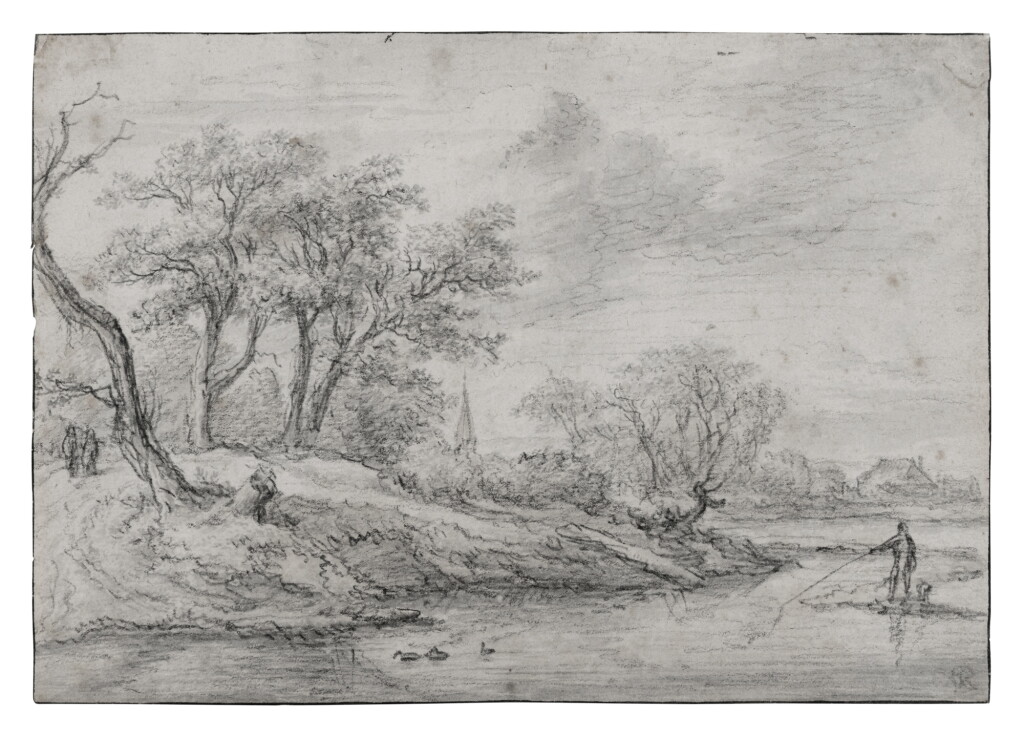
From the collection of Seymour and Zoya Slive
Jacob van Ruisdael
Landscape with Fishermen
Auction Closed
January 25, 04:44 PM GMT
Estimate
20,000 - 30,000 USD
Lot Details
Description
From the collection of Seymour and Zoya Slive
Jacob van Ruisdael
Haarlem 1628/29 - 1682 Amsterdam
Landscape with Fishermen
Black chalk with gray and brown wash and faint traces of yellow and yellowish green watercolor;
signed with the artist's monogram in black chalk, lower right
138 by 197 mm; 5½ by 7¾ in.
Ernst Jürgen Otto (20th century), Celles (L.873b);
sale, London, Sotheby's, 14 December 1992, lot 231 (as Circle of Jacob van Ruisdael),
Seymour and Zoya Slive, Cambridge, MA
S. Slive, "Additions to Jacob van Ruisdael: 2", Burlington Magazine, 137, 1995, pp. 454-56, reproduced;
J. Giltaij, "Further Additions to Jacob van Ruisdael", in Shop Talk: Studies in Honor of Seymour Slive, Cambridge, MA, 1995, pp. 87-88
S. Slive, Jacob van Ruisdael: A Complete Catalogue of His Paintings, Drawings and Etchings, New Haven and London 2001, pp. 588-89, no. D134, reproduced
Professor Seymour Slive was, for the duration of his lengthy academic career, the recognized authority on the artistic oeuvre of Jacob van Ruisdael, the preeminent landscape artist of the Dutch Golden Age. Slive's scholarship on Ruisdael culminated in his magnum opus (see Literature) which covers the full spectrum of the Dutchman's artistic output, in the form of his paintings, drawings and etchings. As noted by William W. Robinson in his dedication to Slive, Seymour was especially pleased to acquire the present work in 1992 and it seems fitting to include here his catalogue entry from his 2001 publication, verbatim.
"The drawing, which is related to the more than thirty black chalk studies datable from the late forties to the mid-fifties (see pp.491-92), is erroneously called a monogrammed "Ruelof [sic] van Vries" in a pencil inscription on the verso of the sheet's old mount. The stick-figure-like angler in the drawing is typical of the staffage in these sketches. So are the rapid, jagged black strokes and gradations of chalk and gray wash that help define textures and spatial relations. But unusual for a drawing in the group are the faint traces of watercolour - for example, the yellow on the church steeple and the yellow-green in parts of the foliage and on the bank. Perhaps they are the last remnants of more extensive passages of watercolour that were organic in nature and have faded; Ruisdael's gray washes were made of carbon blacks, which, when unmixed with organic substances, are relatively stable. The rather old-fashioned wedge-like composition of the angler landscape does not occur often and was abandoned by the mid-fifties. The sheet is datable c.1648-50."
You May Also Like


