
Maria Luigia Raggi
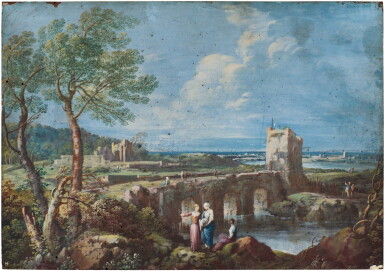
A pair of Roman capricci: a) The tomb of Cecilia Metella with rural buildings in a hilly landscape, an antique column by a river with figures in the foreground; b) A Roman landscape with the Ponte Salario, buildings and a lake in the background with figures
Auction Closed
July 5, 10:16 AM GMT
Estimate
10,000 - 15,000 GBP
Lot Details
Description
Maria Luigia Raggi
Genoa 1742 - 1813
A pair of Roman capricci:
a) The tomb of Cecilia Metella with rural buildings in a hilly landscape, an antique column by a river with figures in the foreground;
b) A Roman landscape with the Ponte Salario, buildings and a lake in the background with figures
Both tempera on vellum laid down on wood.
Both with the two unidentified wax seals on the wooden backings, including a red wax with initials: EG
b) Numbered in ink: 40
Each circa 185 by 264 mm
(2)
Idem, Maria Luigia Raggi: Il Capriccio paesaggistico tra Arcadia e Grand Tour, Roma 2012, p. 99, 18a (Capriccio della campagna romana con il Ponte Salario e figure in primo piano), 18b (Capriccio della campagna romana con la Tomba di Cecilia Metella e frammento di colonna onoraria), p. 116, 18a reproduced
These two Roman capricci and the pair in the following lot are the work of Maria Luigia Raggi, a female artist known for her idealized landscapes of exquisite delicacy and romanticism, often incorporating ancient monuments or recognizable features of the Roman countryside.
The daughter of Giovan Antonio Raggi and Maria Brignole Sale, important members of the Genoese aristocracy, Maria Luigia entered very young in the Monastero della Santissima Annunziata, within the Ordine delle Turchine, noted for being one of the most rigid religious orders in Genoa. However, in 1796, aged 54, Maria Luigia abandoned the nunnery to established herself in Rome, where she stayed with Luca Ferdinado Raggi, a relative with an influential role in the Accademia di San Luca (he was principe in 1781). Her activity as a painter is testified by some eighty temperas on parchment, of which four are signed and one dated 1796.1
The present vedute are typical examples of Raggi's works, executed with delicate and minute brush strokes and with a light colour palette. She integrates architectural features from the past, here the Tomb of Cecilia Metella and the Salario Bridge, into idyllic scenery enriched by natural and rustic elements. Generally in the foreground the composition are enlivened by a number of figures engaged in everyday activities.
Maria Luigia Raggi's works are in several Italian public institutions, including the Capitoline Museum and the Accademia di San Luca, Roma, and the Museo Civico, Prato, and are also preserved in several private European and American collections.
1. Lollobrigida, op. cit., 2012, p. 100, no. 27b, reproduced p. 127


