Property from the Martello Collection
Master of Mezzana
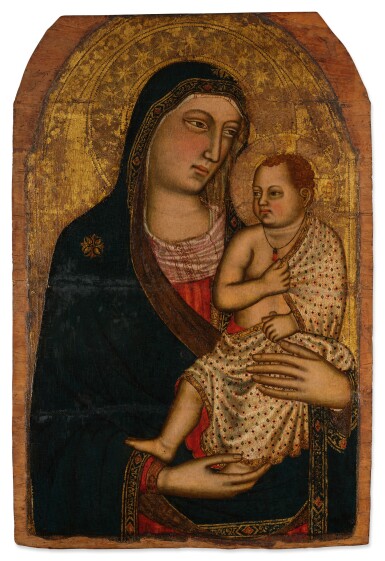
Madonna and Child
Auction Closed
January 27, 09:38 PM GMT
Estimate
40,000 - 60,000 USD
Lot Details
Description
Property from the Martello Collection
Master of Mezzana
active Prato circa 1315-1320 - circa 1340
Madonna and Child
tempera on panel, gold ground, shaped top, unframed
panel: 31 by 20⅝ in.; 78.7 by 52.4 cm.
Raoul Tolentino, Palazzo Acciaioli, Florence, by 1926;
By whom sold, New York, American Art Association, 11 December 1926, lot 792;
New York, American Art Association, 26-30 April 1927, lot 944 (as Jacopo del Casentino);
John Fiske, New York;
Anonymous sale, New York, Sotheby's Parke Bernet, 21 January 1982, lot 105 (as Jacopo del Casentino);
Where acquired by the Martello Collection.
R. Offner, A Critical and Historical Corpus of Florentine Painting, section 3, vol. 2a, New York 1930, p. 92 (as circle of Master of the Da Filicaia Cross);
R. Offner, A Critical and Historical Corpus of Florentine Painting, section 3, vol. 6, New York 1956, p. 56;
M. Boskovits, in The Martello Collection: Paintings, Drawings and Miniatures from the XIVth to the XVIIIth Centuries, M. Boskovits (ed.), Florence 1985, p. 48, cat. no. 10, reproduced in color;
A. Tartuferi, "Master of Mezzana," in The Alana Collection: Italian Paintings from the Fourteenth to the Sixteenth Century, S. Ciodo and S Padovani (eds.), Florence 2014, p. 175 note 3;
A. Tartuferi, "Per il Maestro del Mezzana e alcuni appunti sulla pittura del Trecento a Prato," in Studi di Storia dell'Arte 27 (2017), pp. 65-82.
This impressive Madonna and Child was the central panel of a polyptych. When it first appeared in the early twentieth century in the collection of Raoul Tolentino, it was given to the Florentine painter Jacopo del Casentino, an attribution which followed the painting until it was purchased by the current owners in 1982. However, as early as 1930, Richard Offner had questioned that suggestion, and later placed it close to the anonymous Master of the Da Filicaia Cross (now recognized as Lippo di Benivieni).1 However, in 1956, Offner published a group of works, including the present panel, which he attributed to the Master of Mezzana, christened after two panels in the Museo Diocesano, Prato, which had originally come from the nearby church of San Pietro a Mezzana. In 1984 Miklòs Boskovits attempted to identify the Master with Bettino di Corsino da Prato, a late duecento or early trecento painter who was documented as receiving a payment for a fresco in the Palazzo Comunale of Prato. Subsequent discoveries, however, argued against that identification, as Boskovits later admitted, and the conventional name for the Master of Mezzana is still current.2 The Master was active in Prato from as early as about 1315 or 1320 until about 1340, and shows an awareness of artistic developments in nearby Florence.
Most recently, the present painting has been published by Angelo Tartuferi, who reconfirmed the painting’s authorship, and suggests that it was the central panel of a polyptych of which a Saint Lucy formerly in the collection of Carlo De Carlo was one of the lateral elements. Tartuferi conjectures that if the Saint Lucy panel had been in the "position of honor" in the complex, it seems possible to suggest that the altarpiece could have been painted for Santa Lucia in Monte, a small church overlooking the Bisenzio River to the north of Prato.
1 Offner 1930, p. 92.
2 The fresco on which Boskovits based his theory is indeed by the Master of Mezzana, but he erroneously connected a documented payment to Bettino di Corsino in 1307 with that work. This error was later clarified by Claudio Cerrettelli (in "La piazza e il palazzo del Commune dal XIII agli inizi del XIV secolo," in Prato, Storia e arte 31, no. 77 (1990), pp. 32-35) who correctly noted that the payment was for another fresco of an earlier date in the same palazzo.