
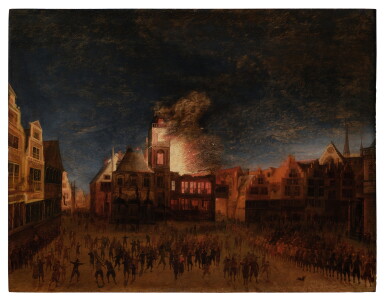
Gerrit Lundens
Fire of the old Amsterdam town hall on Dam Square, July 7, 1652
Auction Closed
January 27, 09:38 PM GMT
Estimate
20,000 - 30,000 USD
Lot Details
Description
Gerrit Lundens
Amsterdam 1622 - 1686
Fire of the old Amsterdam town hall on Dam Square, July 7, 1652
oil on panel
panel: 20½ by 26⅝ in.; 52.1 by 67.6 cm.
framed: 26¾ by 33 in.; 67.9 by 83.8 cm.
Thence by descent until sold, Stockholm, Bukowskis, 4 June 2019, lot 555 (as attributed to Egbert Lievensz van der Poel).
Österbybruk, Uppland, Furstligt besök 1838, 1 July - 28 August 1989.
L. Sjöberg, C.P.A. Tamm, Gyllene tider: Österbysammlingen, exhibition catalogue, Österbybruk 1981, cat. no. 39 (as Egbert van der Poel);
Possibly C.P.A. Tamm, Furstligt besök 1838, exhibition catalogue, Österbybruk 1989;
C.P.A. Tamm, Österbysamlingen : en rätt artig samling af målningar”, Mjölby 2008, pp. 92-93, cat. no. 18, reproduced (as school of Aert van der Neer).
This nightscape by Gerrit Lundens depicts an imagined view the historical fire of July 7, 1652 that razed Amsterdam’s old townhall. Related to a smaller, signed version by Lundens in the Amsterdam Museum, the present work offers a more panoramic view than the Amsterdam version which largely omits the houses on the south side of Dam square and those leading to the Nieuwe Kerk.1 Notably, the compositions both include a little roof atop the central tower, an architectural feature that, in reality, was removed in 1640.
By the early sixteenth century, Amsterdam's historic townhall building had fallen into disrepair. A committee assembled in January 1640 to address the situation offered the following prophetic remarks: ‘As the Townhall is rather ramshackle in various places, to the point that it is to be feared that at one point an accident might happen, one could agree to build a new one instead,”.2 At their advice, construction began in 1648 on a new townhall, designed by architect and painter Jan van Campen (1596-1657), however the project would soon be derailed by the events of 1652.
Observed from a relatively high perspective point at the south side of the Dam – presumably from the so-called ‘Huis onder ‘t zeil’ – the view depicted appears to capture the moment recorded by eyewitness accounts that a barrel of gunpowder exploded in the tower, blowing away part of its wall. Flames pour through the roof, from which issues thick clouds of billowing smoke, and while crowds of spectators, orange-lit by the fire’s immense glow, are hastily gathered in the square below. At right, a bucket brigade contributes to the firefighting effort, passing along leather buckets filled with water from the Damrak. Behind them, three men carry a ‘brandhaak’, a long pole with an iron hook, used to poke holes in rooftops or drag down walls to prevent the fire from spreading.
An Amsterdam native and lifelong resident of the city, Lundens includes identifiable structures throughout the composition, some of which may have held personal significance for the artist. On the right side, the fourth house from the corner is the famous ‘T Schilt van Vranckryck’ tavern, where from 1626 until his death the painter Barent van Someren (1572-1632) was the innkeeper. To the north and only half visible is the house ‘De Bril’ where the art dealer Hendrick Uylenburgh (1587-1661), Rembrandt’s (1606-1669) former business partner, ran his shop from 1647 until 1653 when it was torn down to make way for the new townhall.
On the far left of the painting we recognize the house ‘De Wackere Hond’ (‘The Wakeful Dog’), well known from the landmark dog sign on the façade, where the important publisher Hendrick Hondius (1597-1644/51) and his successors ran their print shop. Behind the curious leg-shaped sign board on the corner of Kalverstraat, we see the ‘De Vergulde Ploeg’ house rented by Joost Hartgers, the publisher of Joost van den Vondel’s (1587-1679) poetry. Just beside the house, a group of men on ladders are attempting to hang a large, wet canvas from the side wall in an effort to protect the house from the nearby flames. This occurence is also described in Jan Six van Chandelier’s epic poem Stadhuisbrand, in which he provides his first-hand account of the destructive fire and articulates that, alas, Hartger's gutter and the stretched canvases accross its facade eventually went up in flames.
1. Inv. no. SB 4512, oil on panel, 29.5 by 33.5 cm.
2. See P.T.A. Swillens, Jacob van Campen: schilder en bouwmeester 1595-1657, Assen 1961, p. 93.
3. Originally published in 1657, see A.E. Jacobs (ed.), Gedichten, Assen/Maastricht 1991, pp. 505-509, no. 305.


