Property from an Important Private Collection
The Master of 1518
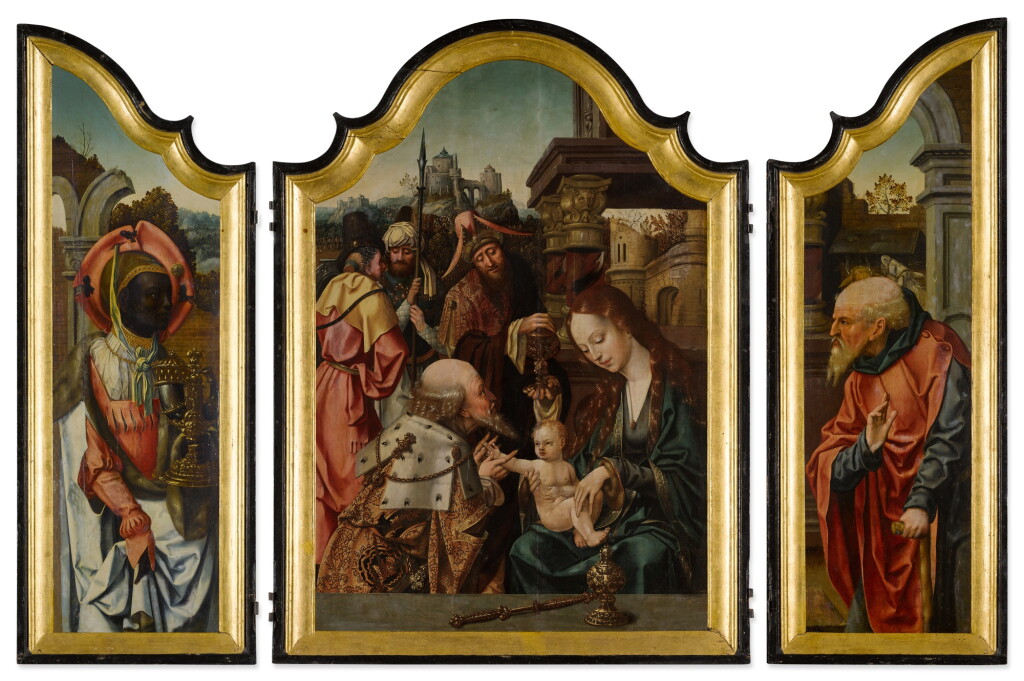
Adoration of the Magi
Auction Closed
January 27, 09:38 PM GMT
Estimate
100,000 - 150,000 USD
Lot Details
Description
Property from an Important Private Collection
The Master of 1518
Active in Antwerp in the early 16th Century
Adoration of the Magi
a triptych, oil on panel, with shaped tops, backed on the reverse in canvas
center panel: 40⅝ by 27¼ in.; 103.2 by 69.2 cm.
center panel framed: 46⅛ by 33½ in.; 117.2 by 85.1 cm.
left and right panels: 40⅝ by 11¾ in.; 103.2 by 29.8 cm.
left and right panels framed: 46 by 17 in.; 116.8 by 43.2 cm.
There acquired.
This large and impressive triptych is a characteristic work of the Master of 1518, an anonymous Mannerist artist active in Antwerp in the early 16th century. Friedländer was the first to identify this master as the author of an altarpiece depicting the Life of the Virgin in the Marienkirche, Lübeck, dated 1518 on the wings. Some scholars have identified the Master of 1518 as Jan van Dornicke, the father-in-law of Pieter Coecke van Aelst, although this identification is not universally accepted. What is certain is that the Master of 1518 freely blended both Italianate and traditional Northern themes, and the works secured to his hand are distinguished by a crisp focus, vivid coloration, a delicate technique, and animated figures. Together, these elements led to notably lively narratives, as visible in the present example.
The Adoration of the Magi was one of the favored subjects of the Antwerp Mannerists, for it allowed them to indulge in the depiction of rich costumes and elaborate architectural settings. Here, the artist has given himself over fully to the sumptuous vestments, the ornate gifts of the three kings, and the detailed backdrop. Caspar, the eldest of the three Magi, kneels before the Virgin and Child. He is garbed in rich furs and fabrics, adorned with jewels and delicate details. Beyond this figural grouping is Melchior, who wears a striking red hat and looks down upon the scene before him. Balthasar, garbed in white and red, appears on the left wing, while Saint Joseph appears on the right.
You May Also Like