Property from a Private Collection
Gerard van Kuijl
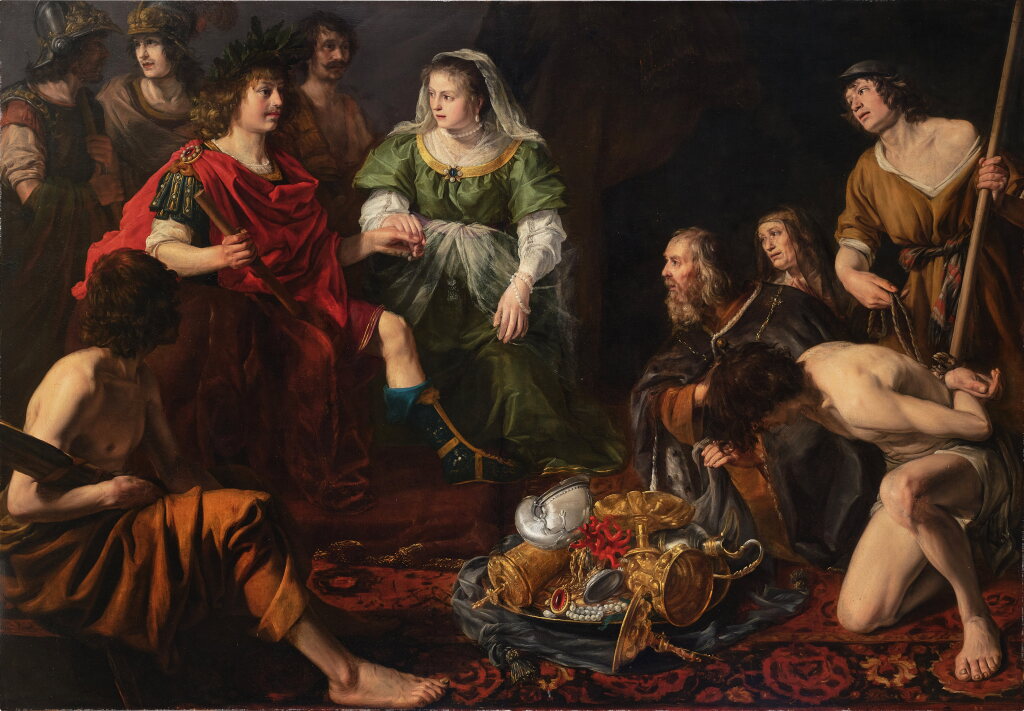
Continence of Scipio
Auction Closed
May 25, 07:43 PM GMT
Estimate
60,000 - 80,000 USD
Lot Details
Description
Property from a Private Collection
Gerard van Kuijl
Gorinchem 1604 - 1673
Continence of Scipio
signed with monogram lower left: GK F.
oil on canvas
canvas: 58 ½ by 83 ½ in.; 148.6 by 212.1 cm.
framed: 66 ¼ by 92 in.; 168.3 by 233.7 cm.
Anonymous sale, London, Christie's, 8 May 1913, lot 126, to Wagner;
Anonymous sale, Zurich, Koller, 9 November 1973, as Scipio's Grandmother, lot 2789;
Anonymous sale, Zurich, Koller, 8 November 1974, lot 2756;
Private collector;
Anonymous sale, New York, 31 January 2019, lot 252;
Where acquired by the present collector.
E.J. Sluijter, "Niet Gysbert van der Kuyl uit Gouda, maar Gerard van Kuijl uit Gorinchem (1604-1673): Een Identiteitsverwisseling sinds Houbraken," in Oud Holland 91, no. 3 (1977), pp. 169, 172-173, 194, cat. no. A2, reproduced fig. 3;
B. Nicolson, International Caravaggesque Movement: Lists of Pictures by Caravaggio and his Followers throughout Europe from 1590 to 1650, Oxford 1979, p. 63;
D. Kunzle, From Criminal to Courtier: The Soldier in Netherlandish Art, Leiden and Boston 2002, p. 569.
This large canvas illustrating the story of the Continence of Scipio probably dates to early in Gerard van Kuijl's career, and according to Sluijter likely was painted a few years after the artist's 1638 historical painting of the life of Sertorius (Townhall, Gorinchem).1
Gerard van Kuijl trained with Utrecht master Gerard van Honthorst and emulated his teacher’s classicizing history paintings. Indeed, the present composition is indebted to Honthorst’s 1624 Solon Before Croesus. 2 Van Kuijl’s figure of Scipio in the present painting also resembles a recurring facial type from Van Honthorst’s history paintings, one that appears to be based on the likeness of King Friedrich V of Bohemia, the so-called Winter King living in exile in the Hague.3
Livy's record of Scipio's magnanimous character was popular in Dutch golden age painting, poetry, and theater as a moralizing example. During Emperor Scipio Africanus’s siege of Carthage in 209 BC, he showed great magnanimity by freeing Celtiberian Prince Allucius and his fiancé and allowing them to marry. Although the woman’s parents offered Scipio their treasure as ransom, Scipio refused it and instead gave it back to the couple as wedding present, prompting Allucius to pledge his own tribe’s loyalty to the Romans. In the politically turbulent 17th century, images of Scipio like the present example were commissioned for town halls and court buildings to remind viewers to be benevolent leaders.
1. Sluijter 1977, pp. 167, 194, reproduced fig. 167.
2. Van Kuijl was a witness to Van Honthorst’s wife’s will in 1625. See F. Tissink & H.F. de Wit, Gorcumse schilders in de Gouden Eeuw, Gorinchem 1987, p. 26.
3. For example, Van Honthorst’s posthumous Portrait of Frederick V, signed and dated 1633. See J.R. Judson & R.E.O. Ekkart, Gerrit van Honthorst: 1592-1656, Doornspijk 1999, p. 260, no. 332, ill. 222.
You May Also Like