Gordon House
Toy Table
Lot Closed
March 14, 01:49 PM GMT
Estimate
800 - 1,200 GBP
Lot Details
Description
Gordon House
1932 - 2004
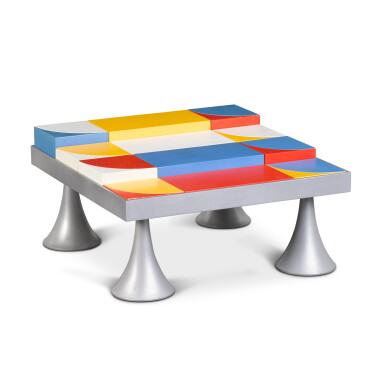
Toy Table
signed Gordon House and dated 1968 (on the underside of the table base)
paint on wood
39 by 76 by 76cm.; 15¼ by 30 by 30in.
Executed in 1968.
Sold together with a design for the present work and the original 1970s wooden crate.
(2)
Kasmin Gallery, London
Private Collection
London, Institute of Contemporary Art, Play Orbit, 28 November 1969 - 15 February 1970
The sculpture Toy Table was a prototype for an intended edition that was never produced. The drawing suggests how the lacquered and spray-painted wooden sculpture could be produced using plastic and metal.
Gordon House had achieved widespread acclaim as a leading artist of the Situation group of artists at the beginning of the 1960s, alongside Robyn Denny, Richard Smith, Bernard and Harold Cohen, Gillian Ayres and others. His hard-edged, geometric abstract paintings such as Double Green Dropped Initial 1968-9 (Arts Council Collection) adopt a minimal sign-like quality – for his first solo exhibition in 1959, the artist Richard Smith compared his paintings to road signs: ‘It is as if they had only a second to register, like signs on the new motorways’. Through the 60s House was also in the midst of a celebrated parallel career as a graphic designer – he made the Toy Table sculpture in the same year that he assisted Richard Hamilton in the design work for the double album The Beatles (more widely identified as The White Album). The year before, he had assisted Peter Blake in the production of Sergeant Pepper’s Lonely Hearts Club Band (1967) and he continued working on other projects for Apple and Paul McCartney (including the design of Wings’ first album), as well as working for public and commercial clients in the art world into the 1990s. Peter Blake has remarked that, ‘There are very few artists who are equally comfortable and talented at being both a painter and graphic designer and Gordon House was one such.’
You May Also Like