Sir John Lavery, R.A.
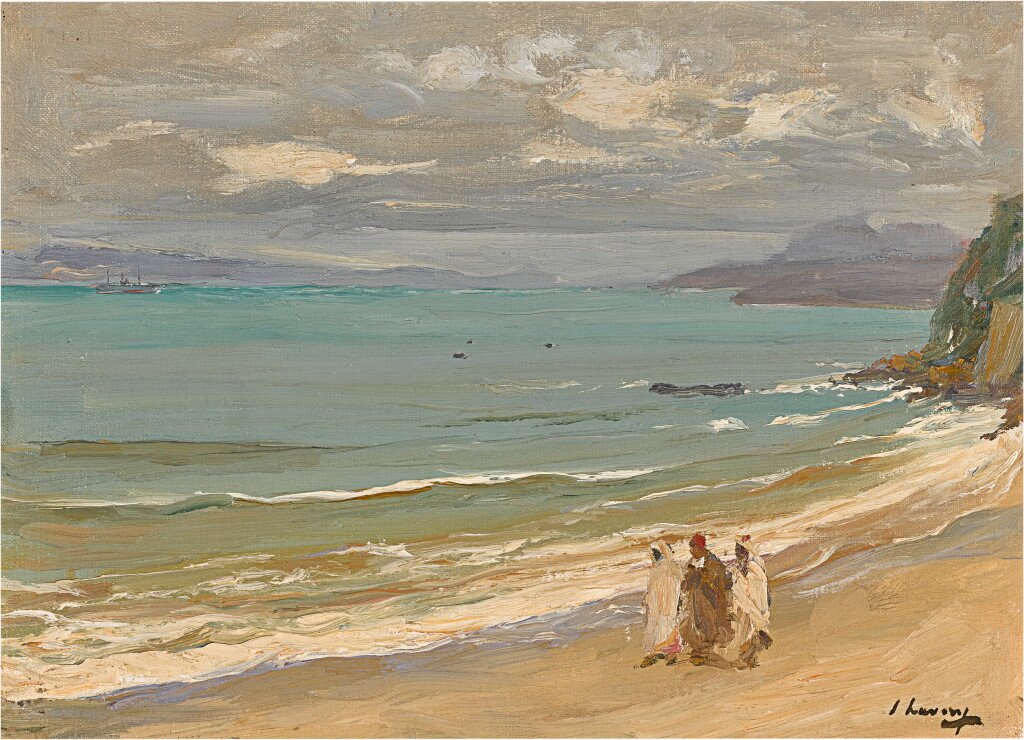
The Three Moors
Lot Closed
May 10, 01:13 PM GMT
Estimate
30,000 - 50,000 EUR
Lot Details
Description
Sir John Lavery, R.A., R.H.A., R.S.A.
1856 - 1941
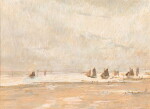
The Three Moors
signed J Lavery (lower right)
oil on canvasboard
unframed: 25.5 by 35cm.; 10 by 13¾in.
framed: 50.5 by 60cm.; 19¾ by 23½in.
Executed circa 1907.
__________________________________________________________________________
Sir John Lavery, R.A.,R.H.A., R.S.A.
1856 - 1941
The Three Moors
signé J Lavery (en bas à droit)
huile sur panneau toile
sans cadre: 25.5 by 35cm.; 10 by 13¾in.
avec cadre: 50.5 by 60cm.; 19¾ by 23½in.
Exécuté vers 1907.
The Goupil Gallery, London
Private Collection, circa 1980, thence by descent to the present owner
---------------------
Galerie Goupil, Londres
Collection privée, vers 1980, puis par descendance au propriétaire actuel
London, Goupil Gallery, John Lavery RSA, RHA, June - July 1908, no. 13
----------------------------
Londres, Galerie Goupil, John Lavery RSA, RHA, juin - juillet 1908, no. 13
Around forty of John Lavery’s recent works shown at the Goupil Gallery in 1908 were painted in Morocco – accounting for almost two-thirds of the exhibition. They inaugurate the second phase of his engagement with the city he had first come to know in 1891 and which would occupy such an important place in his overall production up until his final visit in 1921. Following the first four of these winter visits, and during ten years of career-building, memories of Tangier were kept alive by his good friend, the adventurer, RB Cunninghame Graham and in 1906, with the help of Times correspondent, Walter Harris, they plotted an expedition on horseback to Fez. At the same time the painter acquired a house as a winter studio on what was then known as Mount Washington, to the west of the Tangier Marshan. A short downhill walk took the painter to a small, secluded beach where the ‘Three Moors’ canvas-board was painted.
It was a scene with which, over the next fifteen years, Lavery would become very familiar. From here, on a clear day, the hills of Andalusia were visible and if, as in the present work, he looked in an easterly direction along the Straits of Gibraltar, he could see the peak of Jebel Musa, one of the so-called ‘Pillars of Hercules’ on the extreme right, beyond the headland in The Three Moors. These figures, the focal point of the composition, remind us that sandy shores around the city were thoroughfares, and although the artist’s beach was almost private – there being no settlements between here and Cap Spartel – there were occasional passers-by.
What is the significance of this little painting? Not only does it take the painter back to earlier trips when he painted the resplendent Tangier bay to the east of the Medina, but it also reminds him of paintings by Whistler and the Impressionists that he had much admired. Closely associated with the American painter in his role as Vice-President of the International Society of Sculptors, Painters and Gravers, from 1898 until 1903, Lavery would have seen the small delicate studies Whistler painted at Dieppe and Pourville in the last years of his life. Works such as Whistler’s The Shore, Pourville 1899 (Ashmolean Museum, University of Oxford), with its tiny figures strolling across the sand on a blustery day, are directly comparable to The Three Moors. The colours of North Africa may be shrill, but the handling – the delicacy of the figures – makes the comparison apposite.
Lavery returned to the subject and setting with single figures and couples on many occasions, frequently deploying members of his family in the forthcoming years. The rules were simple but the moment was always different and if one suddenly found a group of colorful wayfarers, in animated conversation, it was, as here, a splendid bonus.
Kenneth McConkey
You May Also Like