
Property from an Important New York Collection
Eugène Printz and Jean Dunand
Sideboard
Auction Closed
June 7, 06:14 PM GMT
Estimate
300,000 - 500,000 USD
Lot Details
Description
Property from an Important New York Collection
Eugène Printz and Jean Dunand
Sideboard
circa 1937
lacquered wood, patinated and oxidized brass
48½ x 83½ x 18 in. (123.2 x 212.1 x 45.7 cm)
Acquired from the above by the present owner, 1987
Félix Marcilhac, Jean Dunand: His Life and Works, London, 1991, p. 260, cat. no. 548 (for the present lot illustrated)
"I have always been moved by the mysterious beauty resulting from the conjugation of curves and straight lines." -Eugène Printz
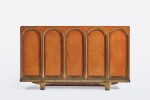
Resplendent in vermillion lacquer and bronze, the present sideboard from 1937 is a superlative example of Eugène Printz and Jean Dunand’s remarkable collaboration. With its five lacquered doors accentuated with bronze curvilinear details, this red and golden cabinet highlights the strengths of each of these artisans. Born in Paris in 1889 and raised in his father and uncle’s cabinet-making workshop, Printz cultivated an understanding of the craftsmanship that honored his family’s heritage. He carefully studied the traditional methods of cabinetry while simultaneously cultivating a taste for contemporary aesthetics. Upon establishing his own furniture atelier in the mid-1920s, Printz broke new ground by combining historic artisanry with a distinct stylistic language that is still celebrated a century later.
An insatiable appetite for modernity led Printz to experiment with exotic materials – palm wood, Brazilian rosewood, and lacquer veneers. Printz had discovered Jean Dunand’s silver vases with artfully inlaid silver in 1912, and would later call on him to decorate some of his works of furniture. Dunand, who had studied sculpture but gained recognition for his mastery of his dinanderie copperwork, later learned the art of lacquering metal from famed Japanese artisan Seizo Sugawara. The technically complex process of lacquering became synonymous with Art Deco elegance, as evidenced in the cabinet’s sumptuously lacquered façade that evokes a sense of modern luxury.
In the late 1930s Printz sought to further distinguish his oeuvre by imbuing his pieces of furniture with a contemporary dynamism. He used baroque forms, like the rounded arches on the façade of this cabinet, to suggest movement and vitality. There is a visual harmony between these curves and the clean lines of the structure of the piece, which serve as a reminder that Printz never swayed from the traditional methods of craftsmanship that were essential to his practice. Embodying the mysterious beauty Printz evokes in the above citation, this cabinet achieves a geometric equilibrium that makes it aesthetically appealing. With its vibrant crimson lacquer hue and sculptural lines, this cabinet is an exquisite example of the collaborative efforts of two masters of French Art Deco.
You May Also Like