Property of a Lady
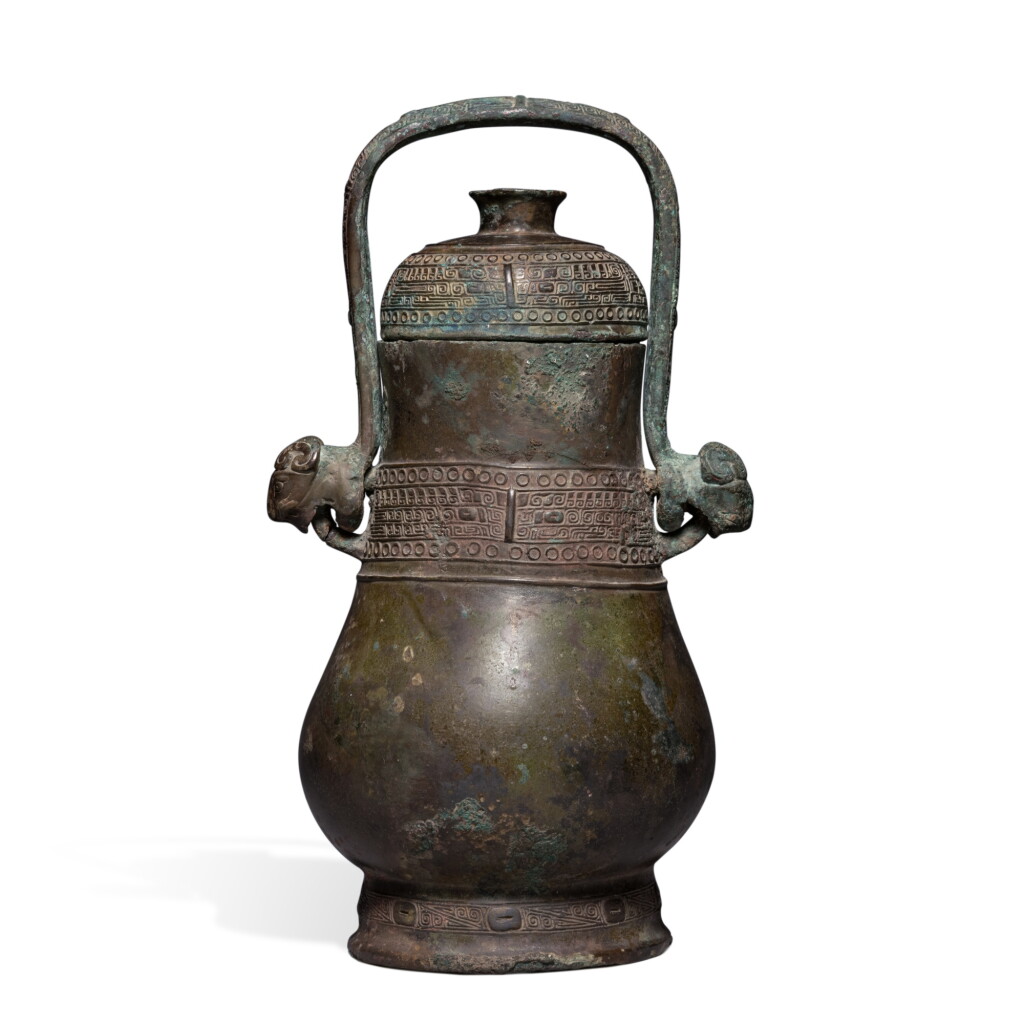
An archaic bronze ritual wine vessel and cover (Hu), Late Shang / early Western Zhou dynasty | 商末 / 西周初 青銅饕餮紋提梁壺
Auction Closed
March 22, 08:01 PM GMT
Estimate
50,000 - 60,000 USD
Lot Details
Description
An archaic bronze ritual wine vessel and cover (Hu)
Late Shang / early Western Zhou dynasty
商末 / 西周初 青銅饕餮紋提梁壺
(2)
Height 9 in., 23 cm
China House of Arts, New York, 1980s-early 1990s.
Offered at Sotheby's London, 12th November 2003, lot 107.
Ralph Chait Galleries, New York.
中國藝術館,紐約,1980年代至1990年代初
上拍於倫敦蘇富比2003年11月12日,編號107
Ralph Chait Galleries,紐約
Archaic ritual bronze vessels with a pear-shaped body tapering to a narrow neck and a swinging handle, such as the present lot, were often called you. However, in Yu Xingwu's Shuangjianyi guqiwu tulu [Catalogue of ancient objects from the Shuangjianyi], this type of vessel was identified as hu 壶. According to Pei Shuyan in Qingtong tilianghu yu you zhi jieding [Debates on the identification of Bronze Hu and You], Kaogu yu wenwu / Archaeology and Cultural Relics, Xi'an, 2013, pp 44-48, the difference between a hu and a you depends on the placement of the lip used to secure the cover and the vessel in place once closed. A hu has the lip set on the cover, allowing it to be inserted into the mouth of vessel, whereas a you has the lip positioned on the vessel, which will be enveloped by the cover upon closure.
Bronze hu functioned as wine containers in ritual settings during the Shang and Zhou dynasties. This has been supported by archaeological findings. Chen Peifen discussed in her book, Zhongguo qingtongqi cidian [The dictionary of Chinese archaic bronzes], vol. 1, Shanghai, 2013, pp 40-41, that liquid was detected in two fully sealed bronze hu discovered from a late Shang to early Western Zhou dynasty tomb in Qianzhangda, Tengzhou, Shandong province. In addition, two further hu were excavated from the tomb of King Cuo of Zhongshan in Pingshan, Hebei province. A scientific analysis of the liquid extracted from the vessels confirmed the presence of ethanol.
Bronze hu of this form and design are rare. See a closely related hu of the same size, from the Minneapolis Institute of Art, Minneapolis (accession no. 50.46.97a,b), formerly in the collection of Alfred F. Pillsbury, included in Wu Zhenfeng, Shang Zhou qingtong qi mingwen ji tuxiang jicheng [Compendium of important inscriptions and images of bronzes from the Shang and Zhou dynasties], vol. 21, Shanghai, 2012, no. 12075; and another of a slightly smaller size, formerly in the collection of Chen Chengqiu, recorded by an ink rubbing in Wang Xiantang, Guoshi jinshizhi gao [Manuscript of archaic bronze in Chinese history], vol. 1, Qingdao, 2004, p. 234.
You May Also Like