
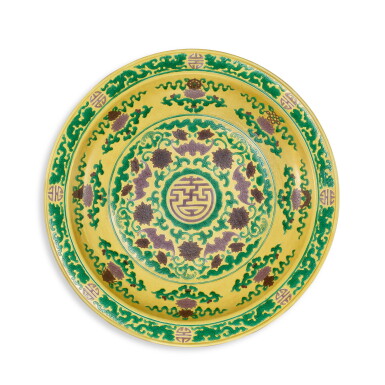
A rare yellow-ground, green and aubergine-enamelled 'auspicious emblems' charger, Mark and period of Yongzheng | 清雍正 黃地素三彩五福捧壽八吉祥紋大盤 《大清雍正年製》款
Premium Lot
Auction Closed
October 9, 09:17 AM GMT
Estimate
4,000,000 - 6,000,000 HKD
Lot Details
Description
A rare yellow-ground, green and aubergine-enamelled 'auspicious emblems' charger,
Mark and period of Yongzheng
清雍正 黃地素三彩五福捧壽八吉祥紋大盤 《大清雍正年製》款
40.6 cm
Collection of Edward H. Bennett (1874-1954), and thence by descent.
Sotheby's New York, 16th March 2016, lot 306 and cover.
Edward H. Bennett(1874-1954年)收藏,此後家族傳承
紐約蘇富比2016年3月16日,編號306及封面
Treasures of Hong Kong: The 20th Anniversary of Hong Kong's Handover, Capital Museum, Beijing, 2017, cat. no. 175.
《香江雅集:香港回歸祖國二十周年特展》,首都博物館,北京,2017年,編號175
An Abundance of Blessings in Three Colours
Regina Krahl
This exquisitely designed and executed, massive charger of the Yongzheng period (1723-35) is extremely rare and only one companion piece appears to be recorded, although the same pattern was recreated again in the Qianlong reign (1736-95) and some examples are also known from that period.
The highly attractive sancai (‘three colour’) glaze combination had been popular with Chinese potters ever since it was devised in the Tang dynasty (618-907), when it was used on low-fired earthenwares, often in accidentally splashed patterns, but already at that time also for more carefully designed decoration with incised outlines separating the colours. This technique, similar to an ink drawing coloured with different washes, was masterfully employed on the present dish.
In the Ming dynasty (1368-1644), when many different low-fired glazes began to be used on porcelains at the imperial kilns of Jingdezhen, yellow and green were often used together, but rarely in combination with brown or aubergine tones. In the Kangxi reign (1662-1722) of the Qing dynasty the imperial kilns revived splashed sancai wares and at the same time began to produce porcelains with incised designs in the sancai palette. While most common in this scheme were small dragon-decorated dishes, which remained popular throughout the Qing dynasty (1644-1911), the imperial kilns already created chargers of this large size, decorated with dragons and flower motifs. A dish of that design in Taiwan is included in Kokyū Shin shi zuroku/Illustrated Catalogue of Ch’ing Dynasty Porcelain in the Palace Museum, Republic of China, vol. 1, Tokyo, 1980-81, pl. 34; another in John Ayers, Far Eastern Ceramics in the Victoria and Albert Museum, London, 1980, no. 197; a pair of dishes of this type from the collection of Captain C. Oswald Liddell, formed during his residence in China between 1877 and 1913, was sold in our New York rooms, 4th December 1985, lot 281, and again in these rooms, 18th May 1988, lots 301 and 302; another from the Morgenroth collection was sold in our New York rooms, 17th March 2009, lot 117. This Kangxi design became popular again in the Guangxu period, when it was recreated on even larger dishes with chu xiu gong mark, see the dish from the Weishaupt collection sold in these rooms, 8th October 2009, lot 1621.
The present design appears to have been devised in the Yongzheng reign. It is remarkable not only for the different tones of aubergine to brown judiciously employed in the decoration, but also for the use of these colors to reproduce the variegated skin of Chinese peaches, that can be seen on the outside. While only one other dish of this design, of Yongzheng mark and period, appears to be recorded, at least four dishes of Qianlong mark and period have been published. Although the Qianlong design follows the Yongzheng model very closely, details of the incised pattern have been simplified overall.
The design is also replete with auspicious meanings. The shou character which appears in the centre was a frequently used motif expressing the desire for longevity. Dishes with shou characters as the main decoration were made for the emperor’s birthday and special occasions where the theme was longevity, such as the 'Greybeard's Banquet' qiansou yan. Bats were also used as symbols for ‘good fortune’ and five bats were especially auspicious, representing the five blessings of long life, riches, good health, love of virtue and natural death. In the present lot, the five bats encircle the shou character in a popular motif known as 'Five Bats Present Longevity' wu fu peng shou. The 'Eight Buddhist Auspicious Emblems', bajixiang , were originally used in ancient India in religious ceremonies and at occasions such as the enthronement of kings. They represent the offerings presented to Shakyamuni by the gods upon his enlightenment, and entered China around the time of the Yuan dynasty, where they became symbols of good fortune.
Compare the Qianlong dish of this design in the Baur Collection, Geneva, illustrated in John Ayers, The Baur Collection Geneva: Chinese Ceramics, vol. 4, Geneva, 1968-74, no. A 545; and three other Qianlong dishes sold at auction, one in our New York rooms 28th September 1979, lot 313; another, reputedly from the collection of the Idemitsu Museum of Arts, Tokyo, sold in these rooms, 6th December 1989, lot 217, at Christie’s Hong Kong, 29th April 2001, lot 543, and in these rooms, 8th April 2013, lot 3043; and a third sold at Christie’s Hong Kong, 25th October 1993, lot 824, and in these rooms, 23rd October 2005, lot 209. A similar Yongzheng dish was sold at Bonhams London, 8th June 2004, lot 119.
三色花開千般瑞
康蕊君
細觀本品,華美瑰麗,造工精巧,製於雍正一朝,極其罕見,現僅知記載一相類例。同者乾隆年間亦有燒造,存世有數。
自唐代起,三彩廣為瓷匠採用。時初創三彩,以陶為胎,釉斑為飾,隨意清灑。亦有精細者,刻劃輪廓分色,頗類繪畫勾勒填彩,如見本盤,技法高超,巧奪天工,實為上作。
明代之時,景德鎮官窰始用低溫釉,多用黃綠兩彩於一器,而並用褐、紫彩者較少。康熙年間,宮廷御窰復燒三彩瓷,同時燒製黃地紫綠彩劃花器。後者多為龍紋小盤,流行於清代各時期。康熙御窰亦有燒製如本品大小之龍紋盤,一例現藏台灣,載《故宮清瓷圖錄·康熙窯 雍正窯》,東京,1980-81年,圖版34;另一例載於 John Ayers,《Far Eastern Ceramics in the Victoria and Albert Museum》,倫敦,1980年,編號197;另可參考一對盤例,出自 Captain C. Oswald Liddell 收藏,其收藏集成於 Liddell 1877至1913年旅華之時,曾售紐約蘇富比1985年12月4日,編號281,繼售香港蘇富比1988年5月18日,編號301及302;另一例出自 Morgenroth 收藏,售紐約蘇富比2009年3月17日,編號117。至光緒年間,康熙紋樣又復流行,唯尺寸更大,帶儲秀宮款,參考 Weishaupt 收藏一例,售香港蘇富比2009年10月8日,編號1621。
本盤紋飾,應始創雍正一朝,紫、褐彩用於盤身紋飾,精細嚴謹,更巧用兩彩描繪盤外壽桃顏色自然變化,彰顯匠者臻藝。據記錄,同紋飾之雍正款作例僅知有一,乾隆例者則至少有四。乾隆作例雖與雍正甚為接近,整體紋飾劃花卻趨於簡化。
本品紋飾,寓意吉祥。盤心壽字,時有所見。古帝王壽辰、千叟宴等慶壽場合均用壽盤,以祝吉興。靈蝠紋飾,意寓多福,五蝠者,表壽長、富貴、康寧、好德、考終,命之五福,齊臨賀祝。見本盤,五蝠環一壽字,合曰「五福捧壽」,更顯祥瑞。八吉祥者,源自古印度宗教儀式,亦有用於帝皇登基大典,代表釋迦牟尼得道之時,眾神呈獻之寶,後於元朝傳入中原,成為吉祥象徵。
日內瓦鮑爾典藏一乾隆例,圖錄於 John Ayers,《The Baur Collection Geneva: Chinese Ceramics》,卷4,日內瓦,1968-74年,編號A545;此外尚可參考三件乾隆例,均售拍場,其一於紐約蘇富比1979年9月28日,編號313;另一例傳為東京出光美術館舊藏,售於紐約蘇富比1989年12月6日,編號217,後於香港佳士得2001年4月29日易手, 編號543,2013年4月8日再售於香港蘇富比,編號3043;第三例售於香港佳士得1993年10月25日,編號824,後易手於香港蘇富比2005年10月23日,編號209。倫敦邦瀚斯2004年6月8日曾售一雍正年相類盤例,編號119。