Zi Zhen Tang Collection of Ming dynasty huanghuali furniture | 紫貞堂珍藏明式黃花梨傢具
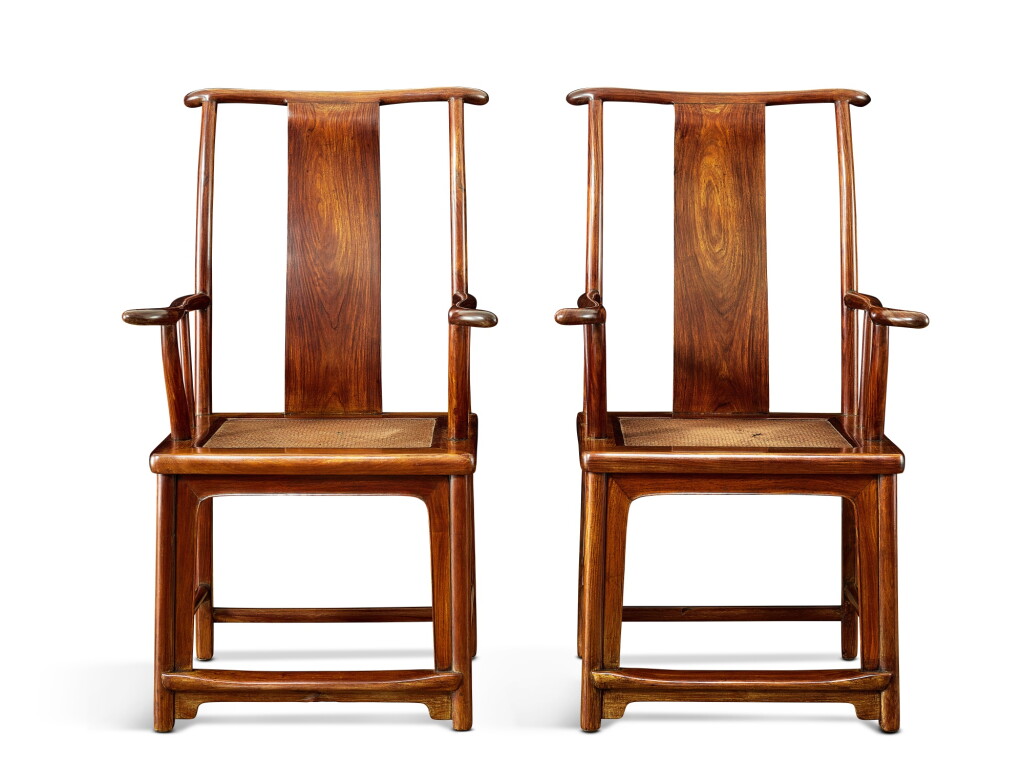
A rare pair of huanghuali yokeback armchairs, guanmaoyi, Ming dynasty, 17th century | 明十七世紀 黃花梨四出頭官帽椅一對
Premium Lot
Auction Closed
October 9, 09:17 AM GMT
Estimate
5,000,000 - 7,000,000 HKD
Lot Details
Description
Zi Zhen Tang Collection of Ming dynasty huanghuali furniture
A rare pair of huanghuali yokeback armchairs, guanmaoyi,
Ming dynasty, 17th century
紫貞堂珍藏明式黃花梨傢具
明十七世紀 黃花梨四出頭官帽椅一對
60 by 56.5 by h. 105.5 cm
C.L. Ma Antiques, Hong Kong, 1987.
《金瓶梅》,第7回,插圖
Yokeback armchairs are a classic type of Ming chairs. Their design, characterised by generous space between the back posts and splat and widely spaced, half-aproned seat stiles, conveys a sense of lightness, balance and sturdiness. Except for a banded edge on the seat frame and flat-banded edge on the aprons underneath the seat, this pair of chairs is completely plain. Consequently, its statuesque proportions are emphasised. The timber chosen for the back splats displays whorl patterns, showing huanghuali wood at its best.
Paintings and woodblock prints provide visual evidence suggesting that tall yokeback armchairs were used by officials, monks, family elders and other higher-ranking members of the society; see, for example, a group of yokeback armchairs depicted in a scene from the late Ming dynasty novel Jin ping mei (Plum in a golden vase), where Ximen Qing, the main character, is introduced to Meng Yulou, a widow of a wealthy textile merchant, by the matchmaker Auntie Xue, with the intention of taking her as his Third Lady in a reception hall. See Sarah Handler, Ming Furniture in the Light of Chinese Architecture, Berkeley, 2015, p. 50.
Compare a pair of similar armchairs with shaped aprons, illustrated in Robert D. Jacobsen and Nicholas Grindley, Classical Chinese Furniture in the Minneapolis Institute of Arts, Minneapolis, 1999, pl. 8, pp. 50-51; a closely related chair, with a slightly arc-shaped apron, illustrated in Wang Shixiang, Classic Chinese Furniture, London, 1986, pl. 45, p. 86. Compare also two related examples with carved aprons, one illustrated in Robert Hatfield Ellsworth, Chinese Hardwood Furniture in Hawaiian Collections, Honolulu, 1982, pl. 9, p. 43; the other is illustrated in Sarah Handler, Austere Luminosity of Chinese Classical Furniture, Berkeley, 2001, fig. 4.13, p. 53; and another pair, sold in these rooms, 7th October 2015, lot 111.
此對官帽椅通體光素無文飾,黃花梨紋理自然天成。造型簡練明快,其中獨特細緻的設計,更顯古代匠人的審美及智慧。
本品最妙之處在椅子的靠背部分,符合人體工學的設計巧妙嚴謹,用料講究。搭腦與後腿以煙斗榫結合,搭腦中稍寬形成靠枕,兩端微微向後翹起,如一雙翅膀;靠背略向後彎曲,線條獨特順暢,背板至搭腦靠枕下巧妙的小彎,讓人體靠於枕處後頸得以支撐。匠心可鑑。
官帽椅乃明式傢具經典制式,靠背與立柱間隔寬綽,造型平穩,座面上作邊抹、下安券口牙子,構造英挺秀拔。此對官帽椅通體光素無紋,尤顯靠背板擇料精良,帶黃花梨天然木紋,屬明式傢具之典範。官帽椅為要員、高僧、家族長者及聲名顯赫之人專用,繪畫及木板印本多有佐證;明末小說《金瓶梅》中可尋一組官帽椅,插繪場景為西門慶經薛嫂兒撮合初識布商遺孀孟玉樓,圖見韓蕙,《Ming Furniture in the Light of Chinese Architecture》,柏克萊,2015年, 頁50。
可比一對官帽椅,牙條作紋飾,錄卓儒博、Nicholas Grindley,《Classical Chinese Furniture in the Minneapolis Institute of Arts》,明尼亞波利斯,1999年,圖版8,頁50-51;另一官帽椅與此對頗似,券口牙子略呈弧圓,錄王世襄,《明式傢具珍赏》,倫敦,1986年,圖版45,頁86。再比兩例,牙條雕花,其一錄安思遠,《Chinese Hardwood Furniture in Hawaiian Collection》,檀香山,1982年,圖版9,頁43;其二錄韓蕙,《Austere Luminosity of Chinese Classical Furniture》,柏克萊,2001年,圖4.13,頁53。仍比一對,售於香港蘇富比2015年10月7日,編號111。
You May Also Like