
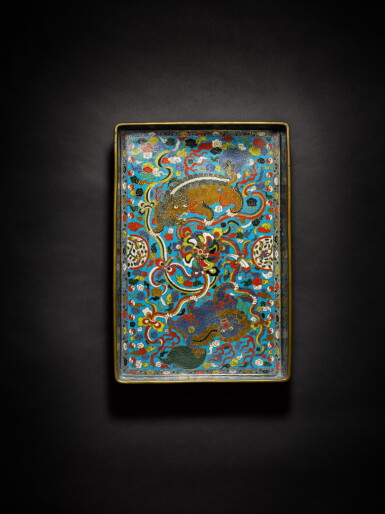
Property from the Collection of Dr Kenneth Lawley (1937-2023) | Kenneth Lawley(1937-2023年)博士收藏
A very rare large cloisonné enamel 'Buddhist lion' rectangular tray, Ming dynasty, Wanli period | 明萬曆 掐絲琺瑯瑞獅紋長方盤 《景泰年製》仿款
Auction Closed
November 1, 04:48 PM GMT
Estimate
20,000 - 30,000 GBP
Lot Details
Description
Property from the Collection of Dr Kenneth Lawley (1937-2023)
Kenneth Lawley(1937-2023年)博士收藏
A very rare large cloisonné enamel 'Buddhist lion' rectangular tray
Ming dynasty, Wanli period
明萬曆 掐絲琺瑯瑞獅紋長方盤 《景泰年製》仿款
the side with an apocryphal Jingtai four-character mark
Length 47.8 cm, 18 7/8 in.
Collection of Mrs Harry Mitchell.
Christie's London, 25th November 1974, lot 136.
Hugh M. Moss, London.
Ben Janssens Oriental Art, London, 29th March 2001.
Harry Mitchell 女士收藏
倫敦佳士得1974年11月25日,編號136
莫士撝,倫敦
Ben Janssens Oriental Art,倫敦,2001年3月29日
Buddhist lions playing with beribboned balls were a popular motif of the Ming dynasty (1368-1644) in various media and the vibrant colouration and vigorous representation of the animals here are characteristic of the period's imperial cloisonné of the Wanli period (1573-1620). In Buddhism, lions are considered as protectors of the doctrine, embodying both power and authority through their fierce and majestic appearance. Lions are not native to China, but in the early Ming period real lions were repeatedly presented to the court as gifts by foreign embassies and subsequently appeared in the decorative repertoire of various imperial workshops; see, for example, a blue and white jar attributed to Xuande period, adorned with Buddhist lions playing with a ball, sold in our Hong Kong rooms, 3rd October 2021, lot 3635; and a Tibetan Buddhist vase a design of four playing lions, preserved in the Palace Museum, Beijing and attributed to mid-Ming period, illustrated in Gugong Bowuyuan cangpin daxi. Falangqi bian / Compendium of Collections in the Palace Museum. Cloisonné, vol. 1, Beijing, 2011, pl. 68.
Compare two cloisonné trays decorated with similar motifs, but of narrower shape, one sold in our London rooms, 24th February 1970, lot 32, the other, in the Pierre Uldry Collection, exhibited in Chinesisches Cloisonné Die Sammlung Pierre Uldry, Rietberg Museum, Zurich, 1985, cat. no. 85. See also a large tray which was believed to have been used for playing the double-six game, decorated with a group of Buddhist lions chasing a beribboned ball, preserved in the Palace Museum, Beijing, attributed to the early Ming dynasty, illustrated in op. cit, pl. 52.