
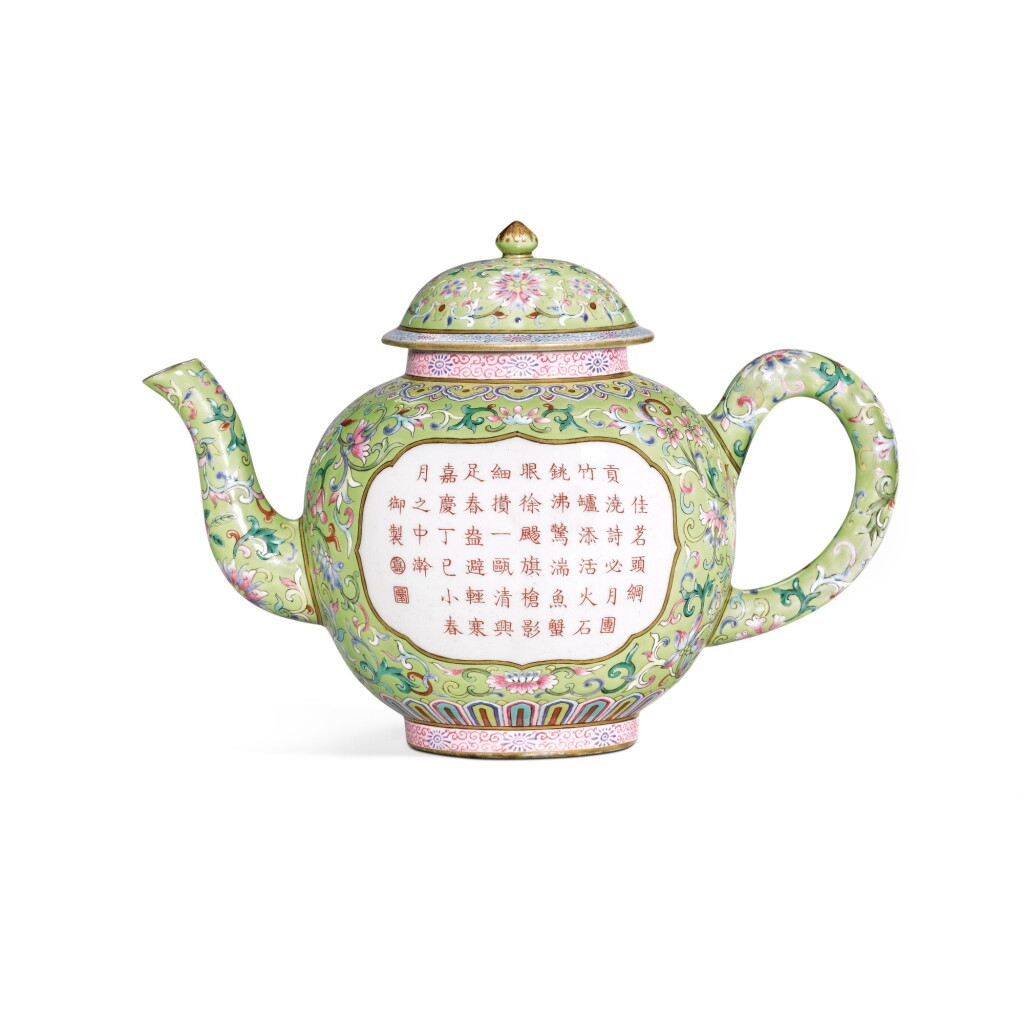
A rare lime green-ground famille-rose and gilt-decorated teapot and cover, Seal mark and period of Jiaqing | 清嘉慶 淺綠地粉彩描金開光御製詩茶壺 《嘉慶丁已小春月之中澣》 「嘉」「慶」印 《大清嘉慶年製》款
Auction Closed
November 1, 04:48 PM GMT
Estimate
80,000 - 120,000 GBP
Lot Details
Description
A rare lime green-ground famille-rose and gilt-decorated teapot and cover
Seal mark and period of Jiaqing
清嘉慶 淺綠地粉彩描金開光御製詩茶壺 《嘉慶丁已小春月之中澣》
「嘉」「慶」印
《大清嘉慶年製》款
the base with a six-character seal mark in iron red
(2)
Width 20.5 cm, 8⅛ in.
Sotheby's London, 6th December 1994, lot 212.
倫敦蘇富比1994年12月6日,編號212
This brilliantly enamelled teapot illustrates the continued influence of the Qianlong Emperor (r. 1736-1795) at court after his abdication in 1796 and even after his death in 1799. Its form, meticulously painted decoration and composition follows the ornate style developed at the imperial kilns in Jingdezhen that catered to the Qianlong’s taste of the ornate. The poetic inscription was also composed by the then retired Qianlong Emperor on the 10th lunar month of 1797. Titled ‘Brewing Tea’, the poem is collected in the First Anthology of Imperial Poetry, has been translated by S.W. Bushell as follows:
Finest tribute tea of the first picking
And a bright full moon prompt a line of verse
A lively fire glows in the bamboo stove,
The water is boiling in the stone griddle,
small bubbles rise like ears of fish or crab.
Of rare Ch’i-Ch’iang tea, rolled in tiny balls,
one cup is enough to lighten the heard,
And dissipate the early winter chill.
(S.W. Bushell, Oriental Ceramic Art, London, 1981, p. 239).
Approaching the 60th year of the reign, in an act of filial piety towards his grandfather, the Kangxi Emperor (r. 1662-1722), who had reigned 61 years, Qianlong abdicated the throne to his fifteenth son, Prince Aisin Gioro Yongyan, who became the Jiaqing Emperor. Prior to the abdication, the court began to plan the transfer of imperial power and in 1796 Qianlong adopted the title Taishang Huang (Emperor Emeritus). However, instead of moving to his newly-built retirement compound, Ningshougong, Qianlong remained in his old quarters, from where he actively administered the empire. The Jiaqing Emperor, who had a vastly different personality to that of his father, gained control over state affairs only after the death of Qianlong in 1799. A highly-educated and talented poet, Jiaqing was exemplary in his moral rectitude. He sought to administer his reign according to Confucian philosophy, and therefore advocated for diligence and frugality and filial piety.
The art of tea drinking represented a shared passion for the Qianlong and Jiaqing Emperors, as attested by the numerous poems they both composed on the subject. The imperial kilns at Jingdezhen produced significant amounts of teawares for the court, including teapots, cups and covered bowls, as well as trays. While the year after the death of Qianlong, the Jiaqing Emperor decreed that porcelain teawares should no longer be inscribed with poems composed by his father, the large quantity of extant examples suggests that they continued to be produced. An entry in the court archives from the 10th year of the reign, lists the order of five pairs of famille-rose teapots, with imperial poems in iron red, most likely this type, that were to be presented at court and sent to the Yuanmingyuan (Garden of Perfect Brightness).
Teapots of this form and covered in this brilliant lime-green glaze are rare, and only two closely related examples are known: a teapot in the National Palace Museum, Taipei, included in the Museum’s exhibition The Far-Reaching Fragrance of Tea. The Art and Culture of Tea in Asia, Taipei, 2015, cat. no. I-71, with its inscribed tray, cat. no. I-72. These teapots would have been used together with a tray and a cups or covered bowls. See for example the lime green-ground tray inscribed with this poem in the National Palace Museum, Taipei, included ibid., cat. no. I-72; and a pair of green-ground covered bowls, sold in our Hong Kong rooms, 8th April 2014, lot 3049.
The form and design of this teapot was replicated in other colour ground and in blue and white: a yellow-ground example is published in Geng Baocheng, Selection of Plates of Porcelain Wares collected by Jin Ming, 1994, p. 210; and a blue and white teapot in the National Palace Museum, Taipei, included in the Museum’s exhibition Lord Jiaqing and the Journey to Taiwan: A Cultural Exhibition of the Cultural Artefacts of the Qing Emperor Renzong, Taipei, 2016, cat. no. III-37.
《煮茗》
佳茗頭綱貢 澆詩必月團
竹爐添活火 石銚沸驚湍
魚蟹眼徐揚 旗槍影細攢
一甌清興足 春盎避清寒
1796年,乾隆帝登位六十年,為尊其祖父康熙帝在位六十一年而退位,乾隆十五子、愛新覺羅顒琰登位為嘉慶帝,乾隆則任太上皇。乾隆雖然退位,卻繼續掌管朝政,直至1799年駕崩後,嘉慶帝始親理政務。嘉慶博學多聞,擅寫詩文,品德正直,性情與乾隆帝頗有不同。嘉慶帝在位期間,主張以儒家思想治國,倡勤奮、節儉、孝義等。
乾隆與嘉慶帝皆愛品茶,從二人寫作之詩文可知。景德鎮御窰製作大量宮廷茶具,如壺、盃、蓋盌及托盤等。乾隆崩逝一年後,嘉慶下令,瓷製茶具不應題乾隆御製詩,唯其製作仍然繼續。嘉慶十年(1805年)之宮廷檔案記載,五對粉彩茶壺題礬紅御製詩,呈交朝廷後送往圓明園。記錄未提及詩文內容,相信與本品所提御製詩相應。
與本品器型及釉色相近之茶壺甚為罕見,據現知僅兩例可比,台北故宮博物院收藏一例,曾展於 《芳茗遠播: 亞洲茶文化》,台北,2015年,編號 I-71。此類茶壺相信出自成套連托盤及盃或蓋盌,參考一托盤例,題詩於本品相同,現藏於台北故宮博物院,出處同上,編號I-72;另比一對綠地蓋盌,曾售於倫敦蘇富比2010年11月10日,編號297,後易手於售於香港蘇富比2014年4月8日,編號3049。
相近器型及紋飾之茶壺,亦見於其他地色以及青花作例, 一黃地例見於耿寶昌,《金明集瓷選錄》,1994年,頁210;台北故宮博物院收藏一青花例,曾展於《嘉慶君遊台灣: 清仁宗文物特展》;台北,2016年,編號III-37。