
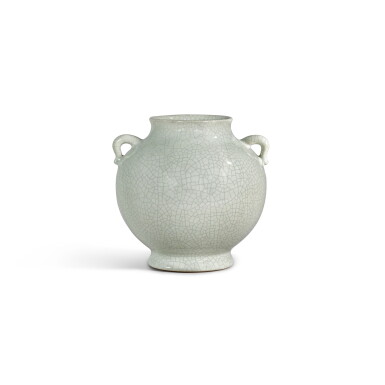
Imperial Porcelain – A Private Collection | 雅静清靈:私人御瓷珍藏
A rare Ge-type handled jar, Seal mark and period of Qianlong | 清乾隆 仿哥釉雙耳罐 《大清乾隆年製》款
Auction Closed
November 1, 04:48 PM GMT
Estimate
50,000 - 70,000 GBP
Lot Details
Description
A rare Ge-type handled jar
Seal mark and period of Qianlong
清乾隆 仿哥釉雙耳罐 《大清乾隆年製》款
the base with a six-character seal mark in underglaze blue
Width 22 cm, 8⅝ in.
This vase is notable in its combination of a form inspired by archaic bronzes, with a highly tactile glaze suffused with a fine network of crackles. The latter clearly references the celebrated guan wares of the Song dynasty (960-1279), which the Yongzheng (r. 1723-1735) and Qianlong (r. 1736-1795) Emperors particularly admired.
While the ravishing crackled glazes of the Song period enjoyed an unbroken history of appreciation through the Ming (1368-1644) and Qing dynasties, reproduction of these glazes reached a peak in the 18th century. Both the Yongzheng and Qianlong Emperors' passion for these classic wares and technological advances at the imperial kilns in Jingdezhen, allowed craftsmen to successfully reproduce these glazes in relatively large quantities. The fine pattern of crackles was purposefully made by carefully calibrating the cooling temperature in the kiln, which would produce two different layers of fissures that were later stained. The technical proficiency of the craftsmen that made this vessel is further evidenced by their ability to recreate both the unctuous crackled glaze and the dark brown foot, here stained dark brown.
Vases of this form are more commonly known covered overall in a flambé glaze; see for example a Yongzheng mark and period vase with mask handles sold in these rooms, 20th May 1980, lot 125, and another sold in our London rooms, 17th December 1996, lot 126. The form of this piece appears to have been inspired by archaic bronze covered jars, known as fou, which were made in the Eastern Zhou dynasty (770-256 BC). See for example a fou unearthed from Liulige, Huixian, Henan province, and illustrated in Jenny So, Eastern Zhou Ritual Bronzes from the Arthur M. Sackler Collections, Washington D.C., 1995, fig. 34.2.