
Property from the Wou Lien-pai Museum | 吳蓮伯博物院收藏
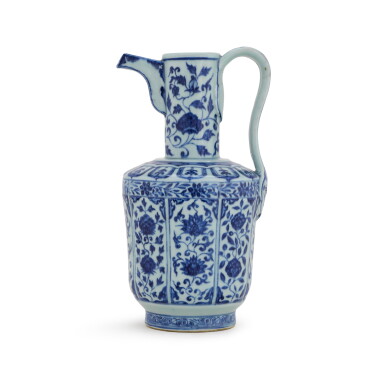
A rare blue and white ewer, Ming dynasty, Yongle / Xuande period | 明永樂 / 宣德 青花纏枝花卉紋執壺
No reserve
Auction Closed
November 1, 04:48 PM GMT
Estimate
40,000 - 60,000 GBP
Lot Details
Description
A rare blue and white ewer
Ming dynasty, Yongle / Xuande period
明永樂 / 宣德 青花纏枝花卉紋執壺
Height 35.8 cm, 14⅛ in.
Collection of Dr Wou Kiuan (1910-1997).
Wou Lien-Pai Museum, coll. no. Q.8.31.
吳權博士 (1910-1997) 收藏
吳蓮伯博物院,編號Q.8.31
China Without Dragons: Rare Pieces from Oriental Ceramic Society Members, The Oriental Ceramic Society, London, 2016, cat. no. 160.
《龍隱:東方陶瓷學會會員稀珍藏品展》,東方陶瓷學會,倫敦,2016年,編號160
Rose Kerr et al., Chinese Antiquities from the Wou Kiuan Collection. Wou Lien-Pai Museum, Hong Kong, 2011, pl. 136.
柯玫瑰等,《Chinese Antiquities from the Wou Kiuan Collection. Wou Lien-Pai Museum》,香港,2011年,圖版
The present piece is an outstanding blue and white example of early Ming porcelain adopting the form and design from Islamic metal works. The form of this ewer is based on Persian metal prototypes, see, for example, three related inlaid brass examples illustrated in Assadullah Souren Melikian-Chirvani, Islamic Metalwork from the Iranian World. 8th – 18th Centuries, London, 1982, nos 45, 75 and 45a.
During the Yongle and Xuande periods, outward-looking policies were introduced, resulting in a high volume of commercial and diplomatic contacts as well as exchanges of goods. This interaction stimulated a desire to incorporate new foreign shapes and designs in blue and white porcelain. Such exotic artefacts were in favour both at the Ming court and at courts of the Middle East.
Two similar examples from the imperial collection, attributed to Early Ming dynasty, are in the Palace Museum, Beijing, illustrated in Zhongguo taoci quanji [Complete series on Chinese ceramics], Shanghai, 2000, vol. 12, pl. 54; and in the National Palace Museum, Taipei, included in the exhibition Mingdai chunian ciqi tezhan mulu / Catalogue of a Special Exhibition of Early Ming Period Porcelain, Taipei, 1982, cat. no. 11.
Closely related examples were also kept in royal collections of the Islamic world, for example, in the Safavid collection preserved in the Ardabil Shrine, now in the Cehel Sotun, Isfahan, illustrated in John Alexander Pope, Chinese Porcelains from the Ardebil Shrine, Washington, D.C., 1956, pl. 54 bottom right; and in the Ottoman collection, kept in Topkapi Palace, Istanbul, illustrated in Regina Krahl, Chinese Ceramics in the Topkapi Saray Collection, London, 1986, vol. 2, no. 622; another ewer of related form, in the Museum Pusat, Jakarta, is illustrated in Oriental Ceramics. The World’s Great Collections, vol. 3, Tokyo, 1982, pl. 166.
Compare also three examples sold at auction, one from the collections of Wu Lai-hsi and Mrs. Seligman, sold twice in these rooms, 26th May 1937, lot 54 and 23rd January 1947, lot 58; another, from the collection of Herman Lindberg, Stockholm, sold twice in our Hong Kong rooms, 28th November 1978, lot 56, and 20th May 1986, lot 12; and the third, sold in our Hong Kong rooms, 7th May 2002, lot 564.