
Property from an Asian Private Collection | 亞洲私人收藏
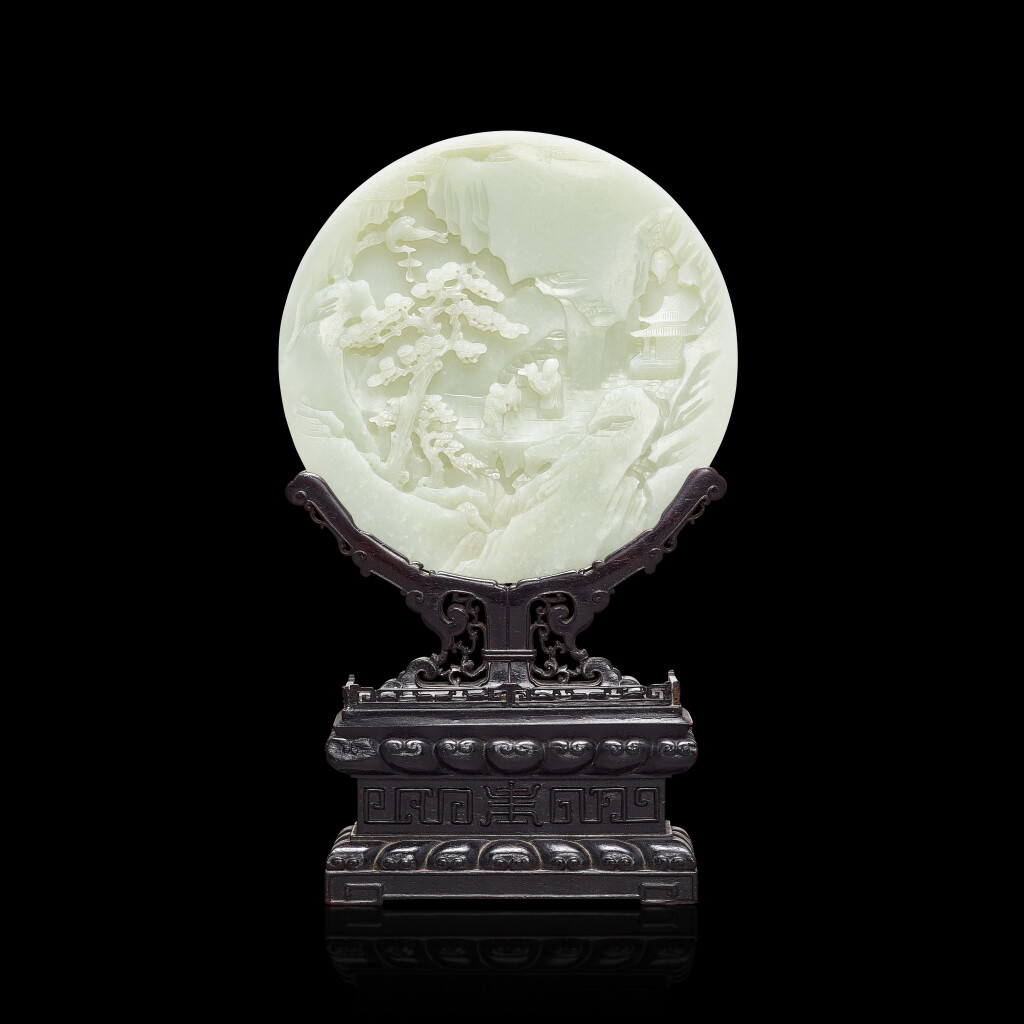
A finely carved imperial white jade 'figural' table screen, Qing dynasty, Qianlong period | 清乾隆 御製白玉雕松鶴祝壽圖圓硯屏
Auction Closed
November 1, 04:48 PM GMT
Estimate
150,000 - 200,000 GBP
Lot Details
Description
Property from an Asian Private Collection
亞洲私人收藏
A finely carved imperial white jade 'figural' table screen
Qing dynasty, Qianlong period
清乾隆 御製白玉雕松鶴祝壽圖圓硯屏
wood stand
Overall height 35.4 cm, 13⅞ in.
Collection of Aisin Gioro Puwei (1880-1936), Prince Gong.
Yamanaka & Co., New York.
American Art Galleries, New York, 27th February 1913, lot 120.
Nagatani, Chicago.
Milwaukee Art Museum, Milwaukee.
Christie's New York, 22nd March 1999, lot 30.
恭親王愛新覺羅溥偉(1880-1936)收藏
山中商會,紐約
American Art Galleries,紐約,1913年2月27日,編號120
Nagatani,芝加哥
密爾沃基美術博物館,密爾沃基
紐約佳士得1999年3月22日,編號30
Notable for its large size and intricately carved scene of two figures in a landscape, this circular screen exemplifies the 'pictorial jades', where the imperial jade carvers treated the stone like a painting canvas. Crafted from carefully chosen white jade, the screen's material enhanced the varying depth of the carved pictorial scene, showcasing the masterful artistry and attention to detail that went into its creation. The carvers' careful employment of varying depths and the associated difference in levels of light passing through the translucent stone, created here a strong sense of three-dimensionality that could not be achieved with a flat painting. By appreciating screens like this, viewers could be transported into a tranquil and harmonious landscape, escaping the daily duties of officialdom.
The screen depicts an auspicious scene of an elderly person holding a peach, accompanied by his young attendant who is presenting a gift, both under a group of pine trees, against a rocky landscape with a crane holding a qing (musical stone) in the sky, and a pavilion in the distance. The pine tree, peach, and crane are symbols of longevity, aligning harmoniously with the qing which is a homophone for 'celebration' in Chinese. Together, these elements make this piece a perfect birthday gift.
The piece is notable for its provenance. It originally belonged to Puwei (1880–1936), Prince Kung (Gong) of the First Rank, who was the grandson of Yixin (1833–1898), the first Prince Kung and the sixth son of the Daoguang Emperor. In the turbulent times that followed the demise of the Qing dynasty, Puwei, who was facing serious economic difficulties, sought refuge in the German protectorate and offered his mansion and belongings as mortgage to the Catholic Benedictine Order. However, it was Yamanaka Sadajiro (1865-1935), the renowned Japanese antique dealer, who had opened a store on West 27th Street near Broadway in New York, who acquired the collection and in 1913 offered it for sale at the American Art Association, where it was sold on 27th February as lot 120.
Compare a table screen with similar carving, but of spinach jade, illustrated in Yubao qiulin. Qinggong jiucang yuqi / Treasure of Imperial Jade. The Collection of the Qing court Special Exhibition, Beijing, 2018, pl. 65. Compare also several related screens, all depicting figures in landscapes, one previously in the Heber R. Bishop Collection, now in the Metropolitan Museum of Art, New York (acc. no. 02.18.652); a pair form in the Royal Collection Trust, illustrated in John Ayers, Chinese and Japanese Works of Art in the Collection of Her Majesty The Queen, London, 2016, vol. III, pls 1794 and 1795; and another pair, one in the Fogg Art Museum, Harvard University, Cambridge, the other from the Frederick Knight Collection, illustrated in Robert Kleiner, Chinese Jades from the Collection of Alan and Simone Hartman, Hong Kong, 1996, pl. 123, sold at Christie's Hong Kong, 27th November 2007, lot 1511.
此品玉雕插屏碩大,雕山水畫意紋樣,近景有人物、岩石、樹木,遠景配以山巒雲霧,其間一小屋若隱若現,具有類似繪畫的視覺效果。白玉質地溫潤,玉料深淺不同的雕琢,呈現繪畫般筆觸,體現宮廷造玉坊工匠精湛的玉雕工藝及對細節的關注。作品的設計因形就勢,景物遠近層次分明,清新祥和的自然美景令人遺忘俗世之憂。
此屏乃一位仙翁手持壽桃,侍童雙捧賀禮,遊走於山石間。圖景見古松參天,仙鶴銜磬。山路蜿蜒,終至亭台。松、桃、鶴乃象徵長壽,磬與「慶」諧音,意喻吉祥,祝頌誕辰之意。
此白玉插屏來源顯赫,為恭親王愛新覺羅溥偉(1880-1936)舊藏。溥偉是道光帝旻寧曾孫,恭親王奕訢之孫,貝勒載瀅之子。清末民初動盪的時代,溥偉在經濟困難之下開始變賣王府珍寶。著名的日本骨董商山中定次郎(1865-1935),同時是山中商會創始人,從其手中收購大批藏品,將一批運往其位於紐約西27街的骨董店,近百老匯。1913年又將部分送至美國藝術協會拍賣,此屏於同年2月27日售出,拍品編號為120。
參考一例近似碧玉插屏,見《御寶璆琳清宮舊藏玉器》,北京,2018,圖版65;另可與數例相比,其一為Heber R. Bishop舊藏,今藏於紐約大都會美術博物館(藏品編號02.18.652);其二為英國皇家信托收藏,載於《Chinese and Japanese Works of Art in the Collection of Her Majesty The Queen》,倫敦,2016年,第三冊,圖1794及1795。再比一例,藏於哈佛大學福格藝術博物館,另件一例為Frederick Knight收藏,收錄於 Robert Kleiner,《Chinese Jades from the Collection of Alan and Simone Hartman》,香港,1996年,圖版123,並售於香港佳士得,2007年11月27日,編號1511。