
Property from the Yousaian Collection
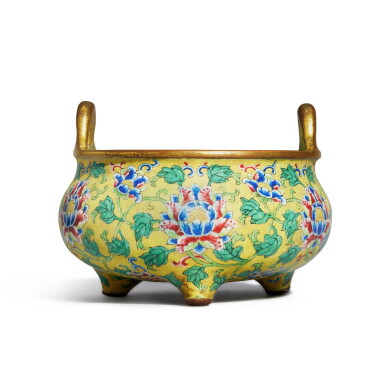
A rare Beijing enamel yellow-ground 'lotus' tripod censer, Yuzhi mark and period of Kangxi | 清康熙 北京銅胎畫琺瑯黃地纏枝蓮紋三足爐 《康熙御製》款
Auction Closed
September 20, 05:51 PM GMT
Estimate
30,000 - 40,000 USD
Lot Details
Description
A rare Beijing enamel yellow-ground 'lotus' tripod censer
Yuzhi mark and period of Kangxi
清康熙 北京銅胎畫琺瑯黃地纏枝蓮紋三足爐 《康熙御製》款
the base with a four-character Kangxi yuzhi mark in blue enamel within a double square, Japanese silver cover with openwork diaper design, wood stand, Japanese wood boxes (7)
Width 4⅜ in., 11 cm
Collection of Goto Family, a tea ceremony master, Kansai, 1930s.
Gallery Yanai, Tokyo, early 2000s.
關西茶道宗師收藏,後藤家族,約1930年代
ギャラリー柳井,東京,2000年代初
The technique used for enameling on metal-bodied ware was introduced in Guangzhou by Jesuit missionaries around 1684, when the ban on overseas trade was lifted. Guangzhou artisans with direct access to wares from Europe mastered the technical skills of enamel painting earlier than those working in the Palace Workshop in Beijing. In the 58th year of the Kangxi reign (1719), the French missionary and enamel specialist, Jean-Baptiste Gravereau, also known as Chen Zhongxin, was sent to Beijing by the Viceroy of Guangdong to teach enameling techniques to the craftsmen working in the Palace Workshops (see the catalogue to the exhibition Treasures from Guangdong to the Qing Court, Art Gallery, The Chinese University of Hong Kong, Hong Kong, 1987, p. 54). The Kangxi Emperor's particular fascination with Western enameled wares and his patronage in establishing the production of such wares in the Imperial Palace Workshop brought a new decorative art that came to represent a harmonious blend of western technique and Chinese workmanship.
The present censer successfully conveys the luxuriousness and exoticism of the Western enameling technique via the familiarity of traditional Chinese lotus floral motifs. Related examples of this type with Kangxi yuzhi marks include one painted with large lotus blossoms amid scrolling leaves, in the National Palace Museum, Taipei, illustrated in Gugong falangqi xuancui / Masterpieces of Chinese Enamel Ware in the National Palace Museum, Taipei, 1971, pl. 37; and another painted with a lotus pond design, from the collection of Alfred Morrison, Fonthill House, Tisbury, Wiltshire, sold at Christie's London, 9th November 2004, lot 21. Compare also a Yongzheng example, painted with peach-shaped panels enclosing bats and double gourds, sold at Christie's Hong Kong, 3rd November 1998, lot 1050; and a black-ground Qianlong example from the collection of Stephen Junkunc III, sold at Christie's New York, 28th March 1996, lot 141.


