
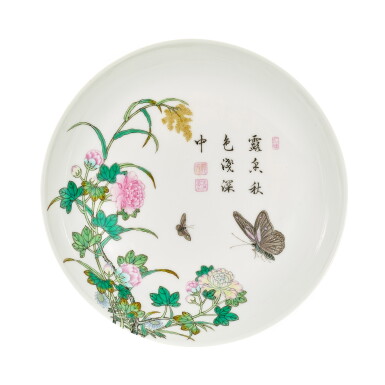
Property from the collection of Quincy Chuang | 莊貴侖珍藏
A Guyuexuan-style 'butterfly and flower' dish, Mark and period of Yongzheng, the enamels possibly later | 清雍正 粉彩題詩古月軒式蝶戀花盤 《雍正年製》款 彩或後加
Auction Closed
April 8, 02:15 PM GMT
Estimate
1,800,000 - 2,500,000 HKD
Lot Details
Description
Property from the collection of Quincy Chuang
A Guyuexuan-style 'butterfly and flower' dish,
Mark and period of Yongzheng, the enamels possibly later
莊貴侖珍藏
清雍正 粉彩題詩古月軒式蝶戀花盤 《雍正年製》款 彩或後加
14.3 cm
Collection of Peter Hyui (1910-90), Min Chiu Society member, Hong Kong.
Acquired from the above, Hong Kong, 1972.
敏求精舍會員許寶驊(1910-90年)收藏,香港
得於上述收藏,香港,1972年
At the turn of the 20th century, undecorated white porcelain vessels originally preserved in the Qing court fell into private hands. They were later enamelled, often by skillful artisans, to simulate imperial polychrome wares from former reigns. The present Yongzheng dish, meticulously enamelled with flowers and butterflies, accompanied by an inscription, may belong to such a group.
In an essay 'lun guyuexuan ciqi [On guyuexuan porcelain]', Sun Yingzhou writes that craftsmen "chose white pieces of the highest quality from the Kangxi, Yongzheng, and Qianlong periods, then boiled them in water to remove impurities before initial firing. After examining the fired pieces for imperfections, choice examples were painted, dried, and put into the kiln to be fired". The pieces were annealed at around 600 degrees, then left inside the kiln to cool for 5-6 hours, followed by treatments to simulate usage and other signs of age. With old imperial porcelain bodies, identifying later enamelled wares can be challenging; the close resemblance of Republican period enamel pigments to the 18th century colours further adds to the difficulty. However, since imperial undecorated ceramic vessels were limited in supply, old wares with later enamels are scarce (See Sun Yingzhou, Sun Yingzhou taoci yanjiu yu jianding [Research and authentication of ceramics by Sun Yingzhou], Taipei, 2012, pp. 200-204).
A pair of Yongzheng imperial falangcai dishes from the Qing court collection is decorated with a closely related design; the pair is now in the National Palace Museum, Taipei (accession nos Gu ci 014008 and 014009), recorded in 'Appendix 1', Porcelain with Painted Enamels of Yongzheng period in the Qing Dynasty, Taipei, 2013, p. 319, no. 22.
The present dish is inscribed with a line composed by the Ming dynasty poet Liu Song, accompanied by three seals reading renhe, sifang and qingjing. The same poetic inscription can be found on another pair of Yongzheng dishes (ibid., cat. no. 026), and a pair of Qianlong dishes, illustrated in Stunning Decorative Porcelains from the Ch'ien-lung Reign, Taipei, 2008, cat. no. 88. See also a teapot with similar seals in the British Museum, London (accession no. PDF A833), illustrated in Regina Krahl and Jessica Harrison Hall, Chinese Ceramics: Highlights of the Sir Percival David Collection, London, 2009, fig. 48.
One characteristic of Republican period enamelling is the meticulous yet slightly restrained painting style. Compare a bowl in the Palace Museum, Beijing, potted and fired in the Yongzheng period and later painstakingly enamelled with butterflies in the Republican period, illustrated in Geng Baochang, Ming Qing ciqi jianding [Appraisal of ceramics from the Ming and Qing dynasties], Hong Kong, 1993, p. 513, pl. 111, together with a Yongzheng famille-rose example, pl. 110; also included in A Contrast Between Genuine and Fake Porcelain and the Porcelain Specimens from Ancient Kiln Sites Collected in the Palace Museum, Beijing, 1998, pl. 92. See also a teapot with prunus and narcissus from the Sir Percival David Collection in the British Museum (accession no. PDF,A.809), which Sun Yingzhou claims to be a later enamelled ware (op.cit., p. 203).
The present dish was in the collection of Peter Hyui (1910-90), one of the earliest members of the Min Chiu Society of Hong Kong. Graduated from St. John's University in Shanghai, he served as a senior manager at Nanjing Kincheng Bank before founding Nanyang Development and Finance Corporation in 1941, and was a founding shareholder of the Hong Kong Pacific Shipping Company founded in 1955.
清末民國,尚未繪彩之潔白瓷胎從清宮流散,巧手匠人便利用舊胚加新彩,半偽半真,多年來讓鑑藏之士費煞心神。此雍正盤,細繪琺瑯彩花蝶,墨題詩文,或為後加彩之屬。
孫瀛洲在〈論古月軒瓷器〉一文中提及舊胚新彩時寫道匠人「選用康熙、雍正或乾隆時期的優質白胎,先用水煮,去其污質,然後放在爐火上燒頭火,看其是否出毛病,在不出任何毛病的情況下,再照選好的樣本繪圖上彩,晾乾以後,放入爐中烘燒」,至約六百度左右退火,在爐中冷卻五至六小時後取出做舊。新舊彩料區別不大,辨別非易,但由於清宮剩餘素胎有限,舊胎掛新彩之器較為鮮見(詳閱《孫瀛洲陶瓷研究與鑑定》,台北,2012年,頁200-204)。
盤心所繪,與乾清宮端凝殿舊藏雍正御製琺瑯彩月季題詩對盤相類,對盤外施黃彩,盤心以澄黃畫穀穗兩串,繪盛綻嫣紅月季成雙,伴以小蕾,同添藍瓣野菊,一對黃蜂盤旋在旁,而非蝴蝶,詩文及鈐印與此略異,底署青花六字款。雍正對盤現貯台北故宮(故瓷014008及014009),見〈附錄一:故宮博物院收藏清雍正琺瑯彩瓷〉,《金成旭映:清雍正琺瑯彩瓷》,台北,2013年,頁319,編號22。
此盤墨題明代劉崧〈題超上人墨菊〉七言絕詩中首句:「露香秋色淺深中」,筆道規矩,卻未見一般後仿器上墨書之躊躇。開首以胭脂紅彩鈐「仁和」印,末添兩印,前者為「四方」,次者應乃「清景」。墨題相同詩句之瓷胎琺瑯彩器,例可見台北故宮藏雍正菊花對盤,雅繪重瓣菊花,同上註,編號026;或乾隆黃地錦上添花對盤,收入《華麗彩瓷:乾隆洋彩》,台北,2008年,編號88。大英博物館藏乾隆款琺瑯彩題詩蘆雁茶壺,藏品編號PDFA833,詩文前後印章與此相近。
粉蝶繪畫細膩入微,惟略嫌拘謹。其他後加彩器有見相類繪風,如北京故宮藏雍正款民國畫粉彩團蝶盌,收錄在耿寶昌,《明清瓷器鑑定》,香港,1993年,頁513,圖111,與雍正年間所繪團蝶盌並列而刊,圖110。孫瀛洲在其專文中(出處同上,頁203)指大英博物館大維德爵士舊藏梅花水仙圖壺同屬舊胎新彩之類,藏品編號PDF,A.809。
此盤前屬敏求精舍早期會員許寶驊(1910-90年)舊藏。許寶驊畢業於上海聖約翰大學,曾任南京金城銀行高層,1941年成立南洋企業,並為1955年創立的香港太平洋輪船公司之創始股東之一
You May Also Like


