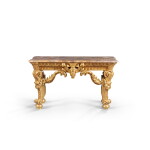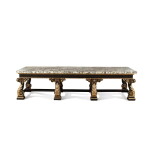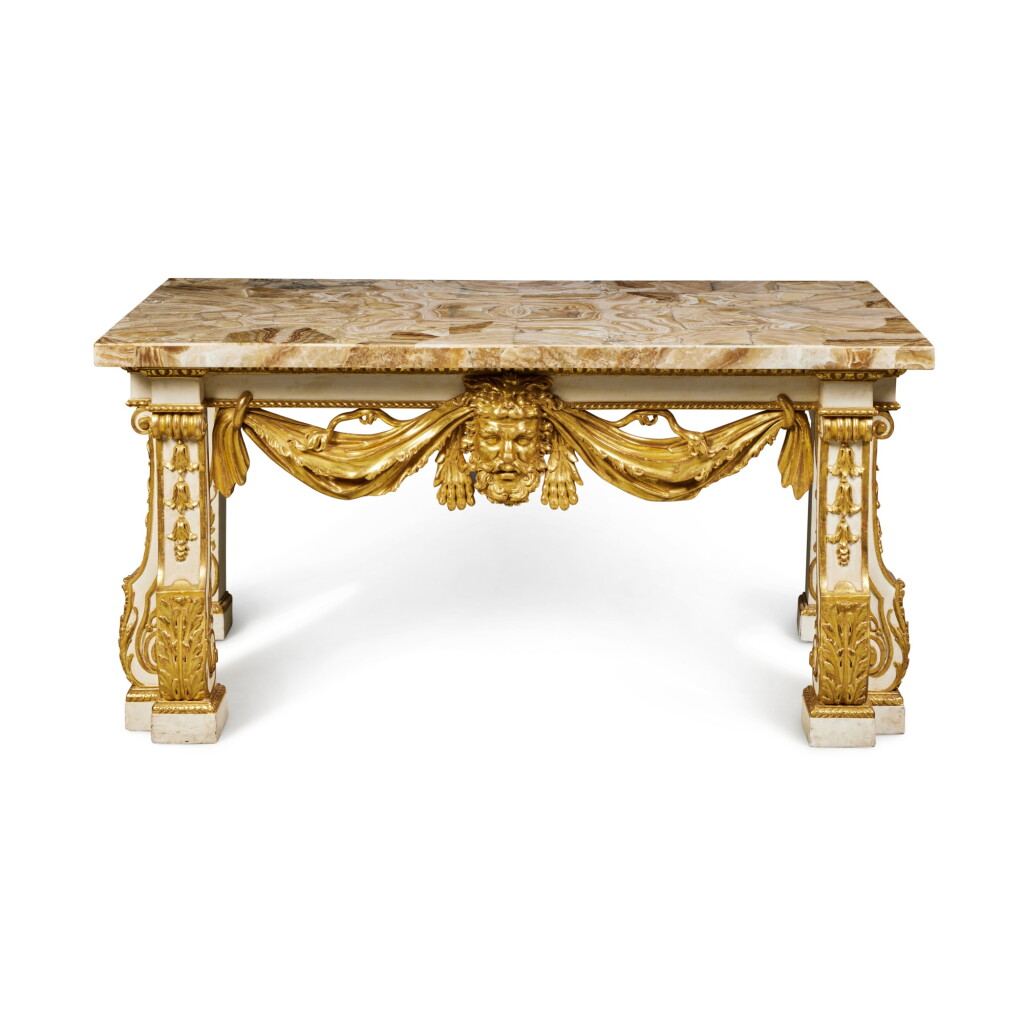
A George II Revival Cream-Painted and Parcel-Gilt Pier Table, after the model by Matthias Lock , Late 19th/Early 20th Century, with a later Alabastro Fiorito Marble Top
No reserve
Lot Closed
February 1, 04:00 PM GMT
Estimate
15,000 - 25,000 USD
Lot Details
Description
A George II Revival Cream-Painted and Parcel-Gilt Pier Table, after the model by Matthias Lock , Late 19th/Early 20th Century, with a later Alabastro Fiorito Marble Top
height 34 in.; width 65 in.; depth 33 in.
86.5 cm; 165 cm; 84 cm
redecorated
Ernest Cook, Esq., Barnet Hill, Surrey
Christie's, London, 6 July 2000, lot 119
Christie's New York, 7-8 October 2015, lot 271
The designer and woodcarver Matthias Lock (c.1710-1765) was one of the most important practitioners of the Rococo style in mid-18th century England. He may have been born in Portsmouth, and is first recorded in London in 1734 on the occasion of his marriage to Mary Lee at St Paul's, Covent Garden. Biographical information and precise details of his commissions are limited, and he is best known for his volumes of engraved designs, which include Six Tables (1746), A Book of Ornaments (1747, later reissued as A Book of Shields); A New Drawing Book of Ornaments, Shields, Compartments, Masks, &c., and The Principles of Ornament, or the Youth's Guide to Drawing of Foliage (undated) and A New Book of Ornaments with Twelve Leaves Consisting of Chimneys, Sconces, Tables, and Panels, Spring Clock Cases, Stands, a Chandelier and Girandole, etc. published in 1752 in collaboration with the engraver Henry Copland and regarded as the most important pattern book of the Rococo style to appear prior to Chippendale's Director (1754).
You May Also Like