
Cartier
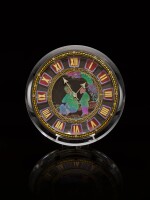
A jewelled gold-mounted rock crystal, burgauté lacquer and enamel Art Déco timepiece, circa 1925
Auction Closed
September 6, 08:20 PM GMT
Estimate
20,000 - 30,000 GBP
Lot Details
Description
A jewelled gold-mounted rock crystal, burgauté lacquer and enamel Art Déco clock, Cartier, circa 1925
circular, the dial decorated in burgauté lacquer representing two chinoiserie figures near a windmill bush-covered rockery, a quiet lake in the background, rose cut diamond-set arrow-shaped hands, framed by a gold and black enamel Greek key border, surrounded by mystery gold Roman numerals in translucent pink and opaque lavender blue plique-à-jour enamel cartouches, encased in faceted rock crystal with applied gold and black enamel border set with square-mounted rose-cut diamonds, silver movement case with crystal strut, post-1918 French bigorne eagle's head control mark, possibly later engraved: Cartier, 457, later bespoke fitted velvet and silk-linked red leather case stamped: Cartier,
10.1 cm., 4 in. diameter
(2)
'Once, Cartier was master of the exquisite objet d’art: his miniature plants, destined for the princely boudoir in their delicate houses, reminded us of the Japanese and Chinese art of the Belle Epoque, with their jade leaves and quartz blossoms’, states the report on Cartier’s contribution to the Paris Exhibition in 1925, published in the Gazette du bon ton of the same year.
While the bold combination of bright pink, lavender blue and black enamel in the present lot seems incredibly modern and certainly ahead of time in the 1920s, the French firm’s aforementioned mastery becomes evident in the combination with the lacque burgauté panel in the centre of the clock. The technique of inlaying dark lacquer with tinted mother of pearl, often in combination with tiny silver and gold foil particles, originated in Ming dynasty China (1368-1644) and soon became popular in Japan and the Ryukyu islands. The majority of the lacquer used by Jean Louis Cartier and his workmen for the vanities, smoker’s accessories and clocks made during the artistic craze for the Far East in the 1920s originates in Japan, which had become the centre for burgauté lacquer in the 19th century. Cartier acquired these through his vast network of Paris antique dealers at the time, among them the Kyoto-based Japanese dealer Yamanaka who also had outlets in Europe and America. The brilliant contrast between the chinoiserie subjects formed of glimmering sea shell inlays and the dark lacquer was extremely popular – to the degree that in 1926, Baron James Armand de Rothschild ordered twenty-four gold-mounted lacque burgauté vases as Christmas presents from Cartier (Judy Rudoe, Cartier 1900-1939, New York, 1999, cat no 112; see also Hans Nadelhoffer, Cartier: Jewellers Extraordinary, London, 1984, cat. no. 65 for a diamond-set coral, rock-crystal and burgau lacquer mystery clock, dated 1928).
The first clocks in Cartier’s stock are mentioned in 1853 and were part of the jeweller’s expansion into new markets. In the 1890s, Cartier was supplied by the greatest watchmakers of the period such as Vacheron Constantin. Early luxurious timepieces by Cartier, often in Fabergé style, soon found their way into the collections of King Edward VII, Lady de Grey and Prince Constantin Radziwill. In the following decade Cartier's supplier of choice became the firm of Prévost, who in 1911 created a table clock incorporating the novice of an electrically illuminated dial which was immediately bought by Aga Khan III. Arguably the most famous member of the Prévost workshop was the ingenious clockmaker Maurice Couët, whose invention of the magnificent ‘mystery clocks’ was predominantly responsible for Cartier’s roaring horological success in the years to come. His small workshop with five employees exclusively supplied Cartier from 1911. Two years later, Couët presented the first mystery clock which was bought by the Gilded Age investment banker J. P. Morgan; another model went to Queen Mary in 1924; and in 1945, General Charles de Gaulle presented a lapis lazuli example to Josef Stalin.
Unsurprisingly, the famous French jeweller was not only favoured by maharajas, barons, sultans, kings and queens, but also by the King of Queen, whose passion for Japanese designs, combined with the typical glittering Cartier glamour, is brilliantly exemplified in the present lot. When Baron de Meyer, American Vogue’s first official fashion photographer, had commented in 1926 that the new dramatic colour combination of red, green, pink, black and silver which was introduced by Cartier in the 1920s, was a ‘dangerous one and required very careful handling’ (Harper’s Bazaar, New York, March 1926), he could not have known that the extraordinarily audacious artist and collector Freddie Mercury was certainly the most adequate candidate to embrace such a visual challenge.
Only very few examples of this type of clock seem to survive. A similar gold, lacquer and rock-crystal example with mystery Roman numerals in the same shade of pink plique-a-jour enamel was sold at Bonham’s New York, 11 December 2008, lot 75; for a second example with a slightly varied colour scheme, see Christie’s Important Jewels, London, 26 November 2014, lot 239.
You May Also Like


