
Eugen von Blaas
The Water Carrier
Premium Lot
Auction Closed
September 8, 06:42 PM GMT
Estimate
50,000 - 70,000 GBP
Lot Details
Description
Eugen von Blaas
Italian
1843 - 1931
The Water Carrier
signed and dated Eugene de Blaas / 1886 along lower right edge
oil on canvas
Unframed: 100 by 65cm., 39½ by 25½ in.
Framed: 111 by 80cm., 43¾ by 31½ in.
Sotheby's, London, 5 July 1978, lot 73
Christies, London, 21 June 1991, lot 78
Thomas Wassibauer, Eugen von Blaas, 1843-1931: Das Werk, Hildesheim, 2005, p. 126, no. 72, illustrated (as The Milkmaid and with incorrect measurements of 95.5 by 63.5cm)
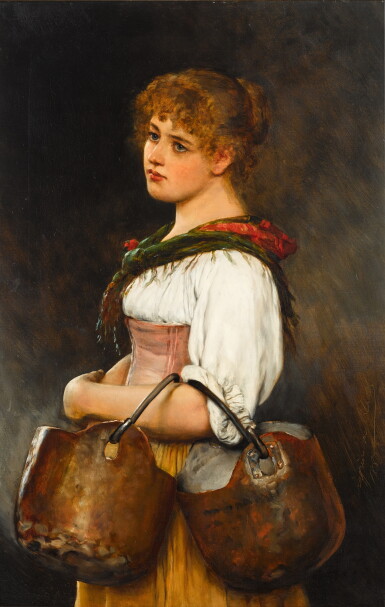
Celebrated for being a painter of Venetian beauties, von Blaas depicts a young woman posing in contemporary costume with two copper kettles resting on her arm, a colourful red and green shawl is draped over her shoulders. In the years leading up to 1890, von Blaas took pleasure in adding everyday props to his paintings, including an abundance of flowers and colourful fruit, as well as copper kettles, set in the backdrop of a Venetian courtyard or street. In this instance, the plain background and three-quarter length composition highlights the woman’s striking youth and beauty, which is rendered with almost photographic realism. While swift brushstrokes are used to depict the fabrics, the softer tones of the flesh are handled carefully and although the artist painted quickly, the composition is highly finished and precise, providing a tender portrait for this young beauty.
Born into an Austrian family of artists in Rome, Eugen von Blaas’ father Karl was a renowned historical painter and professor at the Venice Academy of Fine Art, while his younger brother Julius painted military scenes and horses and, like Eugen, also became a professor at the Accademia in Rome. Detaching himself from the more serious subject matter of his father’s and brother’s compositions, Eugen is best known for his depiction of beautiful women in everyday life. These finely painted, vividly coloured canvases catered to a growing demand for coyishly sentimental contemporary genre scenes that found a ready market among the wealthy travellers and tourists visiting La Serenissima.