
F. P. Journe
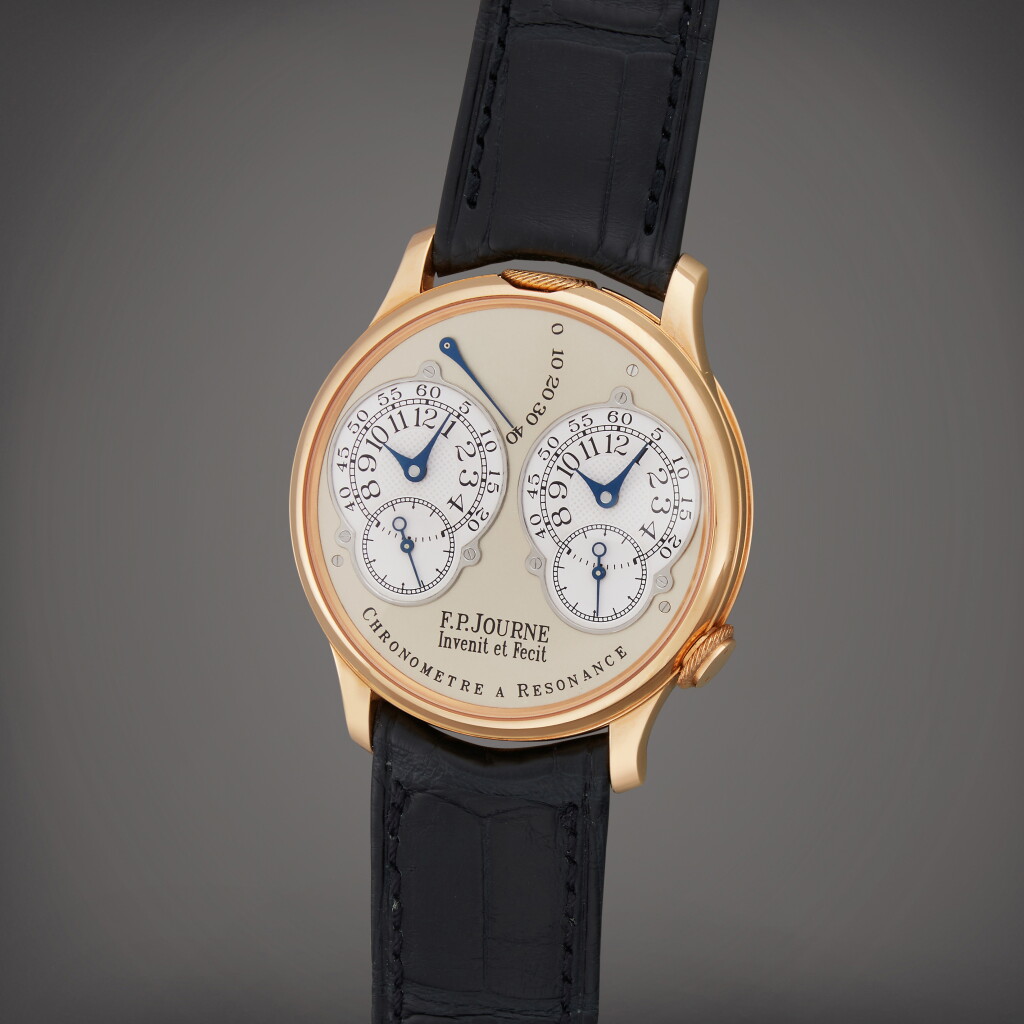
Chronomètre à Résonance | A pink gold dual time zone wristwatch with power reserve indication and brass movement, Circa 2002
Lot Closed
June 15, 06:11 PM GMT
Estimate
100,000 - 200,000 USD
Lot Details
Description
Chronomètre à Résonance
A pink gold dual time zone wristwatch with power reserve indication and brass movement, Circa 2002
Dial: silvered
Caliber: cal. 1499 mechanical brass movement
Case: 18k pink gold, sapphire crystal display back secured by six screws
Case number: 248-02R
Closure: 18k pink gold F.P. Journe buckle
Size: 38 mm diameter
Signed: case, dial and movement
Box: yes
Papers: yes
Accessories: F.P. Journe presentation box with outer packaging, Certificate of Authenticity card dated January 21st, 2004, and booklet
When many hear the name Francois-Paul Journe they immediately think of the Chronomètre a Résonance. It is arguably Journe’s most iconic and recognizable timepiece, the quintessence of his craftsmanship both aesthetically and technically.
At a first glance the Résonance may deceive the public as a simple dual time watch. However, on the contrary, it not only has an appealing watch face, but it also has a very exciting and technologically advanced movement. As its name suggests, the Résonance adopts a pair of balance wheels that not only power the two-time zones displayed, but most astonishingly serve together as an exciter and resonator which provides more inertia to the movement and results in greater accuracy of time. The watch draws its inspiration from Dutch mathematician Christiaan Hygens who circa 1665 observed two pendulum clocks placed on the same wall swinging in perfect duplicity. Antide Janvier (1751-1835), the legendary French clock maker then succeeded in using the principle in the art of watchmaking and created “double pendulum clocks”, also called “Résonance clocks”, which he was the first to make. Prior to the 20th century, there were only 5 résonance clocks in the world. Three made by Janvier and 2 made later by Abraham Louis Breguet. One of these clocks made by Janvier is now in the private collection of Montres Journe.
As early as 1983, François-Paul Journe tried his hand at a pocket-sized résonance watch. The first attempt failed, but his ambition was awakened. It would take about 15 years of research and development before he was able to launch his Chronomètre a Résonance in 2000: the first résonance wristwatch.
The present lot is an important early version with a rhodium-plated brass movement. The Résonance was made with both brass movements (R) and pink gold movements (RN). However, it is the brass movement pieces that are more highly sought after by collectors now due to its rarity. Approximately 2,000 brass movement pieces across all models were produced by FP Journe from 1999 till their production ended in 2004.
Housed in a 38 mm 18k pink gold case, this specific watch is a wonderful being brought to market for the first time. Above the two dials, the power reserve indicator of the Chronomètre à Résonance is reversed from the norm, beginning at 40 and progressing to 0. The power reserve therefore indicates how many hours have passed since the watch was wound versus how many hours are left. This was deliberate by F.P. Journe, who borrowed this from marine chronometer clocks.
The Chronomètre à Résonance is quintessentially an F.P Journe. As a timepiece, this embodies many of the fundamental elements that make the world of horology so alluring a place. It has history, a story behind how and why it was created; it has an unparalleled aesthetics inspired by some of the world's best watchmakers though, at the same time, original and true to Journe’s personal vision; and within, working largely unseen, is the movement.