Property from an Important American Collection
Eliot, George | The author's magnum opus
Lot Closed
December 8, 07:28 PM GMT
Estimate
25,000 - 35,000 USD
Lot Details
Description
Property from an Important American Collection
Eliot, George
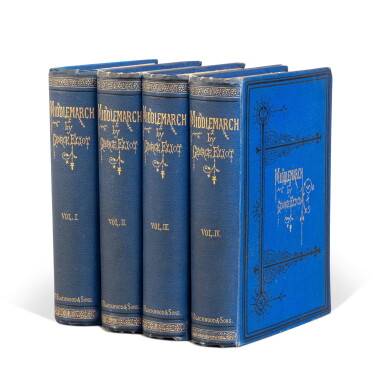
Middlemarch, A Study of Provincial Life. London: William Blackwood and Sons, 1871
4 volumes, 8vo. Half-titles; light scattered spotting, mainly marginal. Publisher's bright blue cloth, blocked in gilt and black, spines gilt; spines a little toned, light rubbing to extremities. Collector's light blue morocco slipcases, folding chemises.
A strikingly bright first edition of the author's magnum opus — the Bradley Martin copy.
Middlemarch evolved into the present eight part epic from two pieces of writing that Eliot had been working on in the two years prior to publication. The death of her partner George Henry Lewes's son, amongst other matters, both held off progress and resulted in the stories changing in length and purpose. As the length of the novel grew, Eliot chose to divide it into eight installments, similar to Victor Hugo's Les Miserables, as she was opposed to serializing it into shorter monthly offerings.
These were released in 1872 to mixed critical response; Henry James called it "at once one of the strongest and one of the weakest English novels". However, it particularly attracted the praise of Eliot's female contemporaries, with Emily Dickinson writing, "What do I think of Middlemarch? What do I think of glory." Today, it is frequently referred to as one of the greatest novels in the English language.
Middlemarch, like Eliot's other novels, is based in the early nineteenth century in a fictional rural town. North Loamshire was probably based on her hometown, Coventry. Four plots can be dissected from the narrative which contain various studies of the "provincial" characters as they interact with one another, interactions which Eliot uses as a platform to discuss marriage, political matters, specifically in relation to the leadup to the 1832 reform act, rural life prior to industrialization, and the plight of women in this period.
A remarkable work; an exquisite copy with exceptional provenance.
REFERENCE:
Baker & Ross A10.1.a; Parrish 32; Sadleir 815; Wolff 2059a
PROVENANCE:
Dollie Dawson (ownership inscription, December 25 1872) — H. Bradley Martin (bookplate; his sale, Sotheby's New York, 30 April-1 May 1990, lot 2825)