Washington, George | Furloughing the Continental Army
Lot Closed
July 20, 08:23 PM GMT
Estimate
15,000 - 20,000 USD
Lot Details
Description
Washington, George
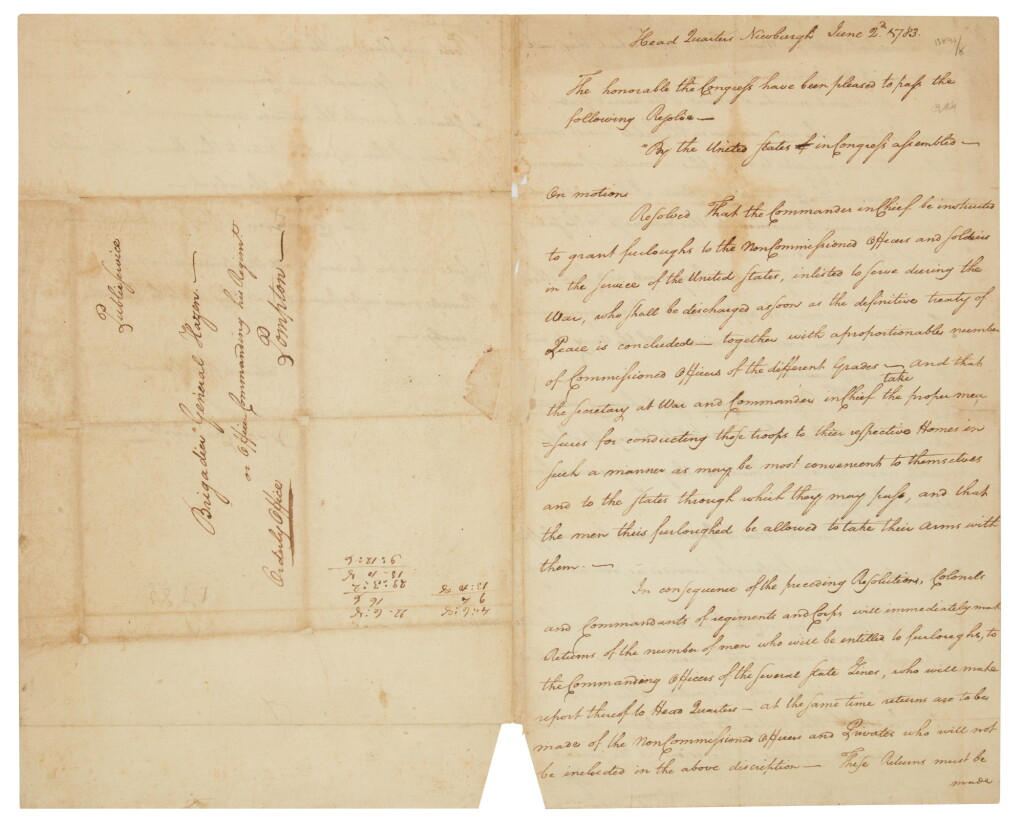
An extract from General Washington's General Orders, in the hand of and signed by his Assistant Adjutant General ("John Carlile"), beginning the demobilization of the Continental Army, sent to the attention of General Moses Hazen
2 1/2 pages (334 x 206 mm) on a bifolium, Head Quarters Newburgh, 2 June 1783, integral autograph address on verso of second leaf directed to "Brigadier General Hazen.— | or Officer Commanding his Regimt. | Pompton [New Jersey," also endorsed "Public Service" and Orderly Office"; browned and soiled, marginal loss at lower central fold, come other chips and repair.
"Generals and Commanding Officers of Lines will be pleased to make the interior arrangements for marching the troops to their respective states to their Homes": an important contemporary record of the disbanding of the Continental Army.
With the Newburgh Conspiracy put down and the Treaty of Paris negotiated and agreed (but not yet signed), Congress began the long process of demobilization, sagely deciding—with the British still occupying New York City—to furlough most troops rather than discharge them immediately.
Washington begins his General Orders of the day with the text of a motion that had recently been passed by the Congress of the Confederation: "Resolved That the Commander in Chief be instructed to grant furloughs to the Non Commissioned Officers and soldiers in the service of the United States, inlisted to serve during the War, who shall be discharged as soon as the definitive treaty of Peace is concluded—together with a proportionable number of Commissioned Officers of the different Grades—and that the Secretary at War and the Commander in Chief take the proper measures for conducting those troops to their respective homes in such a manner as may be most convenient to themselves and to the states through which they pass, and that the men thus furloughed be allowed to take their arms with them."
The orders continue with detailed directions from Washington for implementing the congressional resolutions. He first asks colonels and other regimental commanders to provide returns of the number of their men who will be eligible for furlough, as well as the number of noncommissioned officers and privates "who will not be included in the above description," warning that the returns must comport with the regimental muster rolls, "with which they will be compared at the Inspection Office."
Washington also directs that a "sufficient number of officers … to command the troops who will remain in the field must continue with them," and he asks that the officers "make this a matter of agreement among themselves … to the satisfaction of all concerned." Paymasters are ordered to remain with the army, and the quartermaster general is requested to "have a sufficient number of printed furloughs provided as soon as may be."
Although suffused with military formality, the magnanimous conclusion of Washington's General Orders betrays the great sense of satisfaction he must have felt at having reached the end of the war, turning the world upside down in the process:
"The Commander in Chief wants to give every facility in his power towards carrying the proposed measure into effect, with as great convenience and satisfaction to the troops as possible—for which this purpose the Contractors are directed to lay up adequate supplies of Provisions at the several Posts and places on the Route where it will be necessary.
"Generals and Commanding Officers of Lines will be pleased to make the interior arrangements for marching the troops to their respective states to their Homes—they will receive further instructions on the subject—
"The Commander in Chief is pleased to grant a full and free pardon to all Non Commissioned Officers and Privates now in Confinement, and they are to be liberated accordingly."
PROVENANCE:
E. H. Leffingwell (C. F. Libbie, 6 January 1891, lot 861) — Stan V. Henkels (17 January 1924, lot 558)
You May Also Like


![Pliny, the Elder | Historia naturalis [Italian], Venice, 12 September 1489](https://sothebys-md.brightspotcdn.com/dims4/default/9db2168/2147483647/strip/true/crop/2000x2000+0+0/resize/150x150!/quality/90/?url=http%3A%2F%2Fsothebys-brightspot.s3.amazonaws.com%2Fmedia-desk%2Fwebnative%2Fimages%2F7e%2F0c%2Fa8f2c8eb4fe384efbf7f5fb1128c%2Fn12451-b8s5d-t2-02.jpg)
![Archimedes | De iis quae vehuntur in aqua libri duo, a Frederico Commandino... [Bound with:] Federico Commandino. Liber de centro gravitatis solidorvm, Bologna, 1565](https://sothebys-md.brightspotcdn.com/dims4/default/38d76db/2147483647/strip/true/crop/2000x2000+0+0/resize/150x150!/quality/90/?url=http%3A%2F%2Fsothebys-brightspot.s3.amazonaws.com%2Fmedia-desk%2Fwebnative%2Fimages%2Fe3%2Fa8%2Fdf66fdd24c5ebc499d2a9dc83cd4%2Fn12451-bkh3x-t2-01.jpg)