
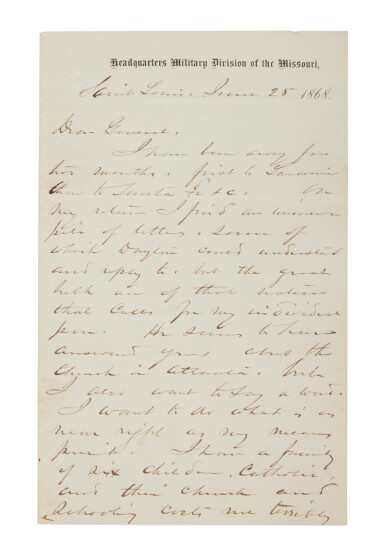
Sherman, William Tecumseh | "Our destruction of Atlanta was confined to the railroad"
Lot Closed
July 20, 08:12 PM GMT
Estimate
6,000 - 8,000 USD
Lot Details
Description
Sherman, William Tecumseh
Autograph letter signed ("W. T. Sherman") as U.S. General and commander of the Military Division of the Missouri, to an unidentified, possibly Confederate, general ("Dear General"), hotly denying that he had targeted the destruction of churches during the Atlanta campaign
4 pages (204 x 129 mm) on a bifolium of Headquarters Military Division of the Missouri letterhead, Saint Louis, 25 June 1868.
Sherman here replies to an old colleague (or foe), who was evidently soliciting funds to rebuild a church that had been destroyed during the brutal Atlanta campaign of four years prior. Sherman pledges to assist the effort, despite his own straitened circumstance.
"I have been away for two months first to Louisiana then to Santa Fe, &c. On my return I find an immense pile of letters some of which [Captain Lewis M.] Dayton [Sherman’s secretary and aide-de-camp] could understand and reply to but the great bulk are of that nature that call for my individual pen. He seems to have answered you about the church in Atlanta but I also want to say a word. I want to do what is as near right as my means permit. I have a family of six children, Catholic, and their schooling costs me terribly. I also have others somewhat dependent on me and I have just assumed the cost of educating one of Kit Carson’s boys.
"Money is so depreciated now that you know how hard it is to maintain our position with decency. Of my own means I really can spare nothing. As to other such as Campbell, Turner, Stickney &c &c as liberal kind men as I ever knew. I hate to make of them a personal request, but I have enclosed several of your circulars to the Rev. Mr. Schuyler who has an Episcopal congregation made up of some of the richest families and as soon as he responds I will let you know. I may send copies also to Mr. Eliot a Congregationalist and Mr. Gratman two of the most charitable men I know."
Sherman spoke and wrote little of the burning of Atlanta, even in his Memoirs. One of his biographers, Michael Fellman, noted of Sherman in the post-war era, "As did many old soldiers, he found a great outlet in conducting feuds—peacetime equivalents to combat. … Sherman and his military cohorts did not refight old battles as ends in themselves; rather, in addition to gaining publicity, they sought through their feuding to reinforce the boundaries of their own honor at the expense of those who impunged it" (Citizen Sherman: A Life of William Tecumseh Sherman, p. 316). While the tone of the present letter does not rise to the level of a feud, it is very clear that Sherman is determined to defend his actions in Atlanta.
"As to the church itself I cannot recall that any one was destroyed by us. Our destruction of Atlanta was confined to the railroad and the mass of brick stores which were near the depot and had been used for storage & office purposes by the Rebel Army. I know all the buildings & churches about the Court House were standing when I left. And I was one of the last to leave the place and at that time the fire had subsided and was only smoldering. I have a faint idea that there was a small church between the Court House and Depot on the same street where I was quartered that was damaged but not destroyed by the explosion of some shells that were in an old foundry at the end of the street close by the RR track."
However, Sherman does acknowledge the destructiveness of the campaign and even offers to investigate the matter of the church further: "Also the Engrs office Genl Ros[crans]. destroyed some houses to make room for his inner line of forts. Please describe to me the location of the church in question that I may form a judgment how far I was instrumental in its destruction." The letter ends on a conciliatory note, "I assume you know that I will take an interest in any object you deem worthy."