Property of a New York Collector
Hand, Edward | A democracy or a republic?
Lot Closed
July 20, 07:47 PM GMT
Estimate
800 - 1,200 USD
Lot Details
Description
Property of a New York Collector
Hand, Edward
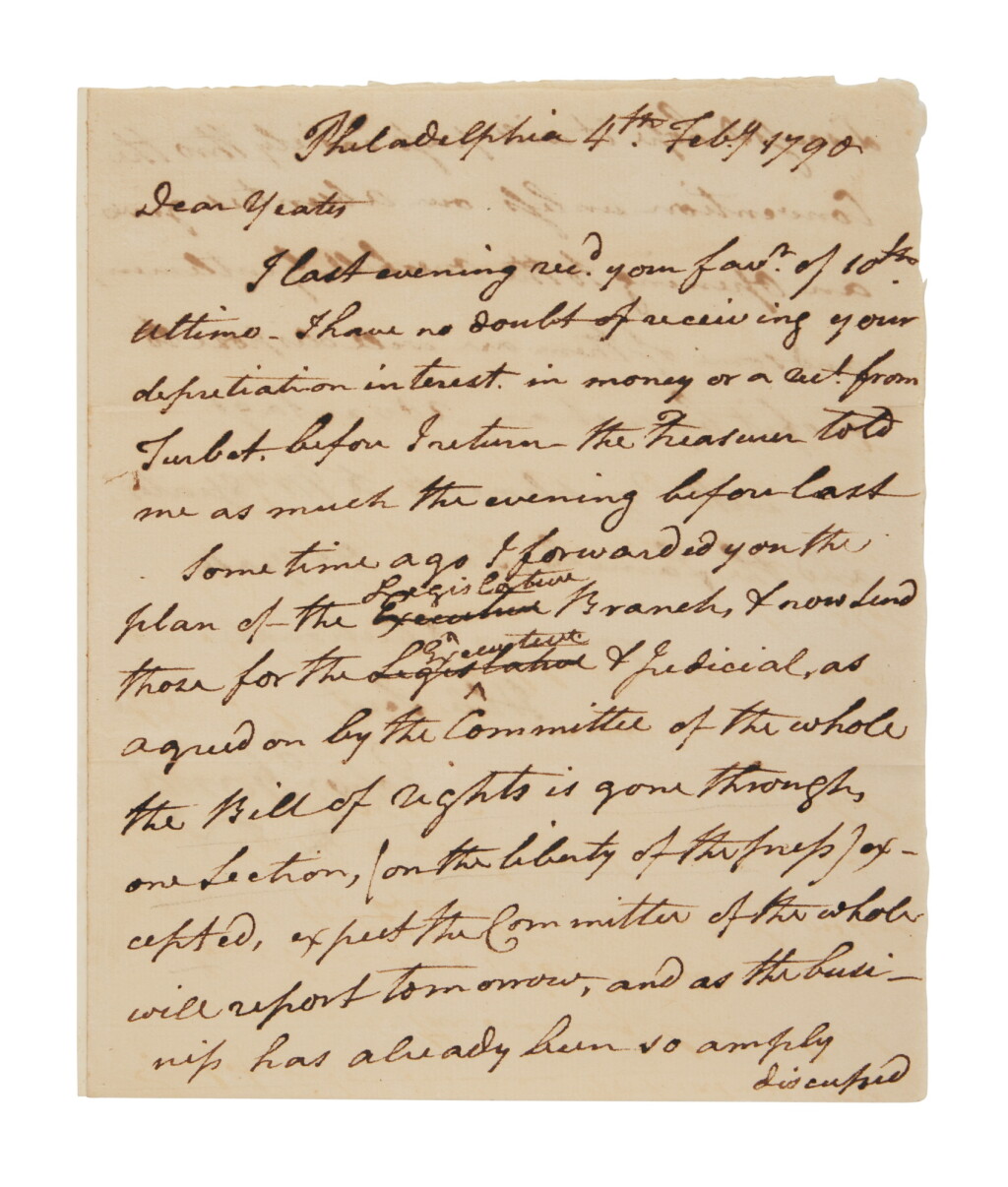
Autograph letter signed ("Edwd. Hand," with paraph) to Federalist (and Republican) ally Jasper Yeates, on framing a new constitution for Pennsylvania
2 pages (204 x 170 mm) on a bifolium, Philadelphia, 4 February 1790, integral autograph address leaf with recipient's docket ("Philada. Feb 4. 1790 | Edward Hand Esq"); lightly browned, integral leaf with loss to upper fore-edge corner not affecting text and album-mounting remnant slightly obscuring docket.
Edward Hand, a physician from Ireland, first came to the North American colonies as a Surgeon's Mate in the 18th (Royal Irish) Regiment of Foot in 1767; a decade later he was a brigadier general in the Continental Army. After the Revolution, Hand settled in Lancaster, practiced medicine, and became active in politics, serving in the Confederation Congress, the Pennsylvania Assembly, and the 1790 Pennsylvania Constitutional Convention.
This letter to Jasper Yeates, a fellow resident of Lancaster who had been a delegate to Pennsylvania's ratifying convention, begins with a brief discussion of a debt—"I have no doubt of receiving your depretiation interest in money or on acct. … before I return …"—but quickly launches into a summary of recent events at the convention to rewrite the state's 1776 constitution, which had convened in late November 1789 and would sit until early September 1790:
"Some time ago I forwarded you the plan of the Executive Legislative Branch, & now send those for the Legislative Executive & Judicial, as agreed on by the Committee of the whole[;] the Bill of Rights is gone through one Section, (on the liberty of the press) excepted, except the Committee of the whole will report tomorrow, and as the business has already been so amply discussed hope it will pass easily thro the Convention unless our absentees give an opening to the overhill Gentlemen, and sine if them are well dispose[d] to profit by such an advantage.” The “overhill Gentlemen” references the Constitutionalist minority of the convention, who wished to preserve the Pennsylvania Constitution of 1776, commonly described as the most democratic in America.
"By the time the convention adjourned … the delegates had repealed Pennsylvania's frame of government enacted in the early months of the Revolution, replacing it with the 1790 Constitution, a document that embodied the republican principles of 1776: a Bill of Rights, an independent judiciary, and an elected legislature and executive. The new frame of government, however, significantly altered the relationship between the branches of government. Gone were the weak plural executive and the all-powerful unicameral Assembly; in their place the delegates provided for a governor equipped with veto power and a bicameral legislature. Furthermore, the convention established the direct popular election of the governor and the members of the Senate and House of Representatives and provided for legislative districts based on equitable divisions of population" (Foster, "The Politics of Ideology: The Pennsylvania Constitutional Convention of 1789–90," in Pennsylvania History, Vol. 59. No. 2 [April 1992]: 123).
You May Also Like

![Cantor, Georg | Fernere Bemerkung über trigonometrische; [And:] Uber ein neues und allgemeines Condensationsprincip der Singularitaeten von Functionen, Halle, 1879 and 1882](https://sothebys-md.brightspotcdn.com/dims4/default/36a9bde/2147483647/strip/true/crop/2000x2000+0+0/resize/150x150!/quality/90/?url=http%3A%2F%2Fsothebys-brightspot.s3.amazonaws.com%2Fmedia-desk%2Fwebnative%2Fimages%2F66%2F39%2Fc61ed7f24bf0ac2557f0693e4122%2Fn12451-bkgzc-t3-02.jpg)




![Pliny, the Elder | Historia naturalis [Italian], Venice, 12 September 1489](https://sothebys-md.brightspotcdn.com/dims4/default/9db2168/2147483647/strip/true/crop/2000x2000+0+0/resize/150x150!/quality/90/?url=http%3A%2F%2Fsothebys-brightspot.s3.amazonaws.com%2Fmedia-desk%2Fwebnative%2Fimages%2F7e%2F0c%2Fa8f2c8eb4fe384efbf7f5fb1128c%2Fn12451-b8s5d-t2-02.jpg)