
Property of a New York Collector
Adams, John | Developing the Federal City and maintaining confidences between two friends
Lot Closed
July 20, 07:31 PM GMT
Estimate
12,000 - 18,000 USD
Lot Details
Description
Property of a New York Collector
Adams, John
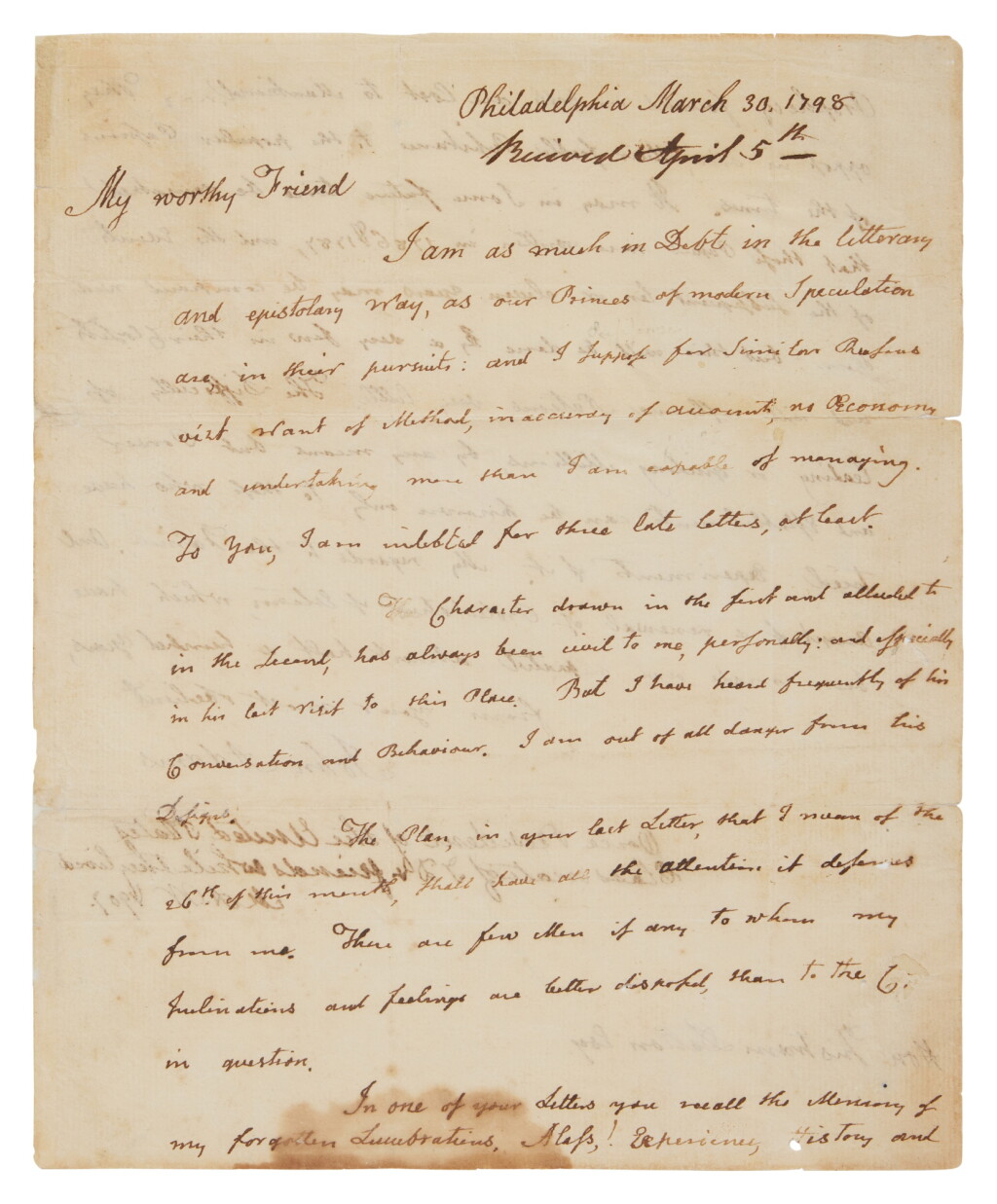
Autograph letter signed ("John Adams") as second President, to Tristram Dalton ("My worthy Friend"), reflecting on the vicissitudes of high office and other matters, including the development of Washington, D.C.
2 pages (250 x 205 mm) on a leaf of laid paper (watermarked Posthorn[?]), Philadelphia, 30 March 1798, Dalton's docket beneath date ("Received April 5th"), later endorsement at lower margin of second page ("Once President of the United States. Class mate of TD & friends while they lived. M.A.W. 1907"); lightly browned, stained at lower margin, neat repairs to a few short fold separations and small holes.
"The Difficulty of leading or guiding Millions, by any means but Power and Establishments can be known only to those who have tried Experiments of it." A sometimes melancholy letter to a boyhood friend in which Adams responds to some political gossip provided by Dalton regarding the development of Washington, D.C., and laments the rise of popular sovereignty that he sees reflected in the "popular Passions of the times." Adams begins by thanking Dalton for the faithfulness of his correspondence, when Adams's own has been sparse: "I am as much in Debt in the litterary and epistolary way, as our Princes of modern Speculation are in their pursuits: and I suppose for Similar Reasons viz want of Method, in accuracy of amounts, no Œconomy and undertaking more than I am capable of managing. To you, I am indebted for three late letters, at least."
Adams was right to add the qualification "at least" to his estimate of having received three unanswered letters from Dalton, who had actually sent the president five missives since last receiving one from Adams: 21 August 1797 and 6 January, 12 February, 20 March, and 26 March 1798. Much of the Dalton-Adams correspondence, like much of Adams's presidency, was focused on the transition of the offices of government from Philadelphia to the new federal city, where Dalton was already resident. Indeed, in Adams's previous letter, 1 July 1797, he responded to Dalton's suggestion that he visit the District of Columbia in order to check on progress by commenting that "The Commissioners of the Federal City are Gentlemen of so much Intelligence and Respectability, that I suppose I cannot do better than to repose myself on their Wisdom in general. The Importance of the City to the Union, I fully understand. … A Visit to your City and its Neighbourhood would be an high gratification to me, but I cannot conceive that such a Visit can be of any Consequence to the City. The Commissioners must be my Eyes. I should shudder at the thought of taking the direction out of their hands into my own."
In his letter of 12 February 1798, Dalton had warned Adams at great length—and with perhaps exaggerated candor—of the machinations of Thomas Law, a British speculator and civic promoter who had expended upwards of £30,000 on land and buildings in the District. Law, Dalton charged, was planning on lobbying Adams and the Commissioners in order "to force improvements to the particular Spot where he has pitched—with a sole View of rendering that more valuable. This is natural, and justifiable when the Publick Good is not sacrificed to obtain it—To him this would be no Stumbling Block."
Remarkably, after leveling these accusations against Law, Dalton sought, in his letter of 26 March, special favor from Adams for a District of Columbia development scheme of his own—although in this instance Dalton maintained that public and private interests were perfectly aligned. The truth was that Dalton and his partner Tobias Lear had purchased land at the junction of the Potomac and Shenendoah rivers that they believed would be ideal for the location of manufacturing works to meet Adams's recent proposal for "replenishing our Arsenals, establishing Founderies, and military Manufactures," and they would, Dalton wrote, "gratefully accept an Appointment" to superintend the establishment and running of such works.
The president responds to the charge of duplicity against Law and to Dalton's own importuning with equal equanimity. He declares himself entirely free from any scheme by Law: "The Character drawn in the first [of the supposed three recent letters by Dalton] and alluded to in the Second, has always been civil to me, personally; and especially in his last visit to this Place. But I have heard frequently of his Conversation and Behavior. I am out of all danger from his designs." And he answers Dalton's solicitation for a sinecure for himself and Lear with deft ambiguity: "The Plan, in your last Letter, that I mean of the 26th of this month, shall have all the attention it deserves from me. There are few Men if any to whom my Inclinations and feelings are better disposed, than to the C. in question."
Adams next remarks on the then-current neglect of his 1787 Defence of the Constitutions of Government of the United States of America—and of the seeming demise of the political philosophy that it espoused. "In one of your Letters you recall the memory of forgotten Lucubrations. Alass! Experience, History and Prophecy foundered on both are lost to Mankind. They oppose in vain, their feeble Resistance to the popular Passions of the times. It may in some future time be remarked that those Papers were written in 1786 & 1787, and the Events of the Subsequent ten or eleven years may be compared with them: but this will be done by a very few in their Closets and will influence Nations very little. The Difficulty of leading or guiding Millions, by any means but Power and Establishments can be known only to those who have tried Experiments of it."
Dalton was one of the few close friends—including Jefferson, Lafayette, and Sam Adams—to whom Adams gave a presentation copy of the Defence of the Constitutions of Government. They had been classmates at Harvard, and they remained fast political allies, with Dalton serving as Speaker of the Massachusetts House of Representatives and as one of the state’s first two senators. He had also been elected to the Continental Congress but did not attend. In 1801 he was appointed by President Thomas Jefferson as the last commissioner of the Federal City, but served for only about a year since the Board of Commissioners of the Federal City was disbanded in 1802. Most of Dalton's fortune was lost in unsuccessful land speculation in Washington, D.C. The letter concludes with Adams renewing his "Protestations of Esteem" for his friend of "almost half a hundred years."
REFERENCE:
"From John Adams to Tristram Dalton, 30 March 1798," Founders Online, National Archives, https://founders.archives.gov/documents/Adams/99-02-02-2395 (Early Access Document). Quotations from other letters in the above description are all from the Founders Online edition of the Adams Papers.
PROVENANCE:
Charles Hamilton Galleries, 10 October 1974, lot 9 (undesignated consignor) — Christie's New York, 14 June 2006, lot 414 (Property of a Gentleman)
You May Also Like
![Pliny, the Elder | Historia naturalis [Italian], Venice, 12 September 1489](https://sothebys-md.brightspotcdn.com/dims4/default/9db2168/2147483647/strip/true/crop/2000x2000+0+0/resize/150x150!/quality/90/?url=http%3A%2F%2Fsothebys-brightspot.s3.amazonaws.com%2Fmedia-desk%2Fwebnative%2Fimages%2F7e%2F0c%2Fa8f2c8eb4fe384efbf7f5fb1128c%2Fn12451-b8s5d-t2-02.jpg)

![Archimedes | De iis quae vehuntur in aqua libri duo, a Frederico Commandino... [Bound with:] Federico Commandino. Liber de centro gravitatis solidorvm, Bologna, 1565](https://sothebys-md.brightspotcdn.com/dims4/default/38d76db/2147483647/strip/true/crop/2000x2000+0+0/resize/150x150!/quality/90/?url=http%3A%2F%2Fsothebys-brightspot.s3.amazonaws.com%2Fmedia-desk%2Fwebnative%2Fimages%2Fe3%2Fa8%2Fdf66fdd24c5ebc499d2a9dc83cd4%2Fn12451-bkh3x-t2-01.jpg)
![Darwin and Wallace | On the Tendency of Species to form Varieties ... [1858–1859], in: Journal of the Proceedings of the Linnean Society, Vol. III, No. 9., 1859, Darwin announces the theory of natural selection](https://sothebys-md.brightspotcdn.com/dims4/default/0ae5d5e/2147483647/strip/true/crop/2000x2000+0+0/resize/150x150!/quality/90/?url=http%3A%2F%2Fsothebys-brightspot.s3.amazonaws.com%2Fmedia-desk%2Fwebnative%2Fimages%2F18%2F98%2Fd0ba6d9f4fada55611b512c2635f%2Fn12451-bkh45-t1-01.jpg)

